
Homemade Dog Food Kidney Disease Recipe: What to Cook, What to Skip
When a vet tells you your dog has kidney disease, the conversation about diet usually happens fast and leaves owners with more questions than answers.
What protein? How much? Which vegetables? Can I still make their food at home?
The answer to the last question is yes — and for many dogs with kidney disease, homemade food is genuinely superior to commercial options because you control exactly what goes in. The kidney-specific adjustments are real but manageable once you understand what the kidneys actually need from food.
I covered the full dietary theory for kidney disease in our kidney disease guide. This article is the practical companion — specific recipes, exact ingredients, and the preparation details that make the difference between a meal that supports kidney function and one that stresses it further.
What to cook for a dog with kidney disease? Low-phosphorus, moderate high-quality protein, low-sodium meals built around egg whites, chicken breast, white fish, white rice, and low-phosphorus vegetables. Three to four small meals daily rather than one or two large ones.
Quick Answer
| What to Include | What to Avoid |
|---|---|
| Egg whites | Organ meats |
| Chicken breast | Dairy |
| White fish | Bones or bone broth |
| White rice | Legumes |
| Green beans | Spinach in large amounts |
| Zucchini | Commercial treats |
| Fish oil | High-phosphorus vegetables |
The One Rule That Overrides Everything
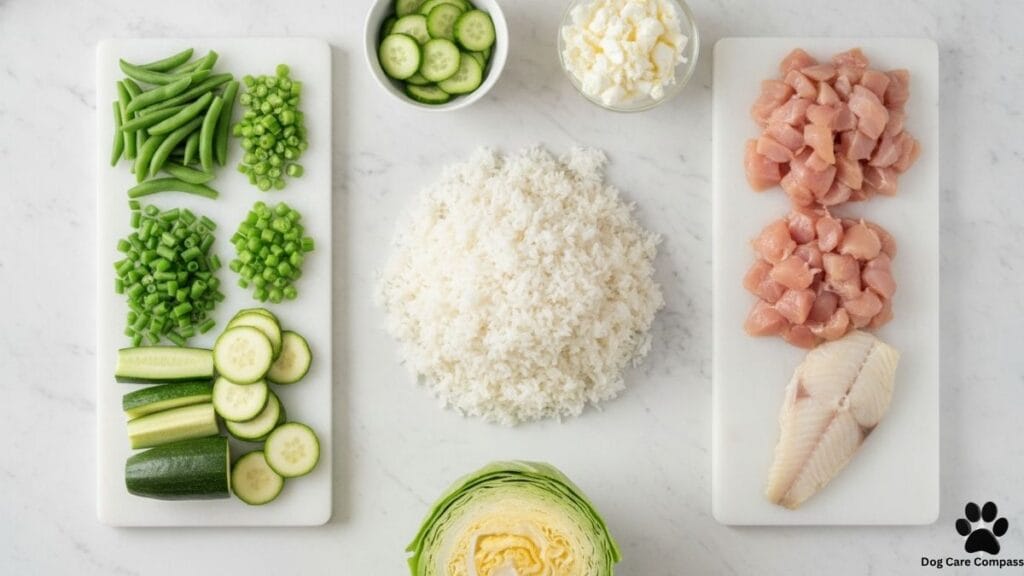
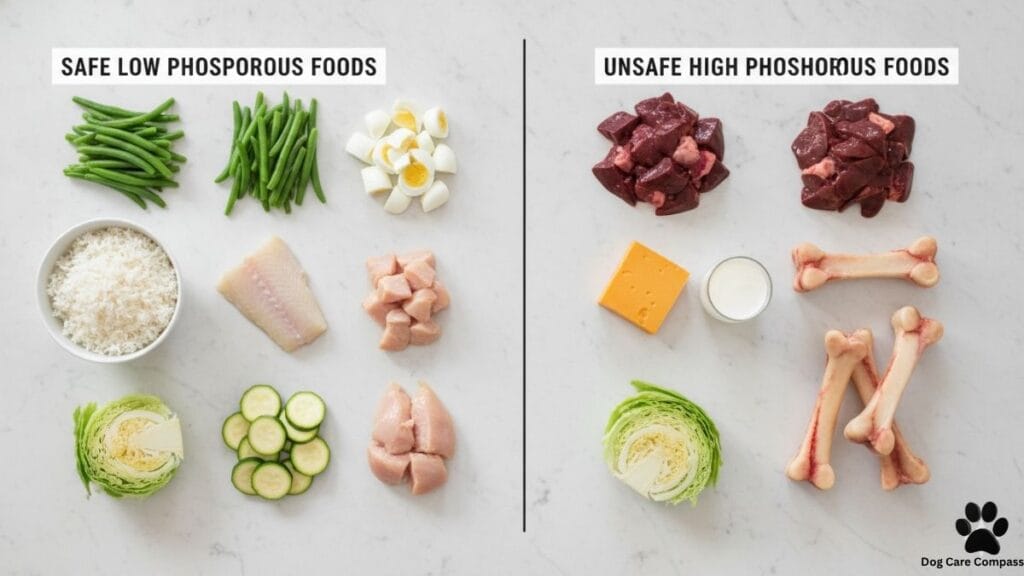
Phosphorus restriction is the single most important dietary principle in kidney disease.
Damaged kidneys cannot filter excess phosphorus efficiently. Phosphorus accumulation accelerates kidney tissue destruction — creating a damaging cycle that the right diet can slow significantly.
Every ingredient decision starts with: what is the phosphorus content?
Organ meats — liver, kidney, heart — are extremely high in phosphorus. Off the menu entirely.
Bones and bone broth — extremely high in phosphorus and calcium. Not appropriate despite being generally beneficial for healthy dogs.
Dairy — high phosphorus. Avoid completely.
Lean muscle meats and egg whites — moderate to low phosphorus relative to protein delivered. These form the protein base.
For dogs with medical conditions like kidney issues, a special homemade diet is required
Recipe 1 — Egg White and Rice (Recovery and Early Stage)
This is the gentlest recipe — appropriate for dogs in the immediate post-diagnosis period or those in acute kidney episodes.
For a 30 lb dog — one day:
- 3 egg whites — boiled or scrambled dry
- 180g white rice — cooked in plain water
- 100g green beans — steamed
- 80g zucchini — steamed
- 1 teaspoon fish oil
- Water or plain low-sodium broth to moisten
Phosphorus per serving: Low
Protein quality: Very high — egg whites have the highest biological value of any whole food
Preparation:
- Separate egg whites from yolks — use whites only, discard yolks
- Cook whites in a dry pan until fully set — no oil, no butter
- Cook white rice in plain water — slightly overcooked is fine
- Steam green beans and zucchini until soft
- Combine with enough water to create a soft, moist consistency
- Add fish oil on top — do not cook the oil
- Cool completely
- Divide into 3 to 4 portions — feed throughout the day
Why egg whites specifically? The yolk contains significant fat and phosphorus. The white delivers almost pure, highly bioavailable protein with minimal phosphorus load on the kidneys.
Recipe 2 — Chicken and Vegetable Bowl
For a 30 lb dog — one day:
- 120g chicken breast — skinless, boiled
- 160g white rice — cooked
- 100g cabbage — steamed
- 80g cucumber — raw, diced
- 60g cauliflower — steamed
- 1 teaspoon fish oil
- Low-sodium broth — small amount
Why cabbage and cauliflower? Both are low-phosphorus vegetables that add volume and fiber without stressing compromised kidneys. Cabbage specifically has gentle detoxifying properties that complement kidney function support.
Preparation:
- Boil chicken breast — absolutely no skin, no seasoning
- Shred into small pieces
- Cook rice in plain water
- Steam cabbage and cauliflower until completely tender
- Dice cucumber — raw is fine, adds hydration
- Combine with small amount of broth
- Add fish oil
- Cool and divide into 3 to 4 meals
Recipe 3 — White Fish Bowl
For a 30 lb dog — one day:
- 130g cod or tilapia — boiled
- 160g white rice — cooked
- 100g green beans — steamed
- 80g zucchini — steamed
- 60g carrot — boiled soft
- 1 teaspoon fish oil
White fish is the protein I recommend rotating in regularly for kidney dogs. The omega-3 content in white fish — even lean white fish — provides anti-inflammatory support for kidney tissue directly through the protein source. The phosphorus content is manageable in appropriate portions.
Preparation:
- Boil fish in plain water — check carefully for bones
- Flake into small pieces
- Cook rice and all vegetables
- Combine with enough water for moisture
- Add fish oil
- Cool completely and divide
Portion Sizes for Kidney Dogs
Feed smaller, more frequent meals — this reduces the phosphorus and protein load the kidneys must process at any single point.
| Dog Weight | Daily Amount | Number of Meals |
|---|---|---|
| 10 lbs | 130–160g | 4 |
| 20 lbs | 210–250g | 3–4 |
| 30 lbs | 290–330g | 3–4 |
| 50 lbs | 420–460g | 3 |
| 70 lbs | 530–570g | 3 |
Increasing Palatability for Kidney Dogs
Kidney disease causes nausea — which reduces appetite. Warming food increases aroma and palatability.
Microwave to just above room temperature — not hot. A dog that smells warm food is more likely to eat than one presented with cold food directly from the refrigerator.
Adding a small amount of low-sodium broth to each portion increases moisture and palatability simultaneously. Hydration is critical for kidney dogs — anything that increases fluid intake is genuinely beneficial.
If appetite loss persists beyond 48 hours — contact your vet. Anti-nausea medication alongside dietary management produces better outcomes than dietary management alone when nausea is significant.
Supplements That Support Kidney Dogs
| Supplement | Why | Discuss With Vet |
|---|---|---|
| Fish oil | Anti-inflammatory, kidney protective | Yes — for dose |
| B vitamins | Lost through increased urination | Generally safe |
| Probiotics | Reduce uremic toxins in gut | Generally safe |
| Phosphorus binders | Reduce phosphorus absorption | Prescription only |
Do not add calcium supplements without specific veterinary instruction. Calcium and phosphorus balance in kidney disease is delicate — supplementing incorrectly worsens the situation.
Transitioning to This Diet
Change the diet slowly — two weeks minimum for kidney dogs.
Their digestive systems are already stressed. A sudden complete food change adds digestive stress on top of kidney stress.
| Days | Current Food | New Recipe |
|---|---|---|
| 1–3 | 75% | 25% |
| 4–7 | 50% | 50% |
| 8–11 | 25% | 75% |
| 12+ | 0% | 100% |
Monitor appetite, energy, water intake, and stool quality throughout. Report significant changes to your vet before proceeding to the next transition stage.
Frequently Asked Questions
Can I use brown rice instead of white rice?
For kidney disease specifically — no. Brown rice contains more phosphorus than white rice. White rice is the better choice for kidney dogs despite being less nutritious overall.
My kidney dog won’t eat the new food — what do I do?
Warm it gently. Add low-sodium broth. Try the fish recipe — the smell of fish is more appealing than chicken for many dogs with reduced appetites. If the dog refuses consistently — contact your vet about appetite stimulants.
How long do I need to feed this diet?
Dogs with chronic kidney disease typically need a modified diet for life. Stage 1 and 2 dogs may have more dietary flexibility — discuss with your vet based on bloodwork results.
Can I add fruit to these recipes?
Small amounts of low-potassium, low-phosphorus fruits — cucumber, a little apple without seeds — are fine. Avoid high-potassium fruits like bananas and coconut water products.
Final Summary
- Phosphorus restriction is the single most important dietary rule for kidney dogs
- Egg whites, chicken breast, and white fish are the best protein sources
- White rice, green beans, zucchini, cabbage, and cauliflower are the safest vegetables
- Feed 3 to 4 small meals daily — reduces single-meal phosphorus load
- Warm food and add broth to increase palatability for nauseous kidney dogs
- Never add calcium supplements without veterinary instruction
- Transition over two weeks minimum — kidney dogs cannot handle abrupt food changes
For the full dietary theory behind kidney disease management, read our complete kidney disease guide.