What Actually Works for Dog Ear Infections at Home — And When to Stop Trying
I lifted my Cocker Spaniel’s ear one evening and the smell hit immediately — warm, yeasty, unmistakable. Two days of head shaking and ear scratching had finally become impossible to ignore.
Can I treat my dog’s ear infection at home? For mild cases — yes. But the wrong remedy on the wrong infection makes things significantly worse. This guide covers every safe home remedy for dog ear infection, what vets actually use, and the exact point where home treatment needs to stop.
Written using veterinary clinical guidelines on canine otitis externa and published research on Malassezia and bacterial ear infections in dogs. Reviewed against AAFCO and WSAVA nutritional and care standards. 2025.
Jump to Section
- Quick Answer — Can You Treat It at Home?
- What Is a Dog Ear Infection? Otitis Externa Explained
- Symptoms — Mild vs Severe
- Step-by-Step Home Treatment Guide
- Dog Ear Yeast Infection Home Treatment
- Bacterial Ear Infection — When Home Treatment Fails
- Natural Remedies — What Works vs What Is a Myth
- What Vets Use — Prescription vs OTC
- What Causes Smelly Dog Ears
- Breed-Specific Risk and Prevention
- FAQs
Can You Treat a Dog Ear Infection at Home? — Quick Answer
Dog ear infection home treatment is appropriate for mild outer ear irritation only — occasional head shaking, minor redness, small wax buildup, no discharge, no pain, no strong odor.
Use a vet-approved pH-balanced ear cleanser. Clean gently with correct technique. Monitor for 48 to 72 hours.
Established bacterial or yeast infections — with discharge, odor, or pain — do not clear with home remedies alone. They progress and worsen without proper treatment.
What Is a Dog Ear Infection? Otitis Externa Explained
Canine otitis externa — infection of the outer ear canal — affects up to 20% of dogs annually, making it one of the top five reasons for veterinary visits worldwide.
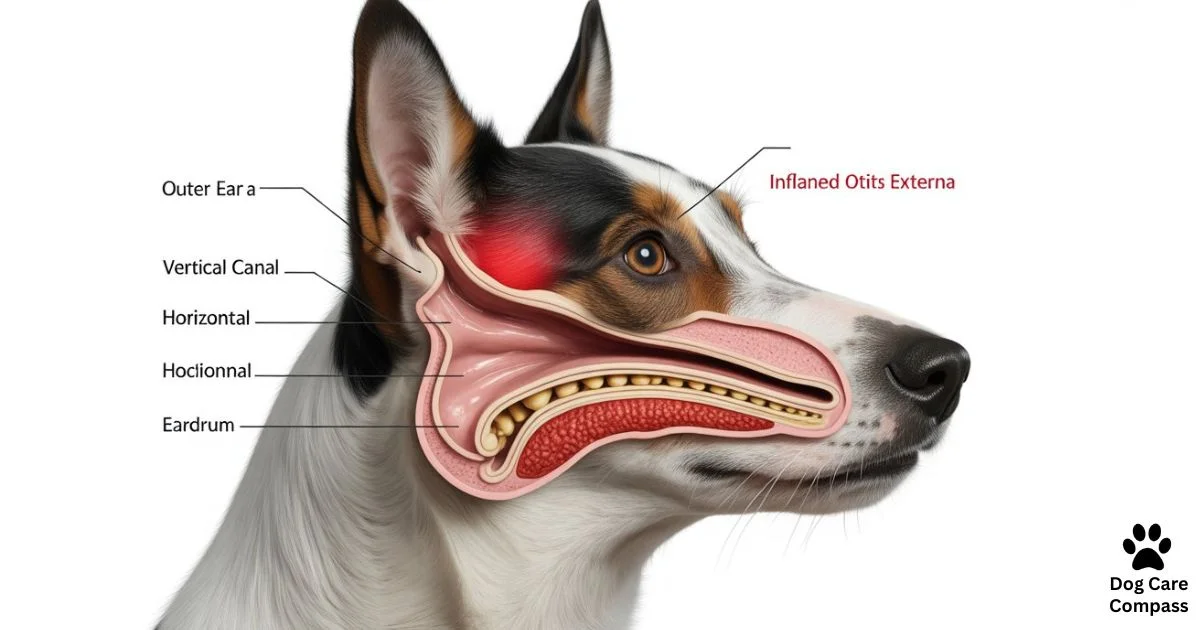
A dog’s ear canal runs vertically downward before bending horizontal toward the eardrum — an L-shaped structure that traps heat, moisture, and debris far more efficiently than a human ear. This anatomy is the primary reason dogs are so much more susceptible to ear infections than their owners.
When the ear canal environment shifts — due to moisture, allergies, or immune changes — Malassezia yeast and bacteria overgrow rapidly in the warm, dark, moist environment created by that L-shaped canal. The result is an inflamed dog ear canal, discharge, odor, and significant discomfort.
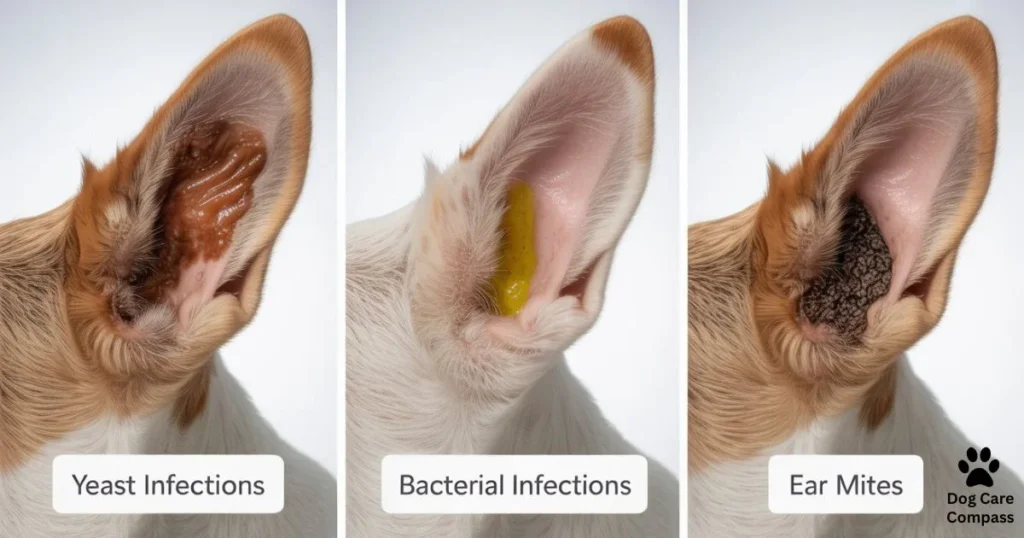
Three types of canine ear infection:
| Type | Primary Cause | Discharge | Odor | Home Treatment? |
|---|---|---|---|---|
| Yeast (Malassezia) | Moisture, allergies | Dark brown, waxy | Musty, corn-chip | Mild cases only |
| Bacterial (otitis) | Secondary infection | Yellow-green | Foul, pungent | Usually not sufficient |
| Ear mites (Otodectes) | Parasites | Dark, crumbly | Mild | OTC drops for mild cases |
Chronic otitis externa — recurring infections in the same dog — almost always has an underlying driver that must be identified. Treating individual infections without finding the root cause produces a predictable cycle of clearing and returning.
Skin around the ear can get irritated too — many owners reach for [Sudocrem] without knowing the risks
Dog Ear Infection Symptoms — Mild vs Severe
Mild Symptoms — Home Treatment May Be Appropriate
- Dog shaking head occasionally — more than usual but not constant
- Dog scratching ears gently without breaking skin
- Mild redness at the visible entrance of the ear canal
- Red dog ear on the inner flap — warm to the touch
- Slight increase in brown discharge in dog ear — waxy, no strong smell
- Dog allows the ear to be touched without pulling away or vocalizing
Severe Symptoms — Call Your Vet Today
| Symptom | What It May Indicate |
|---|---|
| Constant violent head shaking | Established infection, pain |
| Thick yellow, green, or bloody ear discharge | Bacterial infection |
| Black debris in dog ear — crumbly | Ear mites |
| Brown discharge with strong dog ear infection smell | Yeast overgrowth |
| Swelling inside or around the ear | Serious infection, possible hematoma |
| Dog crying or snapping when ear touched | Significant pain |
| Loss of balance, walking in circles | Middle or inner ear involvement |
| Facial drooping on one side | Neurological involvement — emergency |
🚨 Do Not Delay Vet Care If Your Dog Has: Thick colored discharge · Visible swelling · Obvious pain on touch · Loss of balance · Symptoms not improving within 48 hours of home cleaning · Suspected middle ear infection
How fast do dog ear infections get worse? Untreated bacterial infections can progress from outer to middle ear — otitis media — within days to weeks. Once past the eardrum, the risk of permanent hearing damage and facial nerve involvement increases significantly. Do not wait.
Step-by-Step Dog Ear Infection Treatment at Home
For mild cases only. Assess symptoms above before proceeding.
What to Buy First — Best Dog Ear Cleaner Options
The single most important home treatment decision is choosing the right ear cleanser. Three vet-recommended OTC options by category:
| Product Type | Active Ingredient | Best For |
|---|---|---|
| pH-balanced maintenance cleanser | Salicylic acid, lactic acid | Routine cleaning, mild irritation |
| Antifungal ear cleanser | Ketoconazole, miconazole, clotrimazole | Mild yeast infections |
| Chlorhexidine-based cleanser | Chlorhexidine gluconate | Mild bacterial and mixed infections |
| Zymox Ear Solution | LP3 Enzyme System | Mild yeast and bacterial — no pre-cleaning needed |
| Epi-Otic Advanced | Salicylic acid, EDTA | General maintenance, drying formula |
Zymox deserves specific mention — it uses an enzymatic LP3 system that works without pre-cleaning, making it one of the more user-friendly options for dogs that resist ear handling. It is appropriate for mild infections only and is widely recommended by veterinarians as a first-line home product.
Epi-Otic Advanced is the most commonly vet-recommended maintenance cleanser — drying formula, appropriate for dogs with histories of moisture-related infections.
The Correct Cleaning Technique — Step by Step
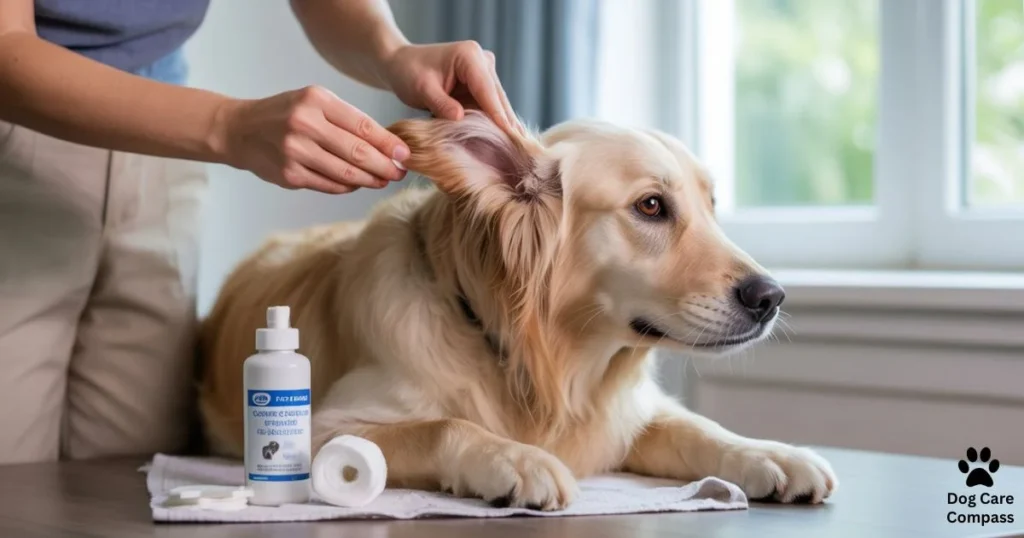
What you need: Vet-approved ear cleanser · Cotton balls or gauze · Treats · Good lighting
- Assess first — lift the ear flap in good light. Smell the ear. Check color and texture of any discharge. If what you see matches mild symptoms — proceed. If not — call your vet.
- Position your dog comfortably. Have someone help hold for resistant dogs — calm assistance, not force.
- Lift the ear flap and hold it upright.
- Insert the bottle tip just at the canal entrance — not deep inside.
- Fill the canal approximately halfway — you will feel resistance when it is enough.
- Massage the base of the ear firmly for 20 to 30 seconds — you will hear a squelching sound as the solution loosens debris.
- Step back — let your dog shake their head vigorously. This is correct. It brings loosened debris upward and out.
- Wipe the outer canal with a cotton ball — only as far as your finger reaches naturally. Never dig deeper.
- Reward generously and repeat on the other ear if needed.
Frequency: Once daily for active mild infection. Every 1 to 2 weeks for maintenance in healthy dogs. More frequently for high-risk breeds as directed by your vet.
Can cleaning too much cause infection? Yes — over-cleaning strips the ear canal’s natural protective microbiome and disrupts its pH, paradoxically increasing susceptibility. If your dog keeps shaking head after cleaning — it may signal over-cleaning, residual solution, or that the infection is more serious than home cleaning can address.
Dog Ear Yeast Infection Home Treatment
Dog ear yeast infections — Malassezia overgrowth — are the most common canine ear infection type. They produce the classic musty, corn-chip smell that dog owners learn to recognize quickly.
Why do my dog’s ears smell like corn chips? Malassezia yeast metabolizes ear wax and skin oils, producing compounds including fatty acids that create that distinctive corn-chip odor. It is the single most reliable indicator of yeast overgrowth in the ear.
Long-term immune health also depends heavily on balanced daily nutrition for dogs alongside allergy management and proper ear hygiene.
Natural Remedies for Dog Ear Infection — Yeast Type
What actually works:
OTC antifungal ear cleanser (ketoconazole or miconazole-based) — the most effective home option for mild yeast ear infections. Directly addresses Malassezia overgrowth. Available without prescription. Use with correct cleaning technique described above.
Diluted apple cider vinegar — outer ear flap only. Mix equal parts raw apple cider vinegar and distilled water. Apply to a cotton ball. Wipe only the visible outer ear flap — not inside the canal. The mild acidity discourages yeast growth on the flap surface. Never apply inside an inflamed ear canal — acid on broken or inflamed tissue causes pain and worsens the situation.
Dietary change for chronic cases. Malassezia overgrowth is strongly linked to food allergies — chicken, beef, wheat, and dairy are the most common triggers in dogs. Eliminating the allergenic protein through a vet-guided elimination diet often produces dramatic reduction in ear infection frequency for allergy-driven cases. This is a long-term strategy, not an acute treatment.
Green tea rinse for mild soothing. Brew two bags of green tea in 8 oz of water. Cool completely. Apply with a cotton ball to the outer ear area only. Tannins provide mild antimicrobial support. Not a primary treatment — a supportive soothing measure.
What does not work for yeast infections:
- Olive oil — feeds yeast
- Coconut oil — creates warm moist conditions Malassezia thrives in
- Plain water — no antifungal action, adds moisture
When home treatment for yeast fails: No improvement within 3 to 4 days of OTC antifungal cleanser use means prescription antifungal ear drops are needed. Established Malassezia infections rarely clear fully with OTC treatment alone.
Bacterial Dog Ear Infection — When Home Treatment Is Not Enough
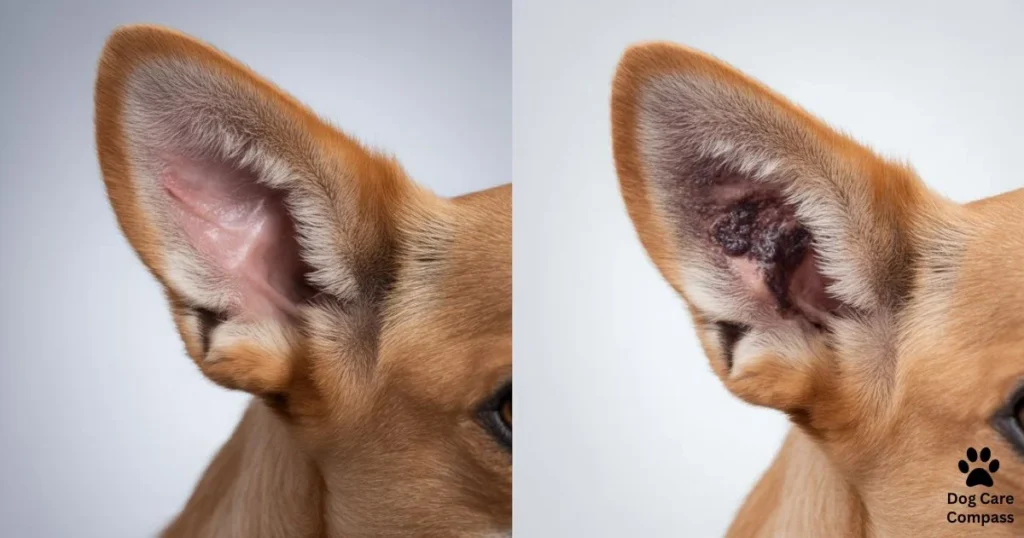
Bacterial ear infections produce yellow-green discharge with a strongly foul odor — very different from the musty smell of yeast. They are almost always secondary infections developing on top of existing yeast overgrowth, moisture problems, or allergic inflammation.
Home remedy for dog ear infection — bacterial type — is largely insufficient.
Bacterial infections require antibiotic ear drops matched to the specific bacteria. Without culture and sensitivity testing or at minimum an otoscope examination, the correct antibiotic cannot be identified. Using the wrong antibiotic accelerates resistance without clearing the infection.
What you can safely do at home while arranging vet care:
- Gentle cleaning with vet-approved ear cleanser to remove debris and reduce bacterial load
- Monitor every 12 hours
- Arrange veterinary assessment within 24 to 48 hours
Dog ear infection medicine for bacterial infections — what vets prescribe:
| Medication | Type | Target |
|---|---|---|
| Otomax / Mometamax | Antibiotic + antifungal + steroid drops | Combined bacterial and yeast |
| Osurnia | Long-acting gel drops | Bacterial otitis — one or two applications |
| Tresaderm | Antibiotic + antifungal + steroid | Mixed infections |
| Oral antibiotics (amoxicillin-clavulanate) | Systemic | Severe or middle ear involvement |
How Do Vets Treat Dog Ear Infections? — What Happens at the Clinic
Understanding what vets do helps contextualize why home treatment has limits.
Step 1 — Otoscope examination. A veterinary otoscope allows visualization of the full ear canal depth including the eardrum — impossible with home visual inspection. This identifies the infection location, severity, and eardrum integrity before any cleaning.
Step 2 — Ear cytology. A swab sample from the ear canal is examined under a microscope. This distinguishes yeast from bacteria and identifies specific bacteria types — critical for choosing the right antibiotic.
Step 3 — Culture and sensitivity test for chronic or treatment-resistant infections. This identifies exactly which antibiotic the specific bacteria respond to.
Step 4 — Professional ear cleaning. Vets clean the ear canal thoroughly — sometimes under sedation for severely inflamed or painful ears. This is called ear flushing and removes debris that home cleaning cannot reach.
Step 5 — Prescription ear drops. Applied directly after cleaning with the canal clear.
Step 6 — Recheck at 2 to 3 weeks. Confirms complete resolution and catches early recurrence before it becomes established again.
How much does a vet visit for a dog ear infection cost? A standard ear infection veterinary visit typically ranges from $75 to $200 depending on location, including examination, cytology, and initial medication. Ear flushing under sedation for severe infections adds $200 to $500. Chronic management with culture testing and prescription ear drops can total $300 to $600 per episode. Home prevention and early treatment significantly reduces lifetime cost.
Natural Remedies for Dog Ear Infection — What Works vs What Is a Myth
| Remedy | Verdict | Notes |
|---|---|---|
| Vet-approved pH-balanced cleanser | ✅ Most effective safe option | First choice for all home cleaning |
| OTC antifungal cleanser (Zymox, miconazole) | ✅ Effective for mild yeast | Use correctly — not for severe infections |
| Chlorhexidine-based cleanser | ✅ Mild antibacterial support | Vet-recommended for mixed infections |
| Diluted ACV — outer flap only | ⚠️ Prevention only | Never inside inflamed canal |
| Green tea compress | ⚠️ Mild soothing only | Not a primary treatment |
| Epi-Otic Advanced (drying formula) | ✅ Excellent post-swim maintenance | Reduces moisture-related recurrence |
| Olive oil | ❌ Avoid | Feeds yeast, adds moisture |
| Coconut oil | ❌ Avoid | Creates conditions for yeast growth |
| Hydrogen peroxide | ❌ Dangerous | Damages delicate ear tissue |
| Garlic-mullein oil | ❌ Insufficient evidence | Delays proper treatment |
| Human antibiotic ear drops | ❌ Dangerous | Wrong pH, may damage eardrum |
| Cotton swabs / Q-tips | ❌ Never | Pushes debris deeper, risks eardrum |
Can I use hydrogen peroxide in my dog’s ear? No — never. Hydrogen peroxide damages the delicate mucous membranes lining the ear canal and disrupts the protective microbiome. It feels like it is doing something — it bubbles and appears to clean — but the tissue damage it causes worsens the underlying situation.
Can I use coconut oil in my dog’s ear? No — particularly for yeast infections. Coconut oil creates a warm, oily, moist environment that Malassezia yeast thrives in. Applying it to a yeast ear infection is the nutritional equivalent of feeding the problem.
What Causes Smelly Dog Ears — And Why Infections Keep Returning
Dog ear infection smell — whether musty-yeasty or strongly foul — is a symptom of microbial overgrowth. But the smell is not the root cause. Something changed the ear canal environment to favor that overgrowth.
Allergies — the most overlooked cause. Up to 50% of recurring canine ear infections are allergy-driven. Can allergies cause dog ear infections? Yes — directly. Allergic inflammation thickens and oils the ear canal skin, creating ideal Malassezia conditions. Seasonal allergies — pollen, grass, dust mites — cause seasonal ear infection flares. Food allergies cause year-round recurrence.
Moisture from swimming. Should I clean my dog’s ears after swimming? Yes — every time. Water trapped in the L-shaped ear canal creates exactly the environment that yeast and bacteria need. Labrador Retrievers, Golden Retrievers, Cocker Spaniels, and Irish Setters face elevated risk from every swim without immediate post-water ear care.
Ear anatomy in floppy-eared breeds. Long ear flaps trap warm air against the canal continuously. Dogs with floppy ears have structurally warmer, more humid ear canals than upright-eared breeds regardless of their environment.
Excess hair inside the canal. Poodles, Bichon Frises, and Schnauzers commonly develop hair inside the ear canal that traps debris and moisture. Professional grooming of ear canal hair reduces this risk.
Seasonal and humidity triggers. Ear infections spike in summer in humid climates — warm, humid air accelerates Malassezia growth in already susceptible dogs. Dogs with allergy-driven ear infections often show seasonal flares matching their environmental allergen exposure.
Immune compromise. Hypothyroidism, diabetes, and Cushing’s disease reduce immune surveillance and allow opportunistic ear infections to establish more easily. Recurring infections without obvious structural cause warrant a full health workup including thyroid panel.
Ear hematoma — a secondary complication. Persistent violent head shaking from an untreated ear infection can rupture blood vessels in the ear flap, causing an aural hematoma — a painful blood-filled swelling of the ear flap that requires separate veterinary treatment. Treating the infection early prevents this painful secondary complication.
Breed-Specific Risk and Prevention Routine
High-Risk Breeds
| Breed | Primary Risk Factor | Recommended Routine |
|---|---|---|
| Cocker Spaniel | Floppy ears + allergy-prone | Weekly cleaning + allergy management |
| Basset Hound | Very long heavy ear flaps | Weekly cleaning + thorough drying |
| Golden Retriever | Floppy ears + loves water | After every swim + weekly check |
| Labrador Retriever | Water-loving + floppy ears | After every swim + bi-weekly cleaning |
| Poodle | Canal hair + allergy-prone | Monthly canal grooming + weekly cleaning |
| Shar-Pei | Very narrow ear canal | Bi-weekly cleaning + regular vet monitoring |
| German Shepherd | Allergy and immune-sensitive | Monthly cleaning + allergy assessment |
| Bichon Frise | Hair in canal | Regular grooming + monthly cleaning |
Puppy Ear Infections
Puppies are more susceptible to ear mites than adult dogs — their immune systems are still developing and contact with other animals spreads mites easily. Puppies also have narrower ear canals that trap debris more readily. Any ear-scratching or head-shaking in a puppy warrants veterinary assessment rather than home treatment — establishing correct diagnosis early prevents chronic patterns from developing.
Senior Dog Ear Infections
Older dogs face increased ear infection risk from immune system changes, reduced skin barrier function, and higher rates of underlying conditions — hypothyroidism and Cushing’s disease both peak in middle-aged to senior dogs. Senior dogs with new ear infections should have a broader health workup alongside ear treatment.
Prevention Checklist — The Routine That Stops Infections
Weekly:
- Lift both ear flaps — look and smell for early changes
- Check for redness, unusual discharge, or odor
- Note any increase in head shaking or ear scratching
Every 1 to 2 weeks:
- Clean with vet-approved ear cleanser using correct technique
- Wipe outer ear with dry cotton ball after cleaning
After every swim or bath:
- Immediately dry the ear canal entrance with a dry cotton ball
- Lift the ear flap and allow air circulation
- For high-risk breeds — use a drying ear formula like Epi-Otic
Monthly (high-risk breeds):
- Grooming check for canal hair buildup
- Assess frequency of head shaking — any increase is an early signal
Annually:
- Veterinary otoscope ear examination
- Allergy assessment if infections have recurred
Recovery Timeline by Infection Severity
| Severity | Type | Expected Recovery | Home Treatment Sufficient? |
|---|---|---|---|
| Mild irritation | No infection | 48–72 hours | Yes |
| Mild yeast infection | Malassezia early stage | 7–14 days | Possibly with OTC antifungal |
| Moderate yeast infection | Established Malassezia | 2–4 weeks | No — prescription needed |
| Mild bacterial | Early stage | 5–10 days | No — prescription needed |
| Moderate-severe bacterial | Established infection | 2–6 weeks | No — vet essential |
| Ear mites — mild | Otodectes early | 3–4 weeks | Yes with OTC mite treatment |
| Chronic otitis externa | Recurring, underlying cause | Ongoing management | No — vet-directed plan needed |
| Middle ear involvement | Otitis media | 4–8 weeks+ | No — urgent vet care |
Dog ear infection home treatment overnight — realistic expectation: Mild irritation may show reduced redness within 12 to 24 hours of correct cleaning. Established infections — even mild yeast — will not resolve overnight. Any expectation of overnight cure from a home remedy is unrealistic and delays appropriate treatment.
Can dog ear infections cause deafness? Yes — untreated infections that progress to the middle and inner ear can cause permanent hearing damage. Inner ear involvement — otitis interna — is a serious medical situation requiring aggressive veterinary treatment. Early treatment of outer ear infections is the most reliable way to prevent progression.
Can dog ear infections affect balance? Yes. Inner ear infections disrupt the vestibular system — the balance control center. A dog that suddenly loses balance, walks in circles, or has rapid involuntary eye movements alongside ear symptoms has an emergency situation requiring immediate veterinary care.
Frequently Asked Questions
Can I treat my dog’s ear infection at home without a vet?
For mild outer ear irritation — yes. Use a vet-approved ear cleanser, clean correctly, and monitor for 48 to 72 hours. For established infections with discharge, odor, or pain — no. Home remedies do not cure confirmed bacterial or yeast infections and delay proper treatment.
Why does my dog’s ear smell like corn chips?
Corn-chip odor from a dog’s ear is almost always Malassezia yeast overgrowth. The yeast metabolizes ear wax and skin oils, producing fatty acid compounds with that distinctive smell. It is a reliable early indicator of a yeast ear infection developing.
Can allergies cause dog ear infections?
Yes — directly. Allergic inflammation changes the skin environment of the ear canal, making it significantly more hospitable to Malassezia yeast and bacteria. Up to 50% of recurring canine ear infections are allergy-driven. Treating infections without addressing the allergy produces recurrence reliably.
Should I clean my dog’s ears after swimming?
Yes — every time without exception for water-loving dogs. Use a dry cotton ball to remove visible moisture from the outer canal, then use a drying ear formula if your dog swims regularly. This single habit dramatically reduces moisture-driven ear infections in susceptible breeds.
Can dog ear infections spread to the brain?
Severe untreated inner ear infections can in rare cases spread to surrounding structures including the brain via the petrous temporal bone. This is uncommon but represents the most serious end-point of consistently untreated ear disease. It is the reason early treatment matters.
Can humans catch dog ear mites?
Dog ear mites (Otodectes cynotis) can technically transfer to humans but almost never establish — human ear canals are a poor environment for them. Temporary skin irritation from contact is possible. This is not a significant public health concern but washing hands after handling an infected dog’s ears is sensible.
Do dog ear infections make dogs tired?
Yes — pain and infection create systemic inflammatory response. A dog with an established painful ear infection often shows reduced energy, appetite changes, and general lethargy alongside the ear-specific symptoms. Behavioral changes alongside ear problems may be related. Sudden unexplained behavioral changes in the house sometimes have a physical discomfort driving them. Dogs recovering from stressful experiences may also show appetite changes worth monitoring alongside any active infection.
Can dog ear infections go away on their own?
Very mild surface irritation occasionally resolves with improved hygiene and drying. Confirmed bacterial or yeast infections almost never self-resolve — they progress steadily. Every day without treatment is a day the infection deepens and the dog’s discomfort increases.
Can cleaning too much cause a dog ear infection?
Yes — over-cleaning strips the natural protective microbiome and disrupts the ear canal’s pH balance, paradoxically increasing infection susceptibility. Healthy dogs need cleaning every 1 to 2 weeks maximum. More frequent cleaning should only be done under veterinary direction during active infection treatment.
Can dog ear infections cause behavioral changes?
Dogs in pain from ear infections sometimes show unusual behavioral changes in dogs that owners initially mistake for emotional problems.
Final Summary
- Dog ear infection home treatment is safe and appropriate only for mild outer ear irritation — no discharge, no pain, no swelling
- Best dog ear cleaner options: Zymox Enzyme Solution for mild mixed infections, Epi-Otic Advanced for maintenance and post-swim drying, ketoconazole-based cleanser for mild yeast
- Natural remedies for dog ear infection — diluted ACV outer flap only, green tea for soothing, dietary allergen elimination for chronic yeast cases
- Never use hydrogen peroxide, coconut oil, olive oil, rubbing alcohol, Q-tips, or human ear drops
- Dog ear yeast infection home treatment works for mild cases — OTC antifungal cleanser, correct technique, 3 to 4 day monitoring window
- Bacterial ear infections require prescription antibiotic ear drops — home remedy for dog ear infection is insufficient for confirmed bacterial cases
- Smelly dog ears, brown or black discharge, persistent dog shaking head — all warrant veterinary assessment if not improving within 48 to 72 hours
- Chronic dog ear infection is almost always allergy-driven or anatomy-driven — treat the cause, not just the infection
- High-risk breeds — Cocker Spaniels, Golden Retrievers, Poodles, Basset Hounds — need weekly maintenance cleaning and annual otoscope examination
- Can dog ear infections cause deafness? Yes — untreated infections progressing to the middle and inner ear carry permanent hearing damage risk
- If symptoms worsen at any point — stop home treatment and schedule veterinary assessment immediately
This article is written for informational purposes using veterinary clinical guidelines on canine otitis externa, published research on Malassezia dermatitis in dogs, and WSAVA care standards. It does not constitute veterinary medical advice. Always consult a licensed veterinarian for diagnosis and treatment specific to your dog’s condition. Reviewed against current veterinary guidelines

researching veterinary sources, scientific studies, and expert
guides to bring dog owners accurate, practical information. Every
article is written with care and reviewed against credible
veterinary references including ASPCA, AKC, and peer-reviewed
literature.
- How to Stop Dog Barking at Night: 8 Proven Methods That Work - July 2, 2026
- Dog Pulls on Leash Every Walk? Fix It With This Simple Method - July 2, 2026
- How to Teach a Dog to Heel Without Treats: Step-by-Step Method - June 27, 2026