The Honest Guide to Crate Training a Puppy at Night — What Nobody Tells You First
The first night I brought Pepper home, I was completely unprepared.
She was a ten-week-old Beagle. Eight pounds of soft fur and enormous ears.
By midnight she was crying loudly enough that my neighbor texted to ask if everything was okay.
By 2 AM I had made every classic mistake — opened the crate, brought her into bed, and completely undone any progress from the evening.
I thought I had ruined her.
I had not. But I had set myself back by about a week.
Crate training a puppy at night is genuinely one of the harder parts of early puppyhood — not because it is complicated, but because it tests your resolve in the middle of the night when your instincts and your training goals are pulling in opposite directions.
This guide covers everything that actually matters — the right setup, the step-by-step process, the nighttime schedule by age, what to do when your puppy cries, and the mistakes that make everything take twice as long.
Also searching for: How to get a puppy to sleep in a crate? Puppy crying in crate at night what to do? How long does crate training take? Puppy crate training schedule? — All covered below.
How to Crate Train a Puppy at Night — Quick Answer
Start crate training on the very first night your puppy comes home.
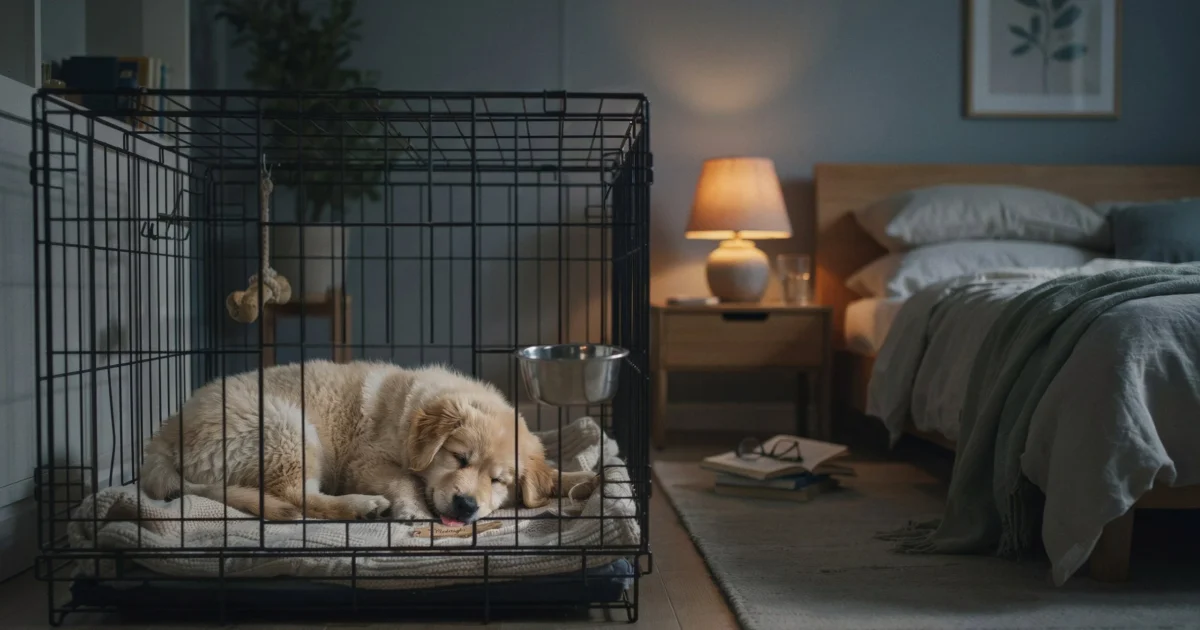
Place the crate in your bedroom — close enough that your puppy can hear and smell you.
Make the crate comfortable and positive before bedtime. Tire your puppy out with play, take a final toilet break, and guide them into the crate with a treat and calm praise.
Expect crying for the first few nights. Do not let your puppy out when they cry for attention — only when they genuinely need a toilet break.
Most puppies settle into a crate routine within 5 to 10 days with consistent handling.
Why Crate Training at Night Actually Works
Before the how — it helps to understand the why.
Dogs are den animals by nature. In the wild, small enclosed spaces feel safe and secure — not restrictive. A well-introduced crate taps into that instinct.
A puppy that accepts their crate sleeps better, is safer overnight, and progresses faster with toilet training. Dogs have a strong instinct not to soil their sleeping area — so a crate that is the right size becomes a powerful toilet training tool.
A crate serves as a secure den for your puppy — where they can retreat if feeling overwhelmed or anxious. It keeps them from wandering off unsupervised at night, saving them from potential accidents. Dogster
The crate is not a punishment. It is the puppy’s bedroom.
That framing changes everything about how you introduce it — and how quickly your puppy accepts it.
Before Night One — Getting the Setup Right
Most crate training problems start before the puppy even gets inside the crate. The setup matters enormously.
Choose the Right Crate Size
This is the single most important equipment decision.
The crate must be large enough for your puppy to stand up, turn around, and lie down comfortably — and nothing more.
If the crate is too large, the puppy can pee in one corner and sleep in another — completely defeating the toilet training benefit. Purina
For puppies that will grow into large dogs — buy a crate with a divider panel. You can adjust the interior size as the puppy grows without buying multiple crates.
Wire crates with a divider are the most practical option for most puppies. Plastic airline crates feel more den-like but offer less airflow. Both work — divider wire crates are easier to resize.
Where to Put the Crate
Initially, place the crate right next to your bed at the same level as you — use a sturdy chair, table, or nightstand. Dog Feeding Advice
This is critical for the first few weeks and something many owners skip.
Your puppy has just left their mother and littermates. Everything familiar — every smell, every sound, every source of warmth — is gone. Waking up in the night and hearing your breathing nearby is genuinely reassuring for them.
Once your puppy is settled and sleeping through the night reliably — you can gradually move the crate to the floor, then to the doorway, then to wherever you want it permanently.
Do not start with the crate in a separate room. That is the end goal, not the starting point.
Set Up the Inside
Make the crate genuinely comfortable — not just functional.
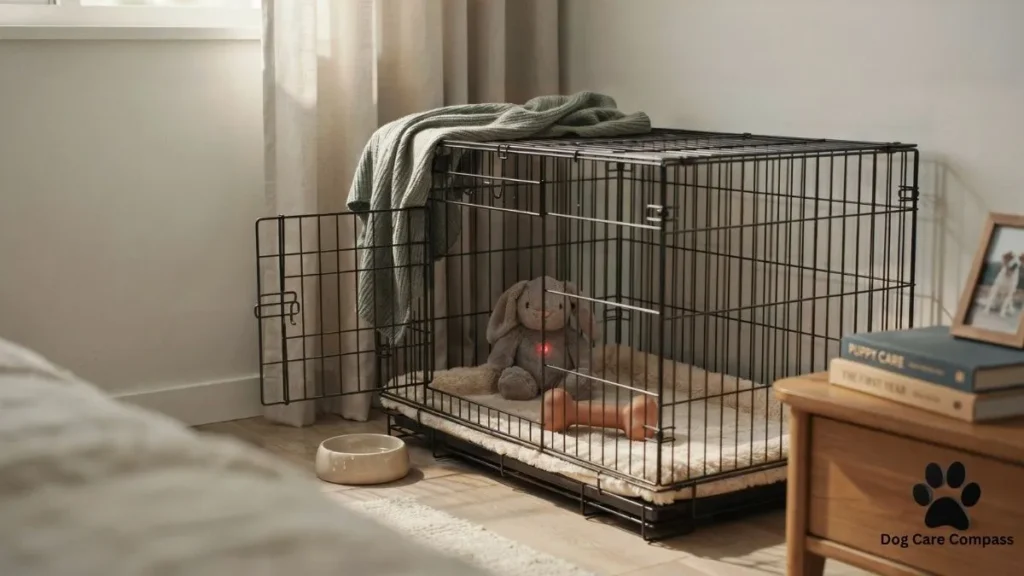
- Soft bedding — a washable fleece blanket or a crate mat
- One or two safe chew toys — something to settle with
- A worn piece of your clothing — your scent is calming for a new puppy
- Plenty of blankets — try sleeping with one before you put it in the crate so it smells like you DogTime
- Partially cover the top and sides with a blanket — this mimics a den and reduces stimulation
Keep a water bowl clipped to the crate door for the first few weeks until your puppy reliably sleeps through without needing bathroom trips.
Consider a Heartbeat Toy
A heartbeat toy is designed to reduce anxiety and replicate the sensation of snuggling with littermates. Hepper Pet Resources
These are small plush toys with a battery-powered heartbeat mechanism inside. They genuinely help many puppies settle on those first difficult nights when the absence of littermates is most acute.
Not every puppy responds to them — but for anxious breeds or puppies from large litters, they are worth trying.
Introducing the Crate Before Bedtime — Do Not Skip This
The biggest mistake owners make is treating the crate as something that only comes out at night.
If the first time your puppy sees the crate is at 10 PM when you are trying to sleep — you have already made bedtime harder than it needs to be.
Start introducing the crate the day your puppy arrives home. During daylight hours.
Daytime introduction steps:
- Leave the crate door open with treats scattered inside
- Let your puppy explore in and out freely — no pressure, no closing the door yet
- Feed meals inside the crate — this builds the strongest positive association fastest
- Once your puppy is walking in and out calmly — close the door briefly while they eat
- Open before they show any distress — build up duration in tiny increments
- Give a stuffed Kong inside the closed crate during the day — mental enrichment in a calm, positive context
Start by slowly introducing your puppy to the crate using open-door, low-pressure tactics. Then, as their crate confidence builds, start experimenting with short closed-door sessions. The Pet’s Sphere
Pepper had eaten three meals in her crate before her first night. By evening she was walking in voluntarily to investigate. That made the first night significantly easier — not perfect, but easier.
The Bedtime Routine — What to Do Every Night
Consistency is everything with puppy crate training at night.
The routine you establish in the first two weeks becomes the signal that tells your puppy what is coming. Predictable = calming.
Step 1 — Exercise 30 to 60 Minutes Before Bed
A tired puppy sleeps. An under-exercised puppy does not.
Play session, short training session, garden exploration — whatever your puppy’s age and vaccination status allows.
Do not exercise immediately before bed — that elevates arousal. Finish play 20 to 30 minutes before the crate so your puppy has time to wind down.
Step 2 — Last Meal 2 to 3 Hours Before Bedtime
Feed your puppy dinner at least a few hours before bedtime — that way your puppy has time to process it and do their business before turning in for the night. Dog Feeding Advice
Feeding too close to bedtime means a full digestive system active overnight — which means more toilet trips and more disrupted sleep for both of you.
Step 3 — Final Toilet Break Right Before Crating
Take your puppy outside immediately before putting them in the crate.
Wait until they actually toilet — not just a quick sniff outside. Praise warmly when they go.
This final toilet break is not optional. It is the foundation of the night routine.
Step 4 — Guide Into the Crate Calmly
Use a treat to guide your puppy into the crate — a small piece of chicken, cheese, or their regular kibble.
Do not push them in. Do not lift and place them in against resistance.
Enter with treats, toys, and praise to make your puppy enter willingly. Do not forcibly put them indoors — it should feel like a safe place, not a punishment. Purina
Once inside — close the door calmly and quietly. No big goodnight ceremony. Low-key is better. High-energy goodbyes create high-energy responses.
Step 5 — Sit Nearby Briefly
For the first few nights — sit next to the crate for 5 to 10 minutes after closing the door.
Since it is best to keep the crate in your bedroom during puppyhood, spend a few minutes next to the crate so your puppy can hear and smell you. Hepper Pet Resources
Your presence settles them. Gradually reduce this time over the first week.
Step 6 — Lights Off, Quiet
Reduce stimulation as much as possible.
Dim lights. Low noise. Make sure the crate is in a quiet, darkened space to encourage relaxation. DogTime
Do not have the TV on, do not have people coming and going. The environment should signal clearly that the active part of the day is over.
Nighttime Toilet Schedule — By Age
This is something every new puppy owner needs to understand clearly.
Young puppies physically cannot hold their bladder through a full night. Puppies can only hold their bladder approximately one hour for every month of age — though most can hold it six to seven hours overnight. pet corner
This means a 2-month-old puppy needs at least one — possibly two — toilet breaks overnight. That is not a training failure. It is biology.
| Puppy Age | Bladder Hold Time | Overnight Toilet Trips Needed |
|---|---|---|
| 8 weeks (2 months) | ~2 hours | 2 to 3 trips |
| 10 weeks | ~2.5 hours | 2 trips |
| 12 weeks (3 months) | ~3 hours | 1 to 2 trips |
| 16 weeks (4 months) | ~4 hours | 1 trip |
| 20 weeks (5 months) | ~5 hours | 0 to 1 trip |
| 24 weeks (6 months) | ~6 hours | Usually none |
Sample overnight schedule for a 10-week-old puppy:
| Time | Action |
|---|---|
| 10:00 PM | Final meal 2+ hours ago. Last toilet break. Crate. |
| 12:00 AM | Quiet toilet break — carry outside, toilet, back to crate |
| 3:00 AM | Toilet break if needed — watch for restlessness signals |
| 6:00 AM | Morning wake-up — toilet immediately |
Keep nighttime toilet trips calm and boring. No play, no talking beyond a quiet “good dog” when they toilet. Carry them to the toilet spot if possible to avoid exciting them on the walk. The message should be: this is not the start of the day. It is a toilet trip and then back to sleep.
Puppy Crying in Crate at Night — What to Do
This is the hardest part of crate training at night — and the place where most people make the mistake that sets them back weeks.
Pepper’s first night was two hours of crying. I nearly caved every fifteen minutes.
The key is understanding the difference between two types of crying — because they require completely opposite responses.
Type 1 — Genuine Need (Toilet or Distress)
Your puppy needs to go outside. Or they are genuinely distressed — cold, hurt, unwell.
Signs of genuine need:
- Restless movement in the crate
- Sniffing insistently at the floor
- Whimpering with urgency rather than volume
- Crying that escalates despite your presence nearby
Response: Take them outside quietly for a toilet break. Check that they are warm, comfortable, and not in physical discomfort. Return to crate without fuss.
Type 2 — Attention Seeking (Protest Crying)
Your puppy wants company. They know crying produces a response. They are testing the boundary.
Signs of attention-seeking crying:
- That 2 AM serenade — the separation protest Doggyzine
- Crying that pauses when you enter the room and resumes when you leave
- Crying that increases when you respond with attention
- Crying without the restlessness signals of genuine toilet need
Response: Do not respond. No talking. No eye contact. No opening the crate.
No talking, no eye contact — releases reinforce it. Wait for 5 seconds of quiet, then praise softly. Doggyzine
This is the hardest instruction to follow at 2 AM when your puppy is screaming and your neighbor is awake.
But every time you open the crate in response to protest crying — you teach your puppy that crying works. You will have more crying, not less.
What you can do without reinforcing the crying:
- Rest your fingers through the crate bars to reassure them — touch without removal Dog Feeding Advice
- Speak very quietly and briefly — “it’s okay, go to sleep” — then silence
- Ensure the crate is close enough to your bed that they can hear and smell you
Most puppies protest cry for 3 to 5 nights. Each night is shorter. By night 7 to 10 with consistent handling, most puppies settle within minutes of being crated.
Common Crate Training Mistakes — And What to Do Instead
Mistake 1: Starting the crate in a separate room. Your puppy needs to be near you for the first weeks. Start in the bedroom, move gradually.
Mistake 2: Using the crate as punishment. Never put your puppy in the crate after scolding them. The crate must remain a positive space. If they associate it with punishment — they will resist it and you will lose the safety and security benefit entirely.
Mistake 3: Crating for too long during the day. The crate is not a babysitter. Puppies need time out of the crate for play, interaction, and exploration. Maximum crate time during the day should match the bladder rule — age in months plus one hour, as a rough guide. Sidekick Vet
Mistake 4: Responding to every sound at night. The first thing NOT to do is give your dog human medication for diarrhea — and similarly, do not rush to respond to every nighttime sound. Learn to distinguish genuine distress from attention seeking. Consistency matters more than silence. Origin Labs
Mistake 5: Giving up after three difficult nights. Three nights of protest crying feels like forever at 2 AM. It is not a sign that your puppy will never sleep in a crate. It is the adjustment period. Consistent handling across 7 to 10 nights produces a puppy that walks into their crate voluntarily.
Mistake 6: Making the crate too large too soon. A crate that is too big loses its toilet training benefit entirely and can feel less secure rather than more secure for a small puppy.
What to Put in the Crate at Night — Checklist
| Item | Include? | Notes |
|---|---|---|
| Soft washable bedding | ✅ Yes | Remove if puppy chews and swallows fabric |
| Worn piece of your clothing | ✅ Yes | Your scent is genuinely calming |
| Safe chew toy | ✅ Yes | Something they can settle with |
| Heartbeat toy | ✅ Optional | Helps anxious puppies, especially first nights |
| Water bowl (clipped to door) | ✅ Yes | For young puppies needing overnight hydration |
| Food bowl | ❌ Not at night | Remove after last meal |
| Puppy pads | ❌ No | Teaches them it is acceptable to toilet in crate |
| Hard or sharp toys | ❌ No | Safety risk overnight without supervision |
How Long Does Crate Training Take?
This is the question every exhausted new puppy owner asks.
Honest answer: it varies — but most puppies follow a predictable pattern.
| Stage | Timeline | What It Looks Like |
|---|---|---|
| Night 1 to 3 | Hardest — significant crying | Learning the boundaries exist |
| Night 4 to 7 | Improving — crying shorter | Beginning to accept the routine |
| Night 7 to 14 | Settling — brief or no protest | Routine established |
| Week 3 to 4 | Mostly sleeping through (age allowing) | Crate = comfortable and expected |
| Month 2 to 3 | Voluntarily entering crate | Full acceptance |
Breeds with stronger independence — Huskies, Malamutes, some terriers — may take longer.
Breeds that bond intensely — Velcro dogs like Vizslas, Labrador Retrievers, Border Collies — may have a harder initial adjustment but settle firmly once the routine is established.
When to Move the Crate Out of Your Bedroom
Many owners want to know when they can move the crate out permanently.
The answer is: when your puppy is sleeping through the night reliably without toilet trips, and accepts being crated without protest.
For most puppies this is around 3 to 4 months — but it varies by individual.
Once your puppy gets used to being in their crate at night — start by putting more distance between the bed and the crate. Then move the crate to the floor, and finally to whatever room your puppy is going to sleep in permanently. Dog Feeding Advice
Move it in small increments — not all at once. Each move should happen only when the previous position is accepted comfortably.
Nighttime Crate Training for Different Breeds — What to Expect
| Breed Type | Typical Crate Training Difficulty | Notes |
|---|---|---|
| Golden Retriever, Labrador | Moderate — people-oriented | Responds well to positive reinforcement, settles quickly |
| Beagle, Hound breeds | Moderate-high — vocal | Expect more crying — consistency is critical |
| German Shepherd | Low-moderate — intelligent | Learns routine quickly, needs daytime enrichment |
| Husky, Malamute | High — independent | Strong-willed — may resist longer, need more exercise |
| Bulldog, French Bulldog | Low — calm temperament | Often settles easily — watch for breathing comfort in hot weather |
| Terriers | Moderate-high — stubborn | Persistent, need very consistent responses to crying |
| Vizsla, Weimaraner | High — extremely attached | Velcro breeds — proximity to owner is critical early on |
| Chihuahua, Toy breeds | Moderate — cold-sensitive | Extra bedding important — small dogs lose warmth faster |
Frequently Asked Questions
How long can a puppy be in a crate at night?
Young puppies under 10 weeks should not be crated for more than 2 to 3 hours without a toilet break. By 3 months most puppies can manage 4 to 5 hours. By 6 months most can sleep through an 8-hour night. Always match crate duration to age-appropriate bladder capacity.
Should I ignore my puppy crying in the crate at night?
Depends on the type of crying. Genuine toilet need — respond quickly and quietly. Attention-seeking protest crying — do not respond with attention. Responding to protest crying teaches your puppy that crying produces results. Consistent non-response is what shortens the crying period.
Where should I put the puppy crate at night?
In your bedroom, as close to your bed as practical, for the first 2 to 4 weeks. Your proximity is genuinely calming for a puppy that has just left its litter. Once crate training is established — gradually move to the permanent location.
Is it cruel to crate train a puppy at night?
No — when done correctly, crate training is one of the most humane things you can do for a young puppy. It provides safety, security, accelerates toilet training, and gives the puppy a consistent space of their own. The key words are “done correctly” — a crate used as punishment or used for excessive confinement is harmful. A crate used as a comfortable den, introduced positively, is beneficial.
My puppy is fine during the day but cries all night — why?
Nighttime is harder because your puppy is alone in the dark without activity to distract them. Daytime crate acceptance does not automatically transfer to nighttime — but it does make nighttime training faster. Continue daytime crate practice. Ensure the crate is in your bedroom so your puppy can hear you. Ensure they are genuinely tired before bedtime.
Can I crate train a rescue puppy the same way?
Yes — with one adjustment. Rescue puppies may have had negative associations with confinement. The introduction period needs to be even more gradual and positive, and the first few nights may involve more distress. Keep the crate in your bedroom, move very slowly with closed-door sessions, and prioritize positive associations above all else.
Final Summary
- Start crate training on the very first night — delays make it harder, not easier
- Place the crate in your bedroom initially — your proximity genuinely settles a new puppy
- Introduce the crate positively during the day before the first night — feed meals inside, build a positive association before any overnight crating
- Bedtime routine: exercise, final meal 2 to 3 hours before bed, last toilet break, calm crate entry with a treat, lights down
- Overnight toilet schedule is age-dependent — a 10-week puppy genuinely needs 2 toilet trips and that is not a training failure
- Distinguish protest crying from genuine need — respond to genuine need, do not respond to attention-seeking crying
- Most puppies settle into a reliable crate routine within 7 to 14 nights of consistent handling
- Common mistakes — crate in a separate room too soon, responding to protest crying, using the crate as punishment — set back training by weeks
- Move the crate gradually to its permanent location only after reliable overnight settling is established
- If your puppy shows genuine distress beyond normal adjustment — anxiety, refusing to eat, sudden fearful behavior — consult your vet or a certified trainer