Is Star Fruit Safe for Dogs? Benefits, Risks & Warning Signs
I was slicing star fruit for a fruit salad when my dog trotted over, tail wagging, clearly interested. My first instinct was to toss him a piece. My second instinct — thankfully — was to stop and check first.
Good thing I did.
Star fruit is one of those fruits that looks completely harmless but sits in a genuinely dangerous category for dogs. This is not a “small amounts are fine” situation. This is one fruit where the right answer is a firm no — and understanding why matters more than just knowing the rule.
Can dogs eat star fruit? No. Star fruit is toxic to dogs. It contains oxalic acid and unidentified nephrotoxic compounds that can cause acute kidney failure — even in small amounts. Dogs with existing kidney issues face the highest risk, but healthy dogs are not immune.
Quick Answer — Is Star Fruit Safe for Dogs?
| Question | Answer |
|---|---|
| Is star fruit safe for dogs? | No — toxic to dogs |
| Can dogs eat a small piece? | No — even small amounts cause harm |
| Is star fruit juice safe? | No — concentrated, more dangerous |
| What if my dog already ate some? | Call your vet immediately |
| Are all parts toxic? | Yes — flesh, juice, and seeds |
What Is Star Fruit?
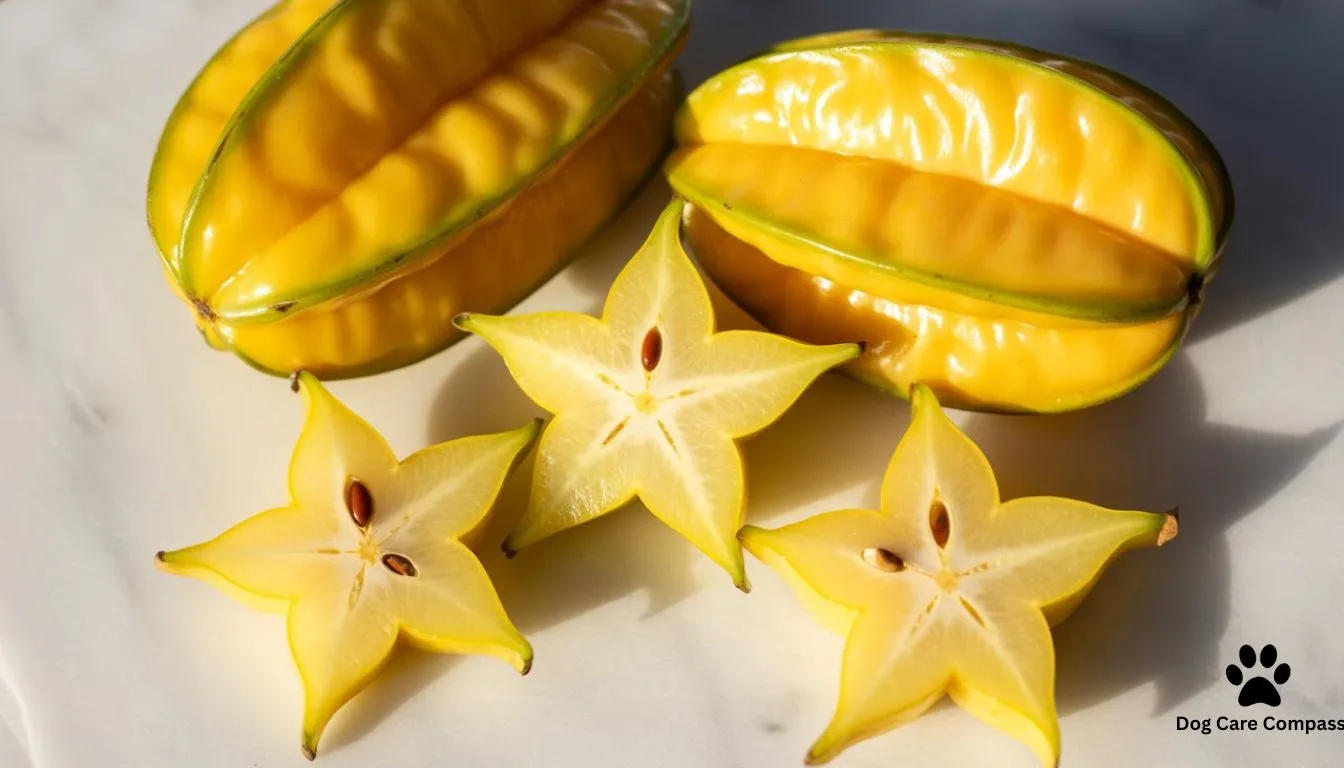
Star fruit — also called carambola (Averrhoa carambola) — is a tropical fruit native to Southeast Asia. When sliced crosswise, it produces a distinctive five-pointed star shape — which is exactly where the name comes from.
The flesh is crisp, juicy, and ranges from very sour to mildly sweet depending on variety. It is eaten fresh, used in juices, salads, and desserts, and widely available across South Asia, Southeast Asia, and increasingly in Western supermarkets.
For humans, star fruit is a low-calorie, vitamin C-rich snack. For dogs, it is something else entirely.
Why Is Star Fruit Toxic to Dogs?
This is the question that actually matters — and it is more nuanced than most “toxic fruit” guides explain.
Oxalic Acid and Nephrotoxic Compounds
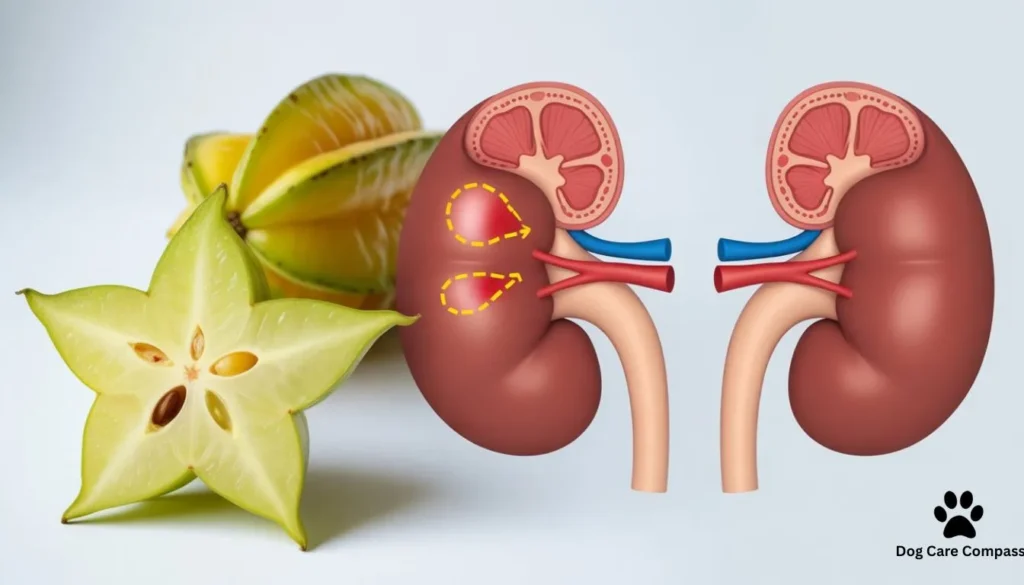
Star fruit contains high levels of oxalic acid — a compound that binds with calcium in the body to form calcium oxalate crystals. In dogs, these crystals accumulate in the kidneys and cause direct tissue damage.
Beyond oxalic acid, star fruit contains additional compounds that researchers have not yet fully identified — referred to as nephrotoxic factors — that appear to cause kidney damage through mechanisms separate from oxalic acid alone.
This combination makes star fruit particularly dangerous. It does not just irritate the digestive system. It attacks kidney function directly.
Why Healthy Dogs Are Still at Risk
Most discussions of star fruit toxicity focus on dogs with existing kidney disease — and rightly so, because those dogs are at extreme risk even from trace amounts.
But here is what often goes unsaid: healthy dogs are not safe either. Documented cases of star fruit poisoning in previously healthy dogs exist. The dose required to cause harm varies between individuals, but there is no established “safe” threshold for any dog.
In my view — and this aligns with veterinary consensus — the risk profile of star fruit places it firmly in the category of fruits that should never be offered to dogs under any circumstances. Unlike durian or lychee, where small amounts of properly prepared flesh carry manageable risk, star fruit has no safe serving size.
Nutritional Profile of Star Fruit (Per 100g)
| Nutrient | Amount |
|---|---|
| Calories | 31 kcal |
| Carbohydrates | 6.7g |
| Natural Sugar | 3.9g |
| Dietary Fiber | 2.8g |
| Vitamin C | 34.4mg |
| Potassium | 133mg |
| Oxalic Acid | High — exact levels vary by ripeness |
| Fat | 0.3g |
The low calorie and sugar count might look appealing on paper. The oxalic acid content makes every other number irrelevant for dogs.
Symptoms of Star Fruit Poisoning in Dogs

Knowing the symptoms matters because early intervention significantly improves outcomes. Star fruit toxicity can progress quickly — particularly in smaller dogs and those with compromised kidney function.
Early symptoms — appear within 30 minutes to 3 hours:
- Vomiting
- Excessive drooling
- Weakness and lethargy
- Hiccups — an unusual but documented early sign
- Agitation or restlessness
Progressive symptoms — hours after ingestion:
- Tremors or seizures
- Decreased urination or complete absence of urination
- Blood in urine
- Confusion or disorientation
- Collapse
Late-stage symptoms — kidney failure developing:
- Severe lethargy — dog cannot stand
- Complete cessation of urination
- Swelling in limbs
- Loss of consciousness
Do not wait for late-stage symptoms. If your dog has eaten any amount of star fruit, contact your vet immediately — even if they seem completely fine in the first hour.
Knowing when symptoms cross from minor digestive upset into something genuinely serious is one of the most practically important things a dog owner can understand — but with star fruit, the answer is always urgent regardless of how mild the initial signs appear.
What to Do If Your Dog Eats Star Fruit
Act immediately. This is not a situation for a 24-hour wait-and-see approach.
- Stay calm — panic helps neither you nor your dog
- Note exactly how much was eaten and when
- Call your vet immediately — do not wait for symptoms
- If your vet is unavailable, contact ASPCA Poison Control at 888-426-4435 (available 24 hours)
- Do not induce vomiting unless explicitly instructed by a vet
- Bring any remaining fruit or packaging to the vet appointment
- Monitor closely during transport — note any changes in behavior
According to the ASPCA Animal Poison Control Center, star fruit is listed as toxic to dogs and cats. The American Kennel Club’s veterinary guidance includes star fruit among foods dogs should never eat. PetMD’s clinical team notes that star fruit toxicity in dogs can cause rapid kidney deterioration requiring emergency treatment.
Early veterinary intervention — within the first few hours — makes a significant difference to outcomes. Do not wait.
Which Dogs Face the Highest Risk?
All dogs face risk from star fruit — but certain dogs are in immediate danger from even trace amounts:
- Dogs with existing kidney disease — any amount can trigger acute failure
- Senior dogs — reduced kidney reserve makes them far more vulnerable
- Small breeds — lower body weight means toxicity threshold reached faster
- Dogs with liver conditions — compromised detoxification pathways
- Puppies — immature kidney development
For dogs already managing health conditions that affect kidney function — including Cushing’s disease, which impacts multiple organ systems — dietary vigilance extends well beyond obvious toxins. The dietary approach for dogs with Cushing’s disease illustrates how systemic conditions require owners to think carefully about every ingredient that enters their dog’s body, not just the obviously dangerous ones.
Star Fruit vs. Safe Tropical Fruits for Dogs
Since we have been building a complete fruit safety reference, here is where star fruit sits relative to everything we have covered:
| Fruit | Safe for Dogs? | Risk Level | Notes |
|---|---|---|---|
| Star fruit | No | High — toxic | Never feed |
| Tamarind | No | Medium | Too much sugar and acid |
| Lychee | Caution | Medium | Seeds toxic |
| Durian | Caution | Low-Medium | High sugar and fat |
| Guava | Yes | Low | Seeds remove for small dogs |
| Dragon fruit | Yes | Very low | Seeds safe |
| Papaya | Yes | Very low | Remove seeds and skin |
| Jicama | Yes | Very low | Flesh only |
Star fruit stands apart from every other fruit in this table. Tamarind and lychee have concerns — but small amounts of properly prepared flesh carry manageable risk. Star fruit has no safe preparation method and no safe serving size.
If you are looking for tropical fruit alternatives that deliver genuine nutritional value without toxicity risk, guava and dragon fruit are both solid options. Papaya in particular is one of the most consistently recommended tropical fruits for dogs — digestive enzyme content, low sugar, and no toxic components make it a straightforward choice.
For dogs that cannot tolerate fruit sugar at all — including those managing diabetes or weight issues — jicama remains the cleanest low-sugar alternative with excellent fiber content.
Common Questions About Star Fruit and Dogs
What about star fruit leaves and flowers?
The leaves and flowers of the carambola plant contain the same oxalic acid compounds as the fruit. Keep dogs away from the entire plant — not just the fruit itself.
Is dried star fruit safer than fresh?
No — dried star fruit is more dangerous. Dehydration concentrates the oxalic acid and other toxic compounds into a smaller volume. A dog eating dried star fruit ingests a proportionally higher toxic load per gram than fresh fruit.
What if my dog only licked star fruit juice?
Contact your vet. Star fruit juice concentrates the same compounds present in the flesh. Even a small amount of juice licked from a cutting board or glass warrants a call to your vet or the ASPCA Poison Control line.
Can star fruit toxicity be treated?
Yes — when caught early. Treatment typically involves inducing vomiting if ingestion was recent, IV fluid therapy to support kidney function, monitoring kidney values, and supportive care. The sooner treatment begins, the better the prognosis.
Frequently Asked Questions
Is star fruit toxic to all dogs or just those with kidney disease?
All dogs. Dogs with kidney disease face extreme risk from even trace amounts, but documented cases of star fruit toxicity exist in previously healthy dogs as well. There is no established safe amount for any dog.
How quickly do symptoms of star fruit poisoning appear?
Early symptoms — vomiting, lethargy, hiccups — can appear within 30 minutes to 3 hours. Kidney-related symptoms develop over the following hours. Do not wait for symptoms to appear before calling your vet.
My dog ate star fruit yesterday and seems fine — is he okay?
Contact your vet immediately. Some dogs show delayed symptom onset. Kidney damage can develop without obvious early symptoms in some cases. A vet assessment and kidney function test is warranted even if your dog appears normal.
Is star fruit the same as carambola?
Yes. Star fruit and carambola are the same fruit — Averrhoa carambola. Both names refer to the same toxic fruit for dogs.
What is the treatment cost for star fruit poisoning in dogs?
Emergency treatment including IV fluids, kidney monitoring, and hospitalization can be significant. This is one of the practical reasons why prevention — simply keeping star fruit away from dogs entirely — is the only appropriate approach.
Are there any circumstances where star fruit is safe for dogs?
No. Unlike some fruits where careful preparation and strict portion control create a manageable risk profile, star fruit has no safe preparation method and no established safe serving size for dogs.
Final Summary
- Star fruit is toxic to dogs — this is not a moderation situation
- It contains oxalic acid and nephrotoxic compounds that damage kidney function directly
- No safe serving size exists — even small amounts carry genuine risk
- Dogs with existing kidney disease face extreme danger from trace amounts
- Symptoms can appear within 30 minutes — vomiting, lethargy, hiccups, tremors
- If your dog eats any amount — call your vet immediately, do not wait
- ASPCA Poison Control: 888-426-4435 — available 24 hours
- Safe tropical alternatives include guava, dragon fruit, and papaya
Star fruit is one of the clearest “never” answers in dog nutrition. Keep it out of reach, keep it off counters, and if your dog gets into it — act immediately rather than waiting to see what happens.