Homemade Dog Food for Sensitive Stomach:
Your dog keeps vomiting. The stools are loose, the energy is low, and no matter which commercial food you try, something always seems off. Here is what most pet food companies will not tell you for dogs with a genuinely sensitive digestive system, the simplest food is almost always the best food — and you can make it yourself at home.
You have been through the cycle. You switch the food, the stomach settles for a week, and then the symptoms come back. You try a grain-free formula, a limited-ingredient diet, an expensive prescription option — and still, something is not quite right. The reason is almost always the same: commercial dog food, even premium versions, contains preservatives, binding agents, unnamed by-products, and synthetic flavor enhancers that a sensitive gut simply cannot tolerate over time. Homemade food removes every one of those variables. What goes into the bowl is exactly what you chose to put there — nothing more.
This guide covers the entire picture: what a sensitive stomach actually means, which ingredients calm it down, five complete recipes you can make this week, a full feeding chart by body weight, what to avoid entirely, how to transition safely, and when to consider adding supplements. Whether your dog is recovering from an active flare or you are trying to prevent the next one, everything you need is here.

What Does “Sensitive Stomach” Actually Mean in Dogs?
A sensitive stomach in dogs is not a single, diagnosable condition — it is a recurring pattern of digestive distress that keeps coming back no matter what you try. Millions of dogs experience it every year, and in the large majority of cases, the root cause is dietary. Unlike a one-time vomiting episode after your dog ate something questionable in the backyard, a genuine sensitive stomach is chronic. Your dog may be perfectly normal one day and then spend the following morning with loose stools, a visibly uncomfortable belly, and no appetite.
The signs most owners notice are loose or watery stools appearing more than twice in a single week, regular vomiting that does not trace back to a single obvious cause, excessive gas and bloating in the hours following a meal, a recurring loss of appetite or reluctance to eat food that was previously accepted, the habit of eating grass — which is often a dog’s instinctive response to nausea — and visibly low energy specifically after feeding time. If your dog shows two or more of these signs consistently over several weeks, their current food is almost certainly a contributing factor.
Always See Your Vet Before Changing the Diet
Persistent digestive symptoms can indicate IBD, pancreatitis, intestinal parasites, or food allergies that require proper diagnosis. Homemade food can absolutely help, but it is not a substitute for a professional evaluation. This guide is educational — not a replacement for veterinary advice.
Why Homemade Food Works Better for Sensitive Stomachs
Commercial kibble is formulated to stay on a store shelf for up to two years. Achieving that shelf life requires synthetic preservatives. Keeping the kibble shaped requires binders and starches. Making it appeal to the broadest possible range of dogs requires artificial flavor enhancers. For a dog with a healthy, resilient gut, these additives pass through the system without much consequence. For a dog with a reactive or inflamed GI tract, they represent a constant, low-grade source of irritation that prevents the gut from ever fully healing.
Homemade dog food removes all of that. There are no mystery ingredients, no unnamed by-products, no synthetic chemical compounds with unpronounceable names. Every single item in the bowl is something you consciously chose, purchased, and prepared. This level of control is genuinely impossible to replicate with any commercial product, regardless of its price point or marketing claims. It also allows you to eliminate one ingredient at a time when your dog reacts — which is the only reliable way to actually identify specific dietary triggers.
The Golden Macronutrient Formula
When veterinary nutritionists formulate food for dogs with GI sensitivity, they consistently return to the same basic macronutrient structure. The goal is maximum digestibility with the minimum possible inflammatory load. Approximately fifty percent of each meal should come from lean, easily absorbed protein — boiled chicken breast, lean ground turkey, or cooked salmon are the top choices. About twenty-five percent should come from a simple, low-fiber carbohydrate like plain white rice, which is gentle enough that it actively helps firm up loose stools. The remaining twenty-five percent should come from gut-supportive vegetables like cooked carrots, pure pumpkin puree, or steamed zucchini, which contribute fiber, vitamins, and anti-inflammatory compounds without the heavy bulk that irritates a reactive digestive system.
Best Ingredients to Use — and What to Avoid
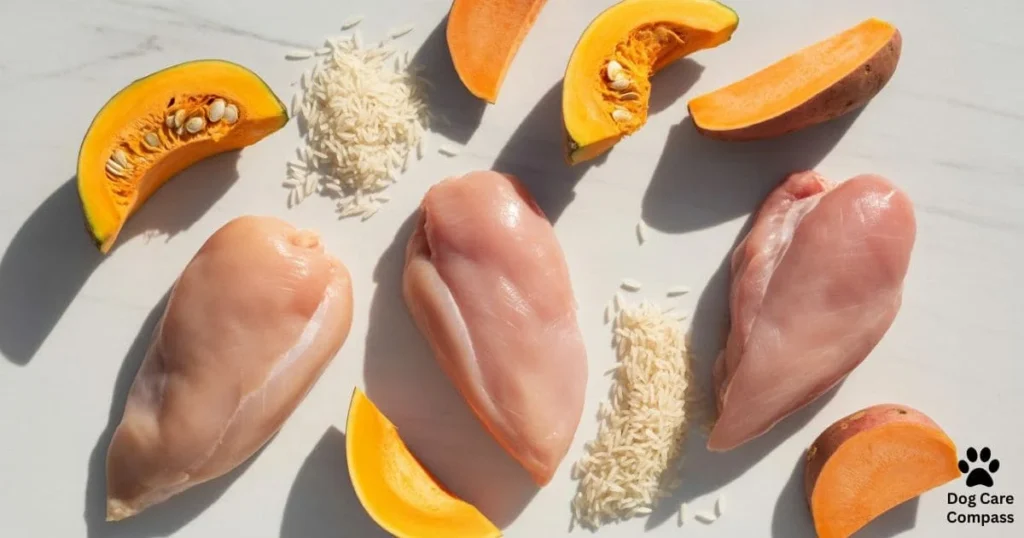
Not every food that is technically safe for dogs is gentle enough for a sensitive stomach. Some ingredients that are legitimately healthy — brown rice, broccoli, or even sweet potato in large amounts — contain too much fermentable fiber or gas-producing compounds to use during an active digestive flare. The ingredients below were selected specifically for their gentleness and their strong track record of being tolerated by dogs with reactive GI systems.
For protein, the safest options are boneless skinless chicken breast that has been boiled (not fried), lean ground turkey with all fat drained completely, cooked salmon with every bone carefully removed, and plain scrambled eggs prepared with absolutely no oil, butter, or salt. These proteins are low in fat, high in bioavailable amino acids, and highly unlikely to trigger any inflammatory response. For carbohydrates, plain white jasmine rice is the gold standard when a stomach is actively upset — it firms stools quickly and absorbs excess fluid in the intestinal tract. Plain oatmeal cooked in water is an excellent secondary option for dogs with recurring gut inflammation. For vegetables, pure canned pumpkin deserves special mention: it is one of the few foods that regulates digestion in both directions, firming up diarrhea and relieving constipation depending on what the gut needs. Cooked carrots, steamed zucchini, and plain green beans are the other consistently well-tolerated options across all breeds and sizes.
On the avoidance side, several ingredients are non-negotiable. Onions and garlic in any form — fresh, powdered, or cooked into a broth — destroy red blood cells and can cause life-threatening hemolytic anemia. Grapes and raisins can trigger sudden, severe kidney failure even in small amounts. Xylitol, found in many sugar-free products and some peanut butters, causes dangerous and rapid drops in blood sugar. High-fat ingredients like meat skin, bacon grease, or any fried item are a primary trigger for pancreatitis, which is a serious and painful condition. Salt, spices, and artificial sweeteners should never be added to any homemade dog food under any circumstances. The simpler the recipe, the safer and more effective it will be for a sensitive stomach.
5 Homemade Dog Food Recipes for Sensitive Stomach
Each recipe below follows the 50/25/25 macronutrient formula and uses exclusively ingredients known to be gentle on a reactive digestive system. All five can be prepared in under thirty minutes and batch-cooked in larger quantities for convenient weekly storage.
Classic Chicken and White Rice Bowl
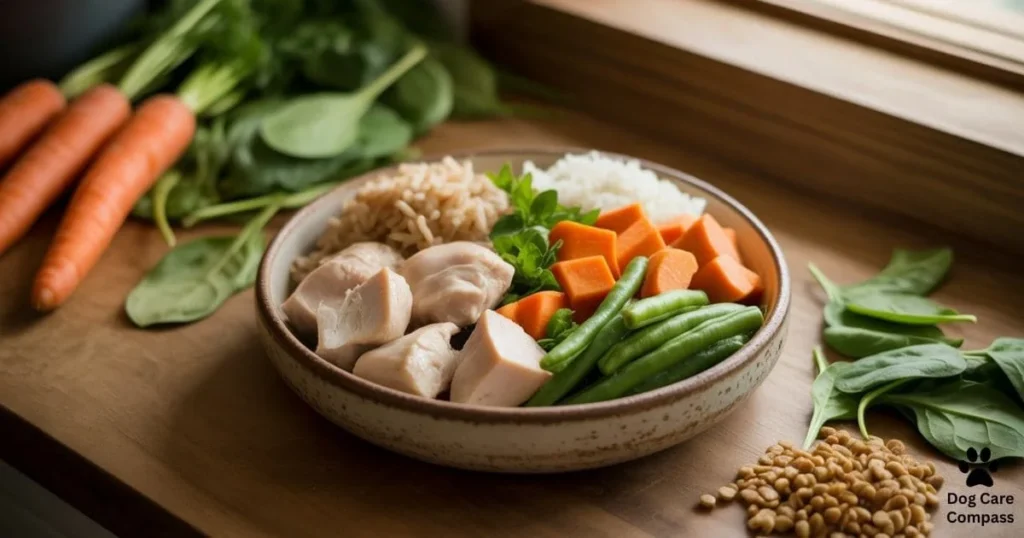
Veterinarians have trusted this simple recipe for decades to help dogs with digestive upset. With just three main ingredients and no additives, it’s gentle on the gut and easy to digest. Ideal for dogs experiencing diarrhea or vomiting, this meal firms stools, provides high-quality protein, and helps reset the digestive system naturally.
Ingredients
- 1 lb boneless, skinless chicken breast
- 2 cups plain white jasmine rice
- ½ cup 100% pure pumpkin puree (unsweetened)
- 2 cups low-sodium bone broth or water
Instructions
- Boil the chicken breast in plain water until fully cooked, ensuring there’s no pink inside. Shred into small, bite-sized pieces.
- Cook the white rice in bone broth instead of water for added flavor and gentle digestive support.
- In a large bowl, mix shredded chicken, cooked rice, and pumpkin puree until evenly combined.
- Let the mixture cool completely to room temperature before serving. Store leftovers in the refrigerator for up to 4 days.
Tip: Use white jasmine rice instead of brown rice during digestive flare-ups — it’s easier on the stomach and helps firm loose stools quickly.
Turkey and Sweet Potato Tummy Tamer Stew
Lean ground turkey is one of the easiest proteins for dogs to digest — lower in fat than beef and gentle on even the most sensitive stomachs. Combined with sweet potato and pumpkin, this wholesome stew soothes gut inflammation and supports healthy bowel movements. It’s perfect for dogs dealing with diarrhea as well as those prone to occasional constipation.
Ingredients
- 1 lb lean ground turkey (93% lean or higher)
- 1 cup cooked white rice
- ½ cup sweet potato, diced and steamed
- ½ cup 100% pure pumpkin puree (unsweetened)
- 1 medium carrot, cooked and chopped
- 2 cups plain bone broth
Instructions
- In a medium pot over medium heat, brown the ground turkey until fully cooked. Drain all excess fat thoroughly.
- Add bone broth, sweet potato, and carrot. Simmer for 10–12 minutes until the vegetables are soft.
- Stir in pumpkin puree and cooked rice. Mix well and simmer for another 5 minutes until the stew thickens slightly.
- Allow the stew to cool to room temperature before serving. Portion leftovers into containers and refrigerate or freeze.
Tip: Serve warm, not hot, to protect sensitive digestive tracts and maintain nutrient integrity.
“Even healthy homemade food can cause [soft poop] if the transition is too fast.”
Lean Beef, Pumpkin & Peas Recovery Meal
Lean ground beef delivers a complete amino acid profile, supporting immune function and muscle maintenance during recovery after a digestive upset. Gentle fiber from peas and carrots nourishes beneficial gut bacteria without causing gas or bloating. This recipe is ideal for the days following an acute digestive flare, when the gut needs rebuilding rather than another challenge.
Ingredients
- 1 lb lean ground beef (90% lean or higher)
- 2 cups cooked white rice
- ½ cup 100% pure pumpkin puree (unsweetened)
- ½ cup frozen peas, thawed
- ½ cup cooked and diced carrots
- 1 hard-boiled egg, chopped
Instructions
- Cook the ground beef in a pan until fully browned. Drain all fat completely — this step is essential, as excess fat can trigger pancreatitis in sensitive dogs.
- In a large bowl, combine cooked rice, pumpkin puree, thawed peas, and cooked carrots.
- Add the drained beef and chopped hard-boiled egg. Mix thoroughly until all ingredients are evenly distributed.
- Allow the meal to cool to room temperature before serving. Do not add salt, sauces, or seasonings.
Tip: Serve at room temperature to avoid irritating your dog’s sensitive digestive system.
Gentle Egg & Oatmeal Breakfast Bowl
Eggs are among the most digestible proteins for dogs, with a biological value comparable to meat. Plain oatmeal cooked in water provides soothing soluble fiber that gently coats the intestinal lining without causing irritation. This breakfast bowl is perfect as a light morning meal, a gentle reset after a vomiting episode, or as an introduction to homemade food for dogs trying it for the first time.
Ingredients
- 3 eggs
- 1 cup plain oatmeal, cooked in water (no flavored packets)
- ½ cup 100% pure pumpkin puree (unsweetened)
- ¼ cup steamed green beans, finely chopped
- 1 tbsp plain low-fat cottage cheese
Instructions
- Scramble the eggs in a completely dry non-stick pan. Do not add butter, oil, milk, or salt.
- Cook the oatmeal in plain water and let both eggs and oatmeal cool completely before combining.
- In a bowl, mix together the cooled oatmeal, scrambled eggs, pumpkin puree, green beans, and cottage cheese until evenly combined.
- Serve at room temperature. Do not serve hot, as heat can create an unpleasant texture and may burn your dog’s mouth.
Tip: This gentle bowl is ideal for sensitive stomachs and can be used as a soft introduction to homemade meals.
How Much to Feed: Daily Amounts by Weight
Portion size is one of the most commonly overlooked aspects of homemade feeding, and getting it wrong in either direction creates problems. Too much food causes weight gain that stresses joints and the digestive system. Too little leaves your dog nutritionally depleted and persistently fatigued. The standard veterinary guideline for homemade dog food is to feed between two and three percent of your dog’s body weight per day, split across two meals. Active, young dogs lean toward the higher end of that range. Senior, sedentary, or overweight dogs should stay firmly at the lower end.
The table below provides a practical baseline. These amounts are based on a caloric density of approximately 380 to 400 calories per cup, which is typical for the recipes in this guide. Every dog is an individual, so monitor body condition closely: you should be able to feel your dog’s ribs without pressing hard, but you should not be able to see them clearly when they are standing.
| Dog’s Weight | Daily Total | Calories/Day | Per Meal (2×) | Practical Reference |
|---|---|---|---|---|
| 5 lbs | 1.5–2.5 oz | 100–150 | ~1.25 oz | 1 small tbsp scoop |
| 10 lbs | 3–5 oz | 200–300 | ~2.5 oz | ¼ cup per meal |
| 20 lbs | 6–10 oz | 400–600 | ~4 oz | ½ cup per meal |
| 30 lbs | 10–14 oz | 600–900 | ~6 oz | ¾ cup per meal |
| 50 lbs | 16–24 oz | 1,000–1,500 | ~10 oz | 1¼ cups per meal |
| 70 lbs | 22–34 oz | 1,400–2,100 | ~14 oz | 1¾ cups per meal |
| 100 lbs | 32–48 oz | 2,000–3,000 | ~20 oz | 2½ cups per meal |
Puppies with sensitive stomachs need roughly double these amounts, since their growing bodies demand significantly more calories. Feed puppies four small meals per day rather than two, keeping each portion small to avoid overwhelming their still-developing digestive systems. Senior dogs often need ten to fifteen percent less than the standard range, particularly if their daily activity has decreased. Weigh your dog every two weeks during the first month of homemade feeding and adjust portions accordingly.
Safe vs Avoid: Complete Ingredient Reference
Not every ingredient that is technically safe for dogs is appropriate for a sensitive stomach. The digestibility rating in the table below reflects how easy each ingredient is for a reactive GI tract to process — not simply whether the ingredient is non-toxic for dogs in general. Use this as your quick reference whenever you are planning a recipe or considering adding something new.
| Chicken Breast (boiled) | Safe | Leanest protein available, virtually zero GI irritation risk | ★★★★★ |
| White Jasmine Rice | Safe | Firms stools fast, minimal fiber, best carb during active flares | ★★★★★ |
| Pure Pumpkin Puree | Safe | Regulates both diarrhea and constipation — a genuine gut-health superfood | ★★★★★ |
| Ground Turkey (lean) | Safe | Lower fat than beef, excellent amino acid profile, easy to digest | ★★★★★ |
| Cooked Salmon | Safe | Omega-3 fatty acids reduce gut inflammation directly | ★★★★☆ |
| Scrambled Eggs (plain) | Safe | Highest biological value protein available, extremely gentle | ★★★★★ |
| Cooked Carrots | Safe | Gentle soluble fiber, beta-carotene, very low irritation | ★★★★☆ |
| Sweet Potato (steamed) | Safe | Soothing fiber, natural vitamins, well tolerated by most sensitive dogs | ★★★★☆ |
| Plain Oatmeal (cooked) | Safe | Coats and soothes the intestinal lining, ideal for chronic gut inflammation | ★★★★☆ |
| Steamed Zucchini | Safe | Very low fiber and calories, adds bulk without any digestive irritation | ★★★★★ |
| Brown Rice | Moderate | Healthy for stable dogs but too high in fiber during active digestive flares | ★★★☆☆ |
| Broccoli | Moderate | Nutritious but produces significant gas — use very small amounts only | ★★★☆☆ |
| Plain Cottage Cheese | Moderate | Good protein source but may cause problems in lactose-sensitive dogs | ★★★☆☆ |
| Onions and Garlic | Toxic | Destroys red blood cells — causes hemolytic anemia, potentially fatal | Never |
| Grapes and Raisins | Toxic | Even small amounts trigger sudden, severe kidney failure | Never |
| Xylitol | Toxic | Causes dangerous rapid insulin release — hypoglycemia and liver failure | Never |
| High-Fat Meat Skin | Avoid | Primary trigger for pancreatitis, especially in sensitive-stomach dogs | Never |
| Salt and Spices | Avoid | Irritates the gut lining and creates unsafe sodium levels for dogs | Never |
| Avocado | Avoid | Contains persin, which is toxic to dogs in all parts of the plant | Never |
How to Transition Without Making Things Worse
This is where most owners accidentally create the very problem they are trying to solve. They find a recipe that looks perfect, serve it as the full meal the following day, and then wonder why the diarrhea has gotten worse. The answer is always the same: even the gentlest homemade recipe introduces new proteins, new fermentation substrates, and a new balance of gut bacteria. Switch too quickly, and the microbiome does not have time to adjust — and the result is a flare, not a recovery.
The correct approach is a gradual transition across 7 to 10 days, and longer is better if your dog is particularly reactive. On days one and two, mix roughly 90 percent of your dog’s current food with just a small spoonful of the new homemade recipe. Watch stool quality carefully. On days three and four, move to a 75/25 split — three quarters old food, one quarter new. If everything remains stable, shift to a 50/50 mix on days five and six. By days seven and eight, flip to 75 percent homemade. By day nine or ten, the transition to 100 percent homemade should be complete. If any setback occurs at any stage, drop back one step and hold that ratio for two additional days before moving forward. Slower always wins with a sensitive stomach.
Dogs with acid reflux need special food — see our Best Dog Food for Acid Reflux guide
Storage and Meal Prep Tips
Batch cooking is what makes homemade dog feeding sustainable over the long term. Most owners cook once or twice per week, portion out individual daily servings, and store them in the refrigerator or freezer. Cooked homemade dog food stays safe in the refrigerator for three to four days in an airtight container. Never leave cooked food at room temperature for more than two hours — bacterial growth begins quickly, regardless of how clean and fresh the ingredients were when you started cooking.
For storage beyond four days, freeze individual daily portions in zip-lock bags or small sealed containers. Properly stored frozen homemade dog food remains safe for up to three months. To serve from frozen, thaw the portion overnight in the refrigerator — never microwave food directly, as microwaving creates hot spots that can burn your dog’s mouth and throat. After retrieving food from the fridge, let it sit at room temperature for ten to fifteen minutes before serving. Serving cold food directly from the refrigerator can trigger stomach cramping in sensitive dogs, which is the exact outcome you have been working to prevent.
Should You Add Supplements?
Homemade dog food is genuinely nutritious, but it is rarely nutritionally complete on its own when used as the sole diet for an extended period. The recipes in this guide are excellent for digestive recovery and for short-to-medium-term feeding, but they lack the precise calcium balance, specific trace minerals, and full vitamin spectrum that commercial foods are legally required to include in every bag.
If you plan to use homemade food as your dog’s primary diet beyond a few weeks, speak with your veterinarian or a board-certified veterinary nutritionist about adding a canine-specific complete nutrient supplement. Products formulated specifically to balance homemade diets are available through most veterinary offices and online. Beyond a full supplement, a daily fish oil capsule appropriate for your dog’s weight delivers the Omega-3 fatty acids that reduce gut inflammation and support coat quality over time. Ground eggshell powder or a calcium supplement may also be necessary to correct the calcium imbalance that commonly results from meat-heavy homemade diets. Never guess on supplement dosages — always follow veterinary guidance based on your specific dog’s weight, age, breed, and health history.
FAQ
Can I feed my dog homemade food every day long-term?
Yes, homemade food can be part of your dog’s long-term diet, but it’s important to ensure it’s nutritionally balanced. Over time, you may need to add a canine-specific supplement to provide calcium, vitamins, and trace minerals. Always consult your veterinarian before making it a permanent diet.
How much pumpkin should I give my dog?
For digestive support, ½ cup of plain, unsweetened pumpkin per meal is generally safe for medium-sized dogs. Smaller dogs may need 1–2 tablespoons per meal. Pumpkin helps firm up diarrhea or relieve mild constipation, but don’t overfeed, as too much can cause loose stools.
Can I use brown rice instead of white rice?
Brown rice is nutritious but higher in fiber, which can be too harsh during an active digestive flare. For sensitive stomachs, plain white jasmine rice is recommended, as it is easier to digest and helps firm loose stools.
My dog has never eaten homemade food. Where do I start?
Start gradually by mixing a small portion of homemade food with your dog’s current food over 7–10 days. Begin with 10–15% homemade and slowly increase the ratio as your dog tolerates it. This prevents digestive upset and allows the gut to adjust.
Disclaimer: This content is for informational and educational purposes only. It is not a substitute for professional veterinary advice, diagnosis, or treatment. Always consult your veterinarian before making significant changes to your dog’s diet, especially if they have a pre-existing health condition, are currently on medication, or are showing acute or worsening symptoms.