Why Your Dog Gets Aggressive Around Food — Causes, Warning Signs, and What Actually Helps
Quick Answer: Food aggression in dogs — also called resource guarding — is when a dog protects food out of anxiety, not dominance. It ranges from mild stiffening to growling or snapping. It’s a manageable behavior with the right approach, but it should never be punished. The goal is to change how your dog feels about people near their food — not to force submission.
You’re Not a Bad Owner — And Your Dog Isn’t a Bad Dog
If you searched this, chances are you’re worried. Maybe your dog growled at you this morning. Maybe they snapped when your child walked by the bowl. Maybe it came out of nowhere and now you don’t know what to think.
First — take a breath.
This doesn’t make you a bad dog owner. It doesn’t make your dog aggressive “by nature.” Food guarding is one of the most common behavior concerns dog owners face, and it almost always has a clear, understandable root cause.
The guilt you’re feeling right now? It’s not useful information. What is useful is understanding what’s actually happening — and what you can do about it.
Your dog is not trying to challenge you. They’re not “taking over.” They’re anxious. And anxious dogs need understanding, not punishment.
What Is Food Aggression in Dogs — And What It’s NOT
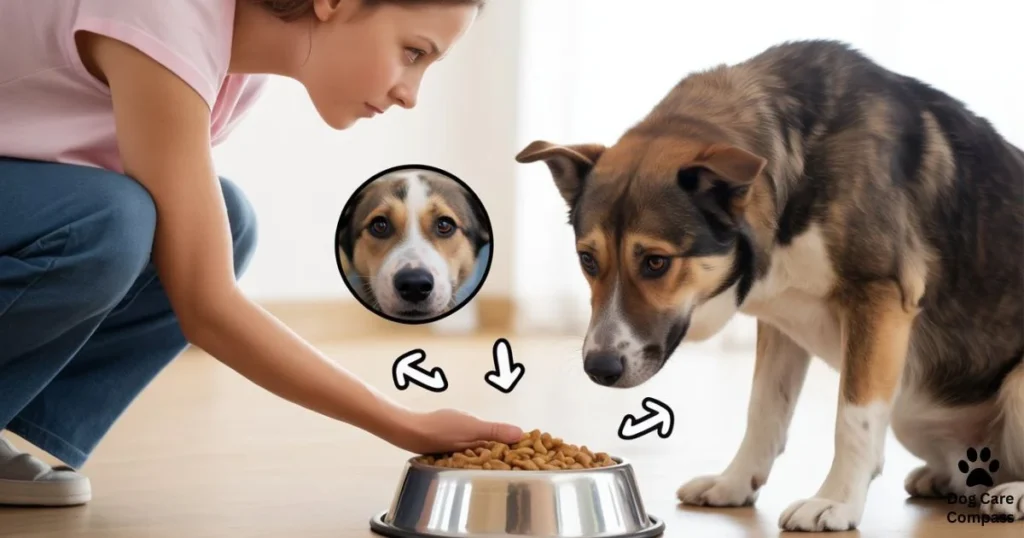
The Real Name for This Behavior: Resource Guarding
What most people call “food aggression” has a proper behavioral name: resource guarding. It means your dog is protecting something they value — in this case, food — because they’re afraid of losing it.
This behavior is anxiety-driven. Your dog isn’t guarding food because they want to dominate you. They’re guarding it because on some level, they believe someone might take it away.
Behaviorist Jean Donaldson, in her foundational book Mine!, describes resource guarding as a normal canine behavior that exists on a spectrum — from barely noticeable to genuinely dangerous. Understanding this spectrum is the first step to addressing it correctly.
Resource guarding can happen in any breed, any age, and any background. A well-loved family dog raised from puppyhood can develop it. A rescue dog with unknown history can show it from day one. It’s not a character flaw — it’s a learned survival response.
Why the Old “Dominance” Explanation Is Wrong
For decades, food aggression was explained as dominance — the dog was trying to be the “alpha,” and the solution was to assert your authority. Take the bowl away. Show the dog who’s boss.
That explanation is now considered outdated and scientifically unsupported.
The American Veterinary Society of Animal Behavior (AVSAB) has published a clear position statement rejecting dominance theory as a framework for understanding or treating dog behavior. Modern behavioral science tells us that dogs don’t guard food to climb a social hierarchy — they guard it because they’re anxious about losing something valuable.
This matters enormously in practice. If you treat guarding as dominance, you’ll use confrontational methods that make the dog more anxious — and more dangerous. If you treat it as anxiety, you’ll use methods that actually work.
How Serious Is My Dog’s Food Aggression? (Severity Scale)
Not all food guarding is the same. Before you can decide what to do, you need to honestly assess where your dog falls on the severity scale.
The 3 Levels of Food Guarding
| Level | What You’re Seeing | Risk Level | What to Do |
|---|---|---|---|
| Mild | Eating faster when you approach, stiffening, avoiding eye contact, subtle side-eye | Low | Management + home training protocol |
| Moderate | Growling, hard stare, body blocking the bowl, low rumble when approached | Medium | Structured training with close monitoring — consider professional support |
| Severe | Snapping, lunging, has bitten before, escalates quickly | High | Stop DIY training — contact a certified behaviorist immediately |
Be honest with yourself here. Many owners underestimate severity because they want to believe it’s manageable at home. If there’s been any snapping or biting — even once — that puts your dog in the severe category regardless of how “normal” they seem the rest of the time.
Is This New Behavior or Has It Always Been There?
This question matters more than most people realize.
If your dog has always shown some food guarding, that’s a behavioral pattern — likely rooted in early experience, competition in the litter, or learned associations.
If this behavior is new and appeared suddenly, that’s a different situation entirely. Sudden changes in behavior around food can signal underlying medical issues — pain, thyroid problems, neurological changes, or cognitive decline in older dogs. Before you start any training protocol, a vet visit is the right first step to rule out a physical cause.
Rescue dogs deserve a special mention here. If your rescue dog guards food, it doesn’t mean they were abused — but it often means food was scarce or competitive at some point. Their history may be unknown, but their behavior makes complete sense given what they may have experienced.
Why Do Dogs Guard Food? The Real Reasons Behind the Behavior
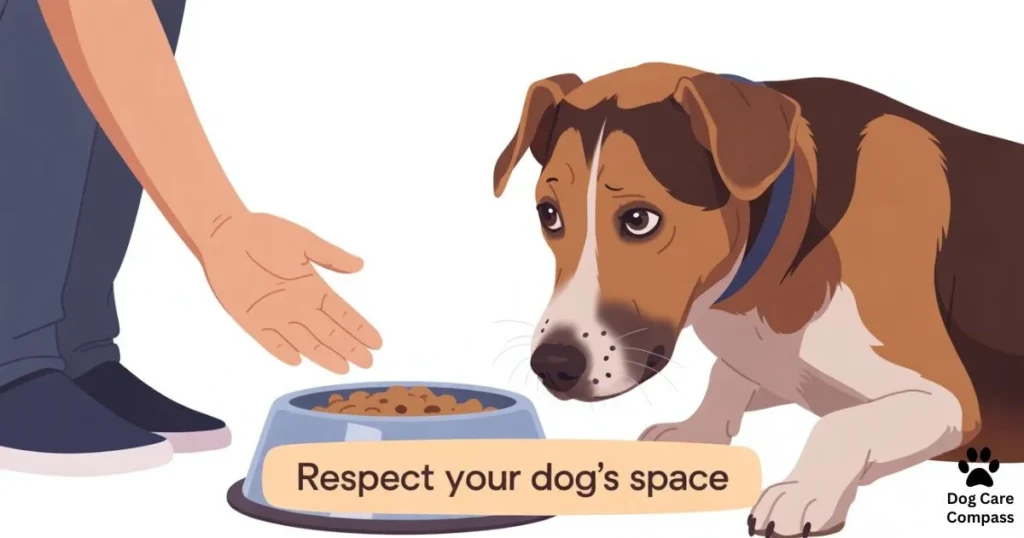
Understanding why this happens makes you a far more effective trainer. It also helps you stop blaming yourself — or your dog.
Survival Instinct — It Starts Before Domestication
Dogs evolved in environments where food was unpredictable. In that world, guarding a meal wasn’t aggression — it was survival. Puppies in a litter compete for nursing access. Dogs in the wild compete for carcasses. The instinct to protect food is deeply wired.
Domestication has softened many instincts, but not eliminated this one. Even a dog raised in a loving home with consistent meals can retain a strong food-guarding drive. It doesn’t mean something went wrong.
Anxiety and Uncertainty — The Emotional Root
At its core, resource guarding is about fear of loss. Your dog isn’t thinking “I will dominate this human.” They’re thinking something closer to “if I don’t protect this, it will be gone.”
Dogs with inconsistent feeding schedules, past food insecurity, or shelter backgrounds often guard more intensely because uncertainty has been part of their experience. Food represents safety — and threatening that safety triggers a protective response.
Learned Behavior — What Accidentally Reinforced It
Here’s a hard truth: well-meaning owners sometimes make food guarding worse without knowing it.
When people repeatedly take a dog’s bowl away “to show them who’s boss,” or grab food away during meals as a training exercise, they inadvertently confirm the dog’s fear. “See? I was right to guard it — they did take it.”
Every time a person approached and the dog growled and the person backed off, the dog learned that growling works. That’s not stubbornness — that’s normal learning. The good news is that what was learned can be unlearned.
Read Your Dog’s Body Language Before It Escalates
Most bites don’t come out of nowhere. They come after a series of warning signals that were missed — or ignored. Learning to read these signals is one of the most important safety skills you can develop.
The Warning Ladder — From Subtle to Serious
Dogs communicate discomfort in layers, starting subtle and escalating only when earlier signals don’t work. Behaviorist Kendal Shepherd’s “Ladder of Aggression” maps this well.
Level 1 — Easy to Miss:
- Eating noticeably faster when you approach
- Body stiffening over the bowl
- Whale eye (white part of eye visible)
- Turning body slightly to block the bowl
Level 2 — Clear Warning:
- Hard, unblinking stare
- Low growl or rumble
- Lip lift — teeth beginning to show
- Hovering low over food, not eating
Level 3 — Danger Zone:
- Snapping — may or may not make contact
- Lunge toward the person approaching
- Bite
Most people only notice Level 2 or 3. By then, the dog has already been communicating distress for a while. The goal is to start noticing — and respecting — Level 1 signals.
Why You Must NEVER Punish the Growl
This is critical enough to say directly: punishing a growl is one of the most dangerous things you can do.
A growl is your dog’s warning system. It’s them saying, “I am uncomfortable — please stop.” When you punish that warning, you don’t make the dog less aggressive. You teach them that warning signs lead to punishment — so they skip the warning.
The result is a dog that bites without any visible buildup. No growl. No stiff body. Just a bite.
“A dog that stops growling after punishment hasn’t become safer — it has become less predictable.”
When your dog growls near food, the right response is to calmly increase distance. Don’t reach in. Don’t correct. Just move away — and then reassess your training approach.
What NOT To Do — Common Mistakes That Make It Worse
This section exists because a lot of popular advice about food aggression is not just unhelpful — it’s actively dangerous. If you’ve already tried some of these, that’s okay. You were doing your best with the information you had.
Don’t Take the Bowl Away to “Show Dominance”
This is the most commonly recommended — and most harmful — piece of advice for food guarding. The idea is that repeatedly taking the bowl away teaches the dog that you control the food.
What it actually teaches: “Every time a human approaches my bowl, something bad happens.” It increases guarding anxiety rather than reducing it.
Don’t Punish Growling or Snapping
Covered above, but worth repeating: punishing warning signals doesn’t reduce aggression. It removes the warning. The dog’s emotional state — the anxiety driving the behavior — hasn’t changed. Only their communication has been shut down.
Don’t Use Alpha Rolls or Physical Corrections
Physically forcing a dog into submission near food — or ever — has been shown to increase aggression and damage trust. The LIMA (Least Intrusive, Minimally Aversive) framework used by modern certified trainers explicitly rejects these methods.
If a trainer recommends alpha rolls or physical corrections, find a different trainer.
Don’t Ignore It and Hope It Resolves on Its Own
Mild resource guarding does not naturally fade if untreated. Without intervention — either management or training — it typically stays the same or gradually worsens. “He only does it sometimes” is not a reason to wait.
Don’t Feed Multiple Dogs Together
If you have more than one dog and food guarding is present, communal feeding is a setup for conflict. This is a management issue, not just a training issue. Separate feeding is non-negotiable until behavior is fully addressed — and possibly permanently.
These mistakes come from a place of love and frustration. Nobody does them to be cruel. Now that you know what doesn’t work, you can focus on what does.
How to Actually Help a Dog That Guards Food
The Foundation Principle — Change the Emotional Association
All effective food guarding training is built on one concept: counter-conditioning. The goal is not to force your dog to accept your presence near food. The goal is to change how your dog feels about your presence near food.
Right now, your approach to the food bowl triggers anxiety. After counter-conditioning, your approach triggers anticipation of something good.
Patricia McConnell and Jean Donaldson both emphasize this point: behavior follows emotion. If you change the emotional response, the behavior follows. You cannot train compliance into an anxious dog — you have to change the anxiety first.
Step-by-Step: The “Approach and Reward” Protocol (Mild Cases)
This protocol is for mild-to-moderate guarding only. If your dog has snapped or bitten, skip to the professional help section.
- For the first few days, do not approach the bowl during meals. Give your dog complete space. This alone reduces baseline anxiety.
- Walk past the bowl at a comfortable distance — 5 to 6 feet — and toss a high-value treat (chicken, cheese, boiled beef) near the bowl without stopping or hovering.
- Repeat this several times per meal. Your dog should begin to notice: “When that person walks by, something good appears.”
- Over the following week, gradually decrease your passing distance — only if the dog remains relaxed. No stiffening, no whale eye, no eating faster.
- Begin pausing briefly near the bowl and dropping a treat in before walking away.
- Eventually, work toward crouching down briefly, adding food to the bowl, and leaving. Your dog learns: your approach = more food appears.
The key principle throughout: you are always adding, never taking away.
Realistic timeline: Most mild cases show meaningful improvement in 2 to 4 weeks of consistent daily practice. This is a trust-building process — not a quick fix.
Management Strategies While Training Is in Progress
Training takes time. In the meantime, management keeps everyone safe:
- Feed in a separate room or crate where your dog feels secure
- Use a baby gate to keep children and other pets away during meals
- Use a consistent feeding schedule — same time, same place every day
- Remove high-value chews (bones, bully sticks, rawhide) when people or other dogs are present
- Pick up all food bowls immediately after meals — don’t leave them out
How to Safely Take Food Away When Necessary
Sometimes you genuinely need to remove food — that’s unavoidable. The safest way is always the trade protocol:
Never snatch. Always offer something better first.
Hold out an extremely high-value treat — something better than what they have. The moment your dog moves toward the treat, calmly pick up the item. No drama, no confrontation.
Over time, “Drop it” and “Leave it” can be built as separate commands using positive reinforcement — completely outside feeding contexts first, then gradually introduced near food situations.
Food Aggression Around Children — A Special Safety Guide
If there are children in your home, this section is the most important thing you will read.
Why Children Are at Higher Risk
Children move unpredictably. They squat down to eye level with dogs. They don’t understand why they shouldn’t approach a dog that’s eating. And because of their height, their faces are at bite level.
A dog that gives a quick snap toward an adult’s hand can inflict a serious facial injury to a child. This is not alarmism — it’s the reason child safety around food-guarding dogs requires its own protocol.
Non-Negotiable Safety Rules If You Have Kids at Home
- Children are never allowed near the dog while the dog is eating — no exceptions, for any reason, during the entire training period.
- Feed the dog in a closed room, crate, or gated area at every meal.
- Teach children clearly: “We never bother the dog when he’s eating.” This is a house rule, not a suggestion.
- Do not assume training progress means the rule can be relaxed prematurely. Progress is gradual — safety rules stay in place until a certified professional confirms the behavior is reliably improved.
- Supervision means eyes on — not in the next room.
When to Choose Professional Help Over DIY If Children Are Present
This is a clear line: any household with children plus moderate or severe food guarding should work with a certified behaviorist — not YouTube tutorials, not blog posts.
The stakes are too high for trial and error. A certified professional from IAABC (International Association of Animal Behavior Consultants) or a Certified Applied Animal Behaviorist (CAAB) can assess your specific dog’s behavior and build a protocol for your specific home environment.
Food Aggression in Multi-Dog Households
When there are multiple dogs involved, food guarding adds a layer of complexity that home training alone often cannot safely address.
Why Dogs Guard More When Other Dogs Are Present
Competition is real. Even dogs that are bonded and friendly can resource guard intensely around each other — because another dog near food represents a direct, immediate threat to the resource. The stakes feel higher.
Management Protocol for Multiple Dogs
- Feed all dogs in completely separate spaces — separate rooms, separate crates — every single meal
- Pick up all bowls immediately when eating is done
- Never allow one dog near another dog’s bowl, even an empty one
- High-value treats and chews are only given in crates or isolated spaces, never in shared areas
- Free-feeding (leaving food out all day) is not an option in multi-dog homes with any guarding history
Can Two Food-Guarding Dogs Live Together Safely?
Yes — with permanent, consistent management. Many households successfully live with multiple resource-guarding dogs by simply never putting them in a position to compete over food.
Be honest with yourself though: this requires lifelong vigilance. It’s not a phase that ends once training is “done.” For some households, that’s completely manageable. For others, it’s worth evaluating with a professional to decide the best long-term plan.
When to Stop DIY Training and Call a Professional
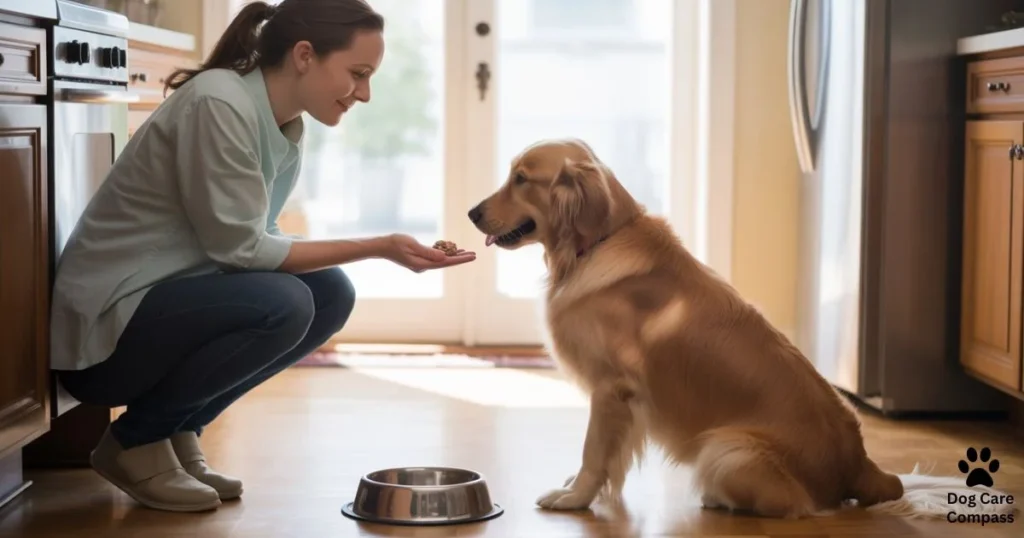
Knowing when to stop trying to handle this alone is not failure — it’s good judgment.
Signs You Need a Certified Behaviorist
| Situation | Action Needed |
|---|---|
| Dog has bitten and broken skin | Certified Applied Animal Behaviorist (CAAB) or veterinary behaviorist — immediately |
| Children in the home with moderate or severe guarding | IAABC certified behaviorist |
| Behavior is escalating despite consistent training | Professional evaluation |
| Sudden behavior change with no clear trigger | Vet first, then behaviorist |
| Multiple dogs with aggression between them | Professional management plan |
| Behavior is unpredictable — sometimes fine, sometimes not | Professional evaluation |
Trainer vs. Behaviorist vs. Veterinary Behaviorist — What’s the Difference?
- Certified Dog Trainer (CPDT-KA): Good for mild cases, obedience, foundational skills. Not equipped for severe aggression.
- IAABC Certified Behavior Consultant: Specializes in behavior problems including resource guarding. Good for moderate cases.
- Certified Applied Animal Behaviorist (CAAB): Advanced behavioral science background. For complex or severe cases.
- Veterinary Behaviorist (DACVB): A veterinarian with behavioral specialization. Can prescribe medication if anxiety is severe. For the most serious cases.
Find certified professionals at IAABC.org, APDT.com, or the DACVB directory.
Realistic Expectations — How Long Does This Actually Take?
Most articles skip this entirely — and then owners feel like they’re failing when week two doesn’t look like a transformation. Here’s the honest picture.
Mild Cases
With daily consistent practice, most mild food guarding shows meaningful improvement in 2 to 6 weeks. Management strategies should stay in place throughout — don’t remove structure just because things seem better.
Moderate Cases
Expect 2 to 4 months of structured, consistent work — possibly longer. Progress is real but non-linear. Good weeks will be followed by setbacks. That’s normal, not failure.
Severe Cases
Severe resource guarding with bite history requires a long-term behavior modification plan, often with a veterinary behaviorist. In some cases, management may need to be permanent even alongside significant improvement. Medication to reduce baseline anxiety is sometimes part of the plan — and that’s a valid, humane tool, not a last resort.
Progress isn’t always linear. A rough day after a good week isn’t regression — it’s just how behavioral change works. Keep going.
Frequently Asked Questions
Why does my dog growl when I walk near his food bowl?
Your dog is communicating discomfort — they’re worried you might take their food. This is resource guarding, an anxiety-driven behavior. It’s not dominance. The growl is a warning signal, not an attack. The right response is to increase distance and begin a counter-conditioning protocol.
Can food aggression in dogs be cured?
“Cured” is a strong word — “reliably managed and significantly improved” is more accurate. Many dogs with mild to moderate food guarding reach a point where the behavior is essentially gone in daily life, but the underlying tendency may resurface under stress. Consistency in management and training is what makes the difference.
Is food aggression more common in certain breeds?
Any breed can develop food guarding. Some working and hunting breeds may show it more intensely due to high drive, but there is no breed that is immune to it or that always displays it. Individual history, early experience, and learning matter far more than breed.
My dog is only food aggressive with other dogs — is that different?
Yes and no. The root behavior — resource guarding — is the same. But the trigger being specifically other dogs rather than humans changes the management approach. Separate feeding is the first and most critical step. A professional can help if tensions between dogs are escalating.
Should I take food away from an aggressive dog to show dominance?
No. This is one of the most common and harmful pieces of advice circulating online. Repeatedly taking food away increases your dog’s anxiety about losing food — which intensifies guarding behavior. It does not teach respect. It teaches fear.
My rescue dog just started food guarding — is this normal?
Very common. Rescue dogs often come from environments where food was scarce or competed for. Guarding food in a new home is a stress response — they haven’t yet learned that food here is consistent and safe. Give them space, structure, and time. Most rescue dogs improve significantly once they feel settled and secure.
My dog was never food aggressive before — why now?
Sudden onset of food guarding in a dog with no prior history is worth a vet visit before anything else. Pain, illness, hormonal changes, or cognitive changes in older dogs can all cause sudden behavioral shifts. Rule out medical causes first.
Can puppies develop food aggression?
Yes — and it’s worth addressing early. Mild guarding in puppies is easier to work with than established guarding in adult dogs. The approach is the same: counter-conditioning, trade protocol, and never punishing growls.
Will neutering or spaying reduce food aggression?
There is no strong evidence that spaying or neutering directly reduces resource guarding. Hormonal influences on behavior are complex, but food guarding is primarily learned and anxiety-driven. Behavioral intervention — not surgery — is the appropriate treatment.
The Bottom Line — Your Dog Can Learn to Feel Safe Around Food
Food guarding is rooted in anxiety. And anxiety, with the right approach, can be meaningfully reduced.
Your dog is not broken. You have not failed them. What you have now is a clear understanding of what’s happening and a realistic picture of what to do next.
Here’s the simple version:
Assess severity honestly. If there’s been biting or children are involved, get professional support — that’s the smart move, not the giving-up move. Rule out medical causes if the behavior appeared suddenly. Use management to keep everyone safe while training is in progress. Build positive associations with your presence near food — slowly, consistently, without force.
If this article leaves you with one thing, let it be this: your dog growls near food because they’re afraid of losing it. The solution is to make them feel safe — not to show them who’s boss.
That shift in understanding is where real progress begins.
Disclaimer: This article provides general behavioral guidance for educational purposes. If your dog has a history of biting, lives with children, or shows severe food guarding, please consult a certified animal behaviorist or veterinary behaviorist. The information here is not a substitute for professional behavioral assessment.

researching veterinary sources, scientific studies, and expert
guides to bring dog owners accurate, practical information. Every
article is written with care and reviewed against credible
veterinary references including ASPCA, AKC, and peer-reviewed
literature.
- How to Stop Dog Barking at Night: 8 Proven Methods That Work - July 2, 2026
- Dog Pulls on Leash Every Walk? Fix It With This Simple Method - July 2, 2026
- How to Teach a Dog to Heel Without Treats: Step-by-Step Method - June 27, 2026