Can Dogs Eat Persimmon? What Every Dog Owner Must Know Before Sharing
Persimmons are one of those fruits that people either grow up eating or have never encountered until adulthood. The deep orange color and sweet, honey-like flavor make them a seasonal favorite — and if you eat them regularly, the question of whether your dog can share a piece is inevitable.
The answer is more nuanced than a simple yes or no — and the seeds make the question significantly more important than most fruit safety questions.
Can dogs eat persimmon? Dogs can eat the flesh of persimmon in small amounts — it is not acutely toxic. However, the seeds and pit contain cyanide compounds and can cause intestinal inflammation and obstruction. The high sugar content also limits appropriate portion sizes significantly.
Quick Answer
| Question | Answer |
|---|---|
| Is persimmon flesh safe for dogs? | Yes — small amounts, plain |
| Are persimmon seeds safe? | No — remove completely |
| Is the skin safe? | Yes — wash thoroughly first |
| Safe for diabetic dogs? | No — high sugar |
| Safe for puppies? | Not recommended |
What Is Persimmon?
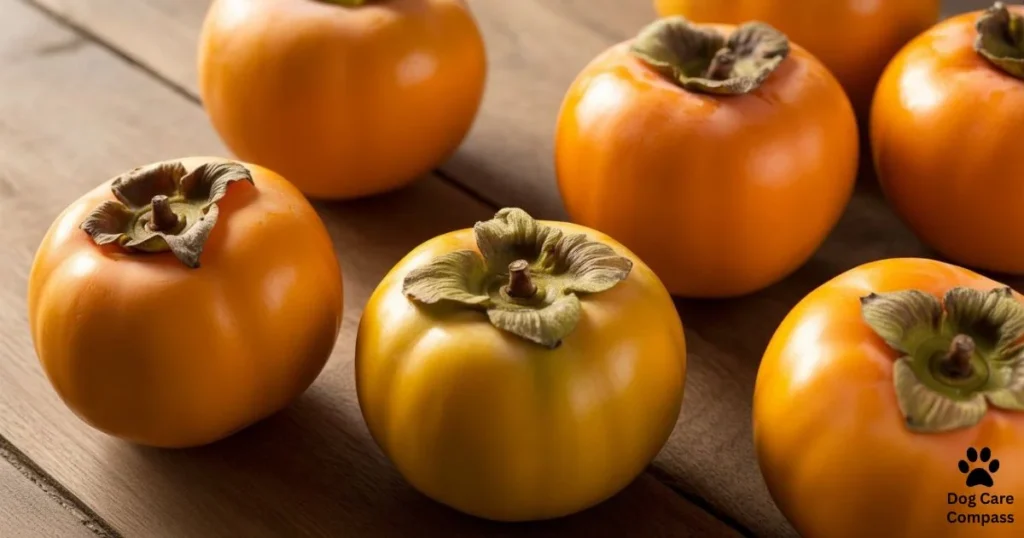
Persimmon is the fruit of trees in the genus Diospyros — native to China but now cultivated across Asia, the Mediterranean, and parts of the Americas.
Two varieties are most commonly available:
Fuyu persimmon: Squat, tomato-shaped, can be eaten while still firm. Mild, sweet flavor.
Hachiya persimmon: Acorn-shaped, must be fully ripe and soft before eating. Intensely sweet, almost jammy when ripe. Astringent and unpleasant when unripe.
Both varieties are nutritious for humans — rich in vitamins A and C, fiber, and antioxidants. The question for dog owners is whether those benefits translate meaningfully and safely to dogs.
Nutritional Profile of Persimmon (Per 100g)
| Nutrient | Amount |
|---|---|
| Calories | 70 kcal |
| Carbohydrates | 18.6g |
| Natural Sugar | 12.5g |
| Dietary Fiber | 3.6g |
| Protein | 0.6g |
| Fat | 0.2g |
| Vitamin A | 1627 IU |
| Vitamin C | 7.5mg |
| Potassium | 161mg |
| Manganese | 0.4mg |
The sugar content at 12.5g per 100g is the most significant dietary consideration — higher than dragon fruit and guava, though lower than lychee and significantly lower than tamarind.
The vitamin A content is notably high — 1627 IU per 100g. This is a genuine nutritional benefit for dogs but also a consideration for overconsumption, as vitamin A toxicity — while rare — is possible with excessive intake over time.
Is Persimmon Safe for Dogs?
The flesh of ripe persimmon is not classified as acutely toxic to dogs.
However — persimmon occupies a more complex safety profile than simple yes or no. The seeds are the primary concern.
Persimmon seeds contain cyanogenic glycosides — compounds that release cyanide when metabolized. This is the same family of compounds found in apple seeds and cherry pits — and the same reason why careful seed removal is non-negotiable before offering persimmon to a dog.
Beyond seed toxicity — the seeds and pit of persimmon have been documented to cause intestinal inflammation and obstruction in dogs. This is a separate concern from chemical toxicity — it is a physical and inflammatory response to the seed material itself.
Benefits of Persimmon for Dogs

Vitamin A Supports Eye and Immune Health
1627 IU of vitamin A per 100g is genuinely significant.
Vitamin A supports vision, immune function, skin health, and cellular growth in dogs. While dogs convert beta-carotene to vitamin A less efficiently than humans — preformed vitamin A from fruit is directly bioavailable.
For senior dogs where immune resilience and eye health are increasingly relevant — a small occasional serving of persimmon contributes meaningful vitamin A support.
Fiber Supports Digestive Health
At 3.6g of fiber per 100g — persimmon provides meaningful dietary fiber.
This supports gut bacteria, aids bowel regularity, and contributes to the stool consistency that matters for overall digestive health. The same fiber principles that benefit dogs in our sensitive stomach guide apply here — appropriate fiber from whole food sources is genuinely beneficial.
Antioxidants Reduce Inflammation
Persimmon contains lycopene, beta-carotene, and various flavonoids with documented antioxidant activity.
For dogs dealing with age-related inflammation or recovering from illness — these compounds contribute to the cellular defense mechanisms that reduce oxidative damage over time.
Very Low in Fat
At 0.2g of fat per 100g — persimmon is one of the lowest-fat fruit options available.
This makes it appropriate for dogs on low-fat diets and breeds with pancreatitis susceptibility — provided seed removal is thorough and portions are kept small given the sugar content.
Risks of Feeding Persimmon to Dogs
Seeds Contain Cyanogenic Compounds — Most Critical Risk
Persimmon seeds must be removed completely before any piece is offered to a dog.
The cyanogenic glycosides in persimmon seeds are not present in concentrations that produce acute cyanide poisoning from a single seed in most adult dogs — but they cause measurable intestinal inflammation and can obstruct the digestive tract.
Dogs that consume multiple seeds may show:
- Vomiting and diarrhea
- Abdominal pain and distension
- Lethargy
- Intestinal obstruction requiring veterinary intervention in severe cases
The ASPCA specifically notes persimmon seeds as a concern for dogs — intestinal inflammation from seed ingestion is well-documented.
If your dog eats persimmon seeds — contact your vet. Do not wait for symptoms.
High Sugar Content Limits Regular Feeding
12.5g of natural sugar per 100g places persimmon firmly in the occasional treat category.
For healthy adult dogs — this is manageable in small portions. For diabetic dogs — persimmon is not appropriate at all. The sugar load affects blood sugar in ways that complicate insulin management.
Our diabetic diet guide covers exactly why sugar management matters so much in canine diabetes and which fruits can and cannot be accommodated.
Unripe Persimmon Causes Digestive Upset
Unripe Hachiya persimmon specifically contains high concentrations of soluble tannins that cause intense astringency and digestive upset.
A dog that eats unripe Hachiya persimmon will likely experience significant digestive discomfort — nausea, vomiting, and diarrhea from the tannin load.
Only fully ripe persimmon should ever be offered. Fuyu persimmons are safer in this regard — they are palatable and less astringent even when slightly underripe.
Vitamin A Overconsumption Risk
The high vitamin A content — while genuinely beneficial in appropriate amounts — becomes a concern if persimmon is fed excessively over a long period.
Vitamin A toxicity in dogs produces joint pain, bone abnormalities, and skin changes. This is not a risk from occasional small servings — it is a consideration that reinforces why persimmon should be an occasional treat rather than a daily staple.
Which Dogs Should Avoid Persimmon
- Diabetic dogs — high sugar content
- Dogs with kidney disease — potassium and phosphorus management
- Puppies — seeds and high sugar both inappropriate
- Dogs with sensitive digestive systems — tannins and sugar can trigger upset
- Any dog unless seeds are completely removed
How to Safely Prepare Persimmon for Dogs
- Choose fully ripe persimmon — soft for Hachiya, firm-ripe for Fuyu
- Wash the outside thoroughly under running water
- Slice open and inspect the interior carefully
- Remove every seed — inspect multiple times
- Cut the flesh into small, bite-sized pieces
- Remove any visible seed remnants or pit material
- Serve plain — no added sugar, no spices, nothing mixed in
- Start with a single small piece and monitor for 24 hours
How Much Persimmon Can Dogs Eat? — Feeding Chart
| Dog Size | Weight | Safe Amount |
|---|---|---|
| Small | Under 10 lbs | Half a small piece — occasionally |
| Medium | 10–50 lbs | 1–2 small pieces occasionally |
| Large | 50+ lbs | 2–3 small pieces occasionally |
Occasionally means once a week at most — not a daily treat.
Persimmon vs Other Safe Fruits for Dogs
| Fruit | Safe? | Sugar per 100g | Seed Safety | Verdict |
|---|---|---|---|---|
| Persimmon | Caution | 12.5g | Seeds toxic — remove | Occasional only |
| Guava | Yes | 8.9g | Remove for small dogs | Good option |
| Dragon fruit | Yes | 8g | Seeds safe | Good option |
| Papaya | Yes | 7.8g | Remove seeds | Good option |
| Jicama | Yes | 1.8g | Skin toxic | Excellent |
| Lychee | Caution | 15.2g | Seeds toxic | Occasional only |
| Wood apple | Caution | 9.5g | Remove seeds | Occasional only |
Persimmon sits alongside lychee in the caution category — the flesh is safe in small amounts but seed removal is non-negotiable and sugar content limits frequency.
For more consistent everyday fruit options — guava and dragon fruit provide comparable nutritional benefits with lower risk profiles.
For a complete reference of safe and toxic fruits — our fruits complete guide covers every major option in one place.
What to Do If Your Dog Eats Persimmon Seeds

Act immediately — do not wait for symptoms.
- Note how many seeds were consumed if possible
- Call your vet right away
- Contact ASPCA Poison Control at 888-426-4435 if vet is unavailable
- Do not induce vomiting unless specifically instructed
- Watch for vomiting, diarrhea, lethargy, or abdominal distension
Early veterinary contact significantly improves outcomes for seed ingestion cases.
Frequently Asked Questions
Is persimmon toxic to dogs?
The flesh is not acutely toxic. The seeds contain cyanogenic compounds and cause intestinal inflammation — they should never be consumed. The ASPCA specifically lists persimmon seeds as concerning for dogs.
Can dogs eat dried persimmon?
Not recommended. Dried persimmon is significantly more concentrated in sugar — sometimes three to four times the sugar content per gram. The dehydration process also makes seed fragments harder to identify and remove. Fresh only.
Can dogs eat persimmon skin?
Yes — the skin of ripe persimmon is safe when washed thoroughly. It contains additional fiber and antioxidants. For dogs with sensitive stomachs — peeling is a safe precaution.
My dog ate a whole persimmon including seeds — what do I do?
Contact your vet immediately. A whole persimmon contains multiple seeds — the intestinal inflammation and obstruction risk from multiple seeds is significant and warrants professional assessment.
Is Fuyu persimmon safer than Hachiya for dogs?
Yes — Fuyu is generally safer for dogs because it is palatable and less astringent even when slightly underripe. Hachiya must be fully ripe before offering — unripe Hachiya contains very high tannin concentrations that cause significant digestive upset.
Can dogs eat persimmon pudding or jam?
No. Processed persimmon products contain added sugar, dairy, and other ingredients inappropriate for dogs. Fresh flesh only — nothing processed.
Final Summary
- Persimmon flesh is safe for dogs in small amounts — not acutely toxic
- Seeds must be removed completely — they contain cyanogenic compounds and cause intestinal inflammation
- High sugar content — 12.5g per 100g — limits appropriate frequency
- Unripe Hachiya persimmon causes significant digestive upset — always use fully ripe fruit
- Diabetic dogs should avoid persimmon entirely
- Guava and dragon fruit are safer, more consistent everyday alternatives
- If seeds were consumed — contact your vet immediately
- Maximum 1 to 3 small pieces, occasionally, for healthy adult dogs only
For more guides on safe fruits and foods for dogs, explore the complete library at dogcarecompass.com.

researching veterinary sources, scientific studies, and expert
guides to bring dog owners accurate, practical information. Every
article is written with care and reviewed against credible
veterinary references including ASPCA, AKC, and peer-reviewed
literature.
- Why Does My Dog Sleep So Much All of a Sudden? 8 Real Reasons - August 10, 2026
- How to Train a Dog to Stop Pulling Without Treats: This Method Works - August 5, 2026
- How to Train an Older Dog New Tricks (Even If They’ve Never Been Trained) - August 1, 2026