
If you just brought home a German Shepherd puppy Temperament and Behavior one thing becomes clear within the first few days — this dog is different. They watch you. They follow you everywhere. They react to sounds and movements with an intensity that surprises most first-time owners.
That is not anxiety. That is German Shepherd temperament, and once you understand it, everything about raising this breed starts to make sense.
In this guide, I am going to walk you through exactly what the German Shepherd puppy temperament looks like, how their behavior changes as they grow, what socialization actually means in practice, and the training approaches that genuinely work with this breed.
What Is the German Shepherd Puppy Temperament and Behavior?
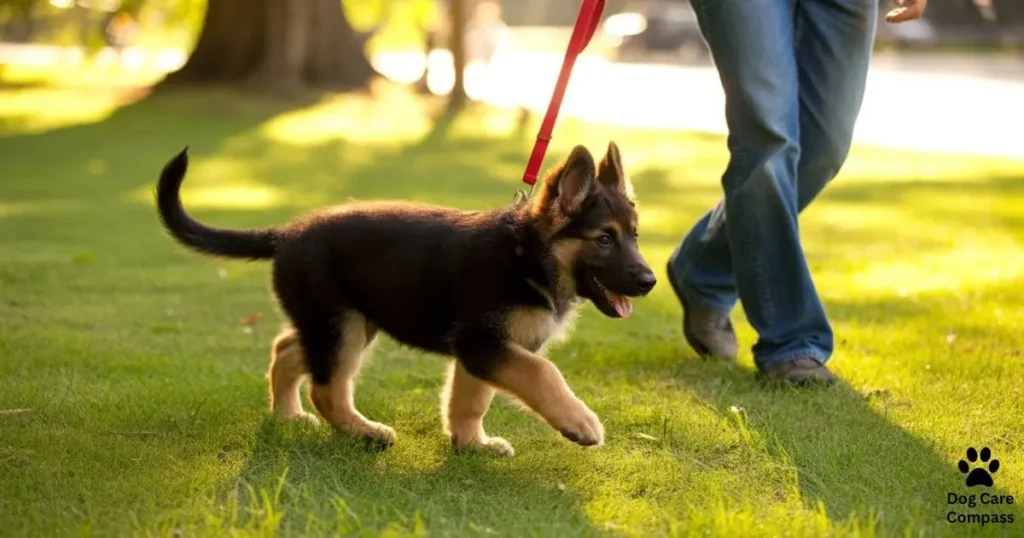
German Shepherds were originally developed in the late 1800s by Captain Max von Stephanitz with one clear goal — create the most capable working dog possible. Not the easiest dog, not the prettiest one. The most capable one. Every personality trait you see in your puppy today flows directly from that origin.
A German Shepherd puppy is alert, driven, deeply loyal, and built to work. Understanding these four traits together is what helps you make sense of your puppy’s daily behavior.
They bond intensely with their family. From the very first week in a new home, a GSD puppy begins forming a deep emotional attachment. They notice when you are upset. They want to be near you — not just in the same room, but physically close to you at all times.
They are always observing. Your puppy is not being suspicious when they stare at strangers or react to sounds. They are gathering information. This breed notices patterns faster than almost any other dog, which is exactly what makes them exceptional working dogs and so responsive to training.
They have a strong drive to do things. A bored German Shepherd puppy is a destructive one. This is not a character flaw — it is a breed trait that goes back generations. They need consistent mental and physical outlets to stay balanced.
They can be cautious around strangers. A GSD puppy that barks at an unfamiliar face is not being aggressive. They are being exactly who they were bred to be — watchful and protective. The solution is proper socialization, not punishment.
For a complete overview of the breed’s history and physical development alongside temperament, check out our German Shepherd Breed Detail Guide.
German Shepherd Puppy Behavior by Age: What to Expect and When
Puppy behavior does not stay the same — it shifts through distinct developmental stages. Knowing which stage your puppy is in completely changes how you should respond to their behavior.
| Age | Stage | What You Will See | What to Focus On |
|---|---|---|---|
| 0 – 3 weeks | Neonatal | Eyes and ears closed; fully dependent on mother | Warmth, feeding, leave to mother |
| 3 – 7 weeks | Transitional | First explorations; littermate play begins; eyes open | Gentle daily handling by humans |
| 7 – 12 weeks | Primary Socialization | Fear responses emerge; bonding to new family; highest learning receptivity in life | Positive exposure to everything — this window will not come again |
| 3 – 6 months | Testing & Ranking | Boundary testing; heavy mouthing; high curiosity | Consistent rules; basic obedience; redirect rather than punish |
| 6 – 14 months | Adolescence | Selective hearing; peak energy; may “forget” known commands | Patience; daily training reinforcement; structured exercise |
| 14 – 24 months | Maturation | Calmer and more focused; protective instincts solidify | Advanced training; continued socialization |
The window I want to emphasize most is 7 to 12 weeks. Neuroscience backs up why this matters so much — puppy brains during this period form neural connections faster than at any other point in their lives. Positive experiences during these weeks literally shape how your dog perceives the world for the rest of their life. Missing this window does not ruin your dog, but it does mean you will work significantly harder to achieve the same results later.
Socialization: The Single Most Important Thing You Will Do
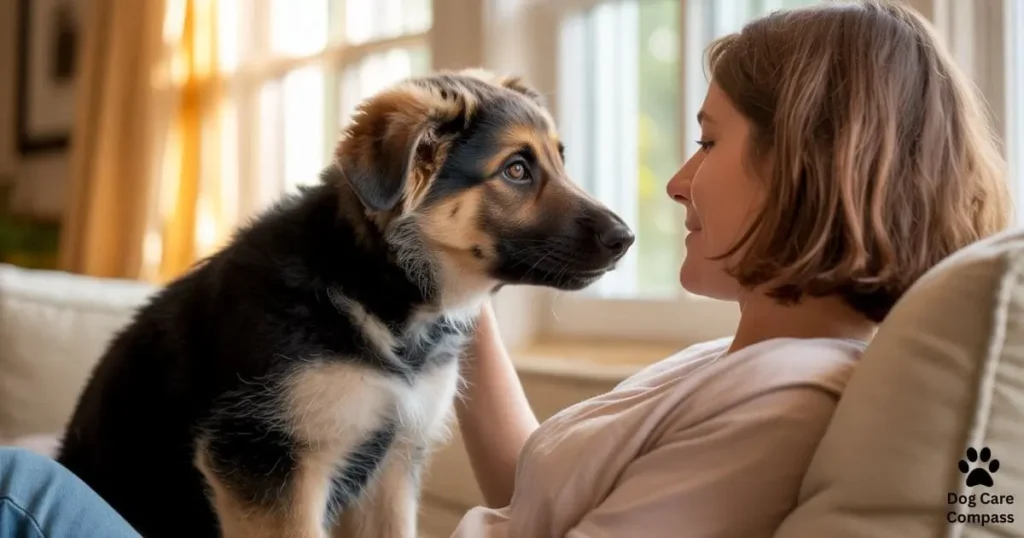
I want to be very direct here — socialization is not optional for a German Shepherd. It is the foundation everything else is built on. An under-socialized GSD is not just difficult to live with. They can become genuinely reactive and fearful in ways that are extremely hard to reverse.
Most people think socialization means letting your puppy meet other dogs. That is only a small part of it. True socialization means deliberately exposing your puppy to a wide variety of people, environments, sounds, and surfaces — always in a controlled, positive way — so they learn that new things are safe and interesting rather than threatening.
What Your GSD Puppy Should Encounter Before 14 Weeks
- Children of different ages — toddlers, school-age kids, teenagers
- Adults who look different — men with beards, people wearing hats or uniforms, people carrying umbrellas or bags
- Loud sounds like traffic, vacuum cleaners, doorbells, and thunderstorm recordings
- Different surfaces underfoot including grass, tile, gravel, sand, and metal grating
- Other calm and vaccinated dogs
- Cats and small animals under supervision
- Car rides, the vet’s office, and grooming tables
- Busy environments like parking lots, parks, and pet stores
The golden rule: Every new experience must be paired with something your puppy loves — a high-value treat, enthusiastic praise, or play. You are not just exposing them to new things. You are teaching them that new things predict good things. That is the difference between a properly socialized dog and one that was merely exposed to things.
What to Do When Your Puppy Shows Fear
This is where many owners go wrong. When a puppy backs away or tucks their tail, the instinct is to comfort them immediately. You pick them up. You say “it’s okay.” But soothing a fearful puppy actually reinforces the fear response — it tells your puppy there is something worth being afraid of.
Instead, stay calm and neutral. Do not push them toward the scary thing. Let them set the pace entirely. If they approach something on their own and nothing bad happens, that is a successful session — even if the interaction lasted three seconds.
Energy Levels and Exercise: Getting the Balance Right
German Shepherd puppies are high-energy dogs. But here is the nuance that most guides miss — you can actually over-exercise a GSD puppy, and the consequences are serious.
A puppy’s growth plates do not fully close until 18 to 24 months. Before that point, repetitive high-impact exercise on hard surfaces can damage developing joints. This matters especially for German Shepherds, who are already genetically predisposed to hip and elbow problems.
The guideline I follow is five minutes of structured exercise per month of age, twice daily. So a 10-week-old puppy needs about 10 to 12 minutes of structured walking twice a day. Everything else should be free play, exploration, and rest.
Safe Exercise Options for GSD Puppies
- Gentle leash walks on grass
- Short fetch sessions in the yard
- Training games — sit, down, recall — mentally exhausting and completely safe for joints
- Swimming, if your puppy takes to water
What to avoid: long runs, repetitive ball throwing on concrete, jumping on and off furniture, and sudden stops and direction changes on hard ground.
Mental exercise is just as important as physical exercise for this breed. A 15-minute training session can tire out a German Shepherd puppy faster than a 30-minute walk.
Diet directly affects your puppy’s energy and recovery too. If you are considering fresh food options, our guide on Homemade Food for German Shepherd Puppies gives you safe, practical options to consider.
Training a German Shepherd Puppy: What Actually Works
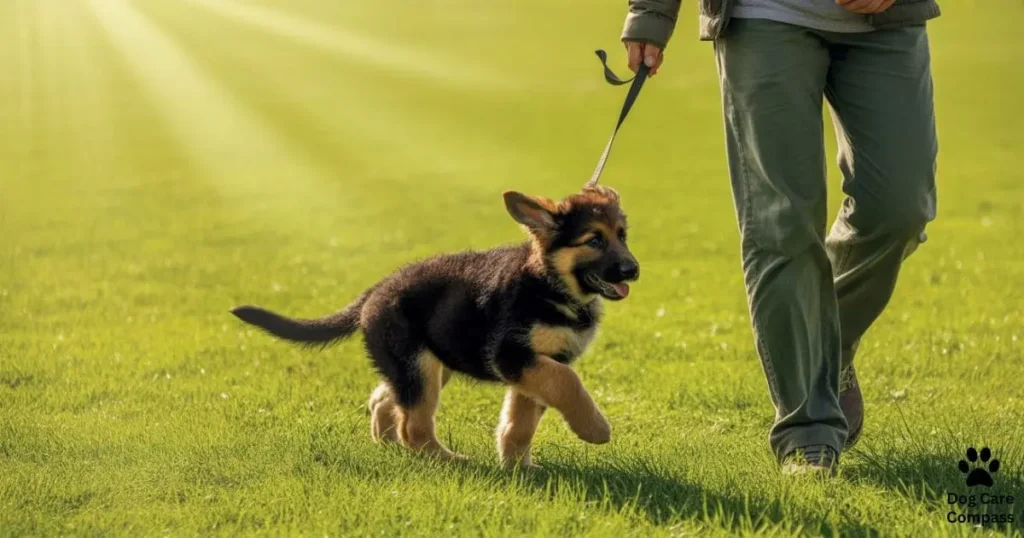
German Shepherds are among the most trainable dogs in the world. Stanley Coren’s research on canine intelligence ranks them third overall. They can learn a new command in as few as five repetitions and respond to a known command on the first try over 95 percent of the time.
But their intelligence works both ways. They learn good habits fast and they learn bad habits just as fast.
Positive Reinforcement Is the Only Method Worth Using
Correction-based training — collar corrections, physical punishment, intimidation — does not work well with German Shepherds. It damages trust. And a GSD that does not fully trust their owner is a dog that will not perform reliably when it actually matters.
Positive reinforcement works by marking the exact moment your puppy does something right and immediately rewarding it. The mark — a clicker sound or a sharp verbal “yes” — needs to happen within one to two seconds of the behavior. That precision is what makes the learning connect.
The Five Commands to Teach First
Sit — The gateway to every other command and the fastest way to interrupt unwanted behavior.
Stay — Builds impulse control, which is the single most valuable skill a high-drive dog can develop.
Come — The most important safety command you will ever teach. Practice it hundreds of times in low-distraction environments before you ever need it in a real situation.
Leave it — Critical for preventing dangerous ingestion and for stopping resource guarding behavior before it starts.
Down — Teaches a calm, settled posture and reinforces your leadership relationship with your puppy.
Keep Sessions Short and End on a Win
Ten minutes three times a day will always outperform one 45-minute session. When puppies lose focus, training stops working. End every session while your puppy is still engaged. Even if a session went badly, ask for something easy at the end — a simple sit — reward it enthusiastically, and stop there. Always finish on a success.
Common Behavioral Challenges and How to Handle Them
Mouthing and Nipping
Every puppy mouths — GSD puppies do it with particular enthusiasm. This is developmentally normal behavior that teaches bite inhibition. When your puppy bites too hard, give a sharp “ouch,” then withdraw all attention completely for 20 to 30 seconds. No eye contact, no talking, no reaction. Return calmly and redirect to an appropriate chew toy.
Never use your hands as toys. Never allow children to roughhouse with a GSD puppy using their hands. This directly reinforces the behavior you are working to eliminate.
Jumping Up
Ignore it completely. No eye contact, no pushing the dog down, no verbal correction — all of these are forms of attention and attention rewards the jumping. The moment all four paws touch the floor, reward immediately and enthusiastically. Every person who interacts with your puppy must do this consistently. One person who lets the jumping slide undoes weeks of training.
Excessive Barking
German Shepherds are natural alert dogs. Some barking is appropriate — it is part of what makes them excellent watchdogs. The goal is not to eliminate barking but to control it. Teach a “quiet” cue by waiting for a natural pause in the barking, saying “quiet” calmly, and rewarding the silence. Repeat consistently until the cue is reliable.
Separation Anxiety
Given how intensely this breed bonds, separation anxiety is a genuine risk. Prevention is far easier than treatment. Build alone-time tolerance from the very first week at home. Leave the room for 30 seconds, come back calmly, and repeat. Extend duration gradually over weeks. Provide a stuffed Kong or lick mat when you leave. Keep departures and arrivals completely calm — no dramatic goodbyes, no excited greetings.
If your puppy shows digestive upset from stress, our Vomiting in Dogs guide and Gut Health in Dogs guide explain what to watch for and when it requires a vet visit.
Destructive Chewing
A GSD puppy that is destroying your home is almost always under-stimulated — physically, mentally, or both. Before trying any behavioral fix, ask yourself honestly whether this puppy is getting enough exercise and enough training time. In most cases, increasing structured daily activity solves the chewing problem faster than any other intervention.
How Diet Affects German Shepherd Puppy Behavior
Most behavior guides skip nutrition entirely. That is a mistake. What your puppy eats has a direct effect on their energy stability, mood, and focus. A puppy fed poor-quality food with inconsistent blood sugar levels will be harder to train and harder to settle.
Protein quality matters. Feeding frequency matters — most GSD puppies under six months do better with three meals a day rather than two. Knowing which human foods are safe to add matters too. Our posts on Can Dogs Eat Papaya and Can Dogs Eat Raisins answer two of the most common questions I hear from German Shepherd owners who want to add variety to their puppy’s meals.
German Shepherd vs Other Large Breeds: Temperament Comparison
| Trait | German Shepherd | Belgian Malinois | Labrador Retriever | Rottweiler |
|---|---|---|---|---|
| Intelligence | Exceptional | Exceptional | High | High |
| Trainability | Very High | Very High | Very High | High |
| Energy Level | High | Extremely High | Medium-High | Medium |
| Family Adaptability | Excellent | Moderate | Excellent | Good |
| Protective Drive | High | Very High | Low | High |
| Best Suited For | Active families, working roles | Experienced handlers only | First-time owners | Experienced owners |
The German Shepherd sits in a unique position among large working breeds. More family-adaptable than the Belgian Malinois, more driven than the Labrador, and more versatile than the Rottweiler. That balance is exactly why they remain one of the most popular breeds worldwide.
To understand how your puppy’s domesticated behavior compares to their wild relatives, our piece on German Shepherd vs Wolf explores those differences in a way most GSD owners find genuinely eye-opening. And if you are curious about coat variations within the breed, the Long-Haired German Shepherd guide covers a coat type that looks completely different but shares identical temperament.
Frequently Asked Questions
Are German Shepherd puppies aggressive?
No. German Shepherd puppies are protective and alert by nature, but not aggressive. Aggression in a young GSD almost always has a root cause — fear, pain, poor socialization, or an owner who accidentally reinforced the behavior. A well-raised GSD is confident and friendly, not aggressive.
At what age do German Shepherd puppies calm down?
Most German Shepherds begin settling noticeably between 18 months and 3 years. The adolescent phase from 6 to 18 months is typically the most intense. Consistent daily training and adequate exercise during this period significantly accelerates how quickly your puppy matures.
Are German Shepherds good with children?
Yes — when properly socialized, German Shepherds are excellent family dogs. They are patient, gentle, and naturally protective of the children they grow up with. Supervised interactions and socialization with children from puppyhood set the foundation for a lifelong positive relationship.
How do I stop my GSD puppy from biting?
Give a sharp “ouch” when biting gets too hard, withdraw all attention for 20 to 30 seconds, then redirect calmly to a chew toy. Repeat every single time, consistently, with every person who handles the puppy. The behavior fades when your puppy learns that biting ends the fun.
Can German Shepherd puppies be left alone?
Yes, but you need to build up to it gradually from day one. Start with 30-second absences and increase slowly over weeks. Provide enrichment when you leave. Keep arrivals and departures calm. A crate introduced positively gives your puppy a secure space while you are away and significantly reduces anxiety.
Final Thoughts
German Shepherd puppy temperament is a remarkable combination of intelligence, loyalty, and drive. These dogs give everything they have — and they deserve owners who match that commitment.
Invest in early socialization during that critical window, stay consistent with positive training, provide the right amount of exercise for their age, and get through adolescence with patience rather than frustration. The German Shepherds that end up reactive or difficult are almost never born that way. They are shaped that way by a lack of guidance, socialization, or appropriate outlets for their energy.
Give your puppy what they need from the start, and you will raise one of the most extraordinary dogs you have ever known.