
German Shepherd Barking at Night: Why It Happens and How to Stop It
My German Shepherd started barking at 2am on a Tuesday for no reason I could identify. Windows closed. No one outside. Food bowl full. He just stood at the bedroom door and barked like the house was on fire.
Three nights of this and I was desperate for answers.
If you are here at an unreasonable hour searching for solutions — I understand completely. This guide covers every real reason German Shepherds bark at night and exactly what to do about each one.
Why is my German Shepherd barking at night? GSDs bark at night due to sounds outside, territorial responses, anxiety, insufficient exercise, medical discomfort, or boredom. Identifying the specific trigger is the first step — because the fix depends entirely on the cause.
Quick Answer
| Reason | How Common | Fix |
|---|---|---|
| Sounds outside | Very common | White noise, desensitization |
| Territorial response | Common | Training + management |
| Separation anxiety | Common | Gradual independence training |
| Insufficient exercise | Very common | More vigorous daily activity |
| Medical discomfort | Less common | Vet check |
| Boredom | Moderate | Mental stimulation |
| New environment | Temporary | Routine and patience |
| Age-related changes | Senior dogs | Vet assessment |
Why German Shepherds Bark More Than Most Breeds at Night
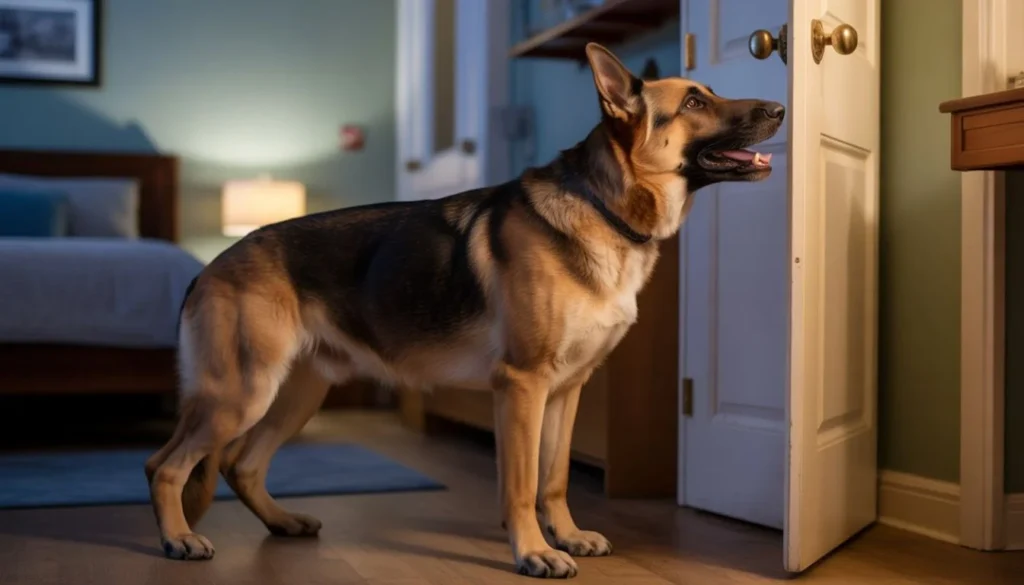
GSDs were bred to be alert, protective, and vocal.
Their hearing is significantly more sensitive than humans — they detect sounds at four times the distance we can. What sounds like silence to you is often a complex soundscape of distant cars, animals, and neighborhood activity for a German Shepherd.
Their protective instinct means they take perceived threats seriously. A sound that a Labrador ignores will often trigger a full alert response in a GSD.
Understanding this is not about excusing the behavior. It is about knowing that suppressing the bark without addressing the trigger produces temporary results at best.
8 Real Reasons Your GSD Barks at Night
1. Sounds Outside — The Most Common Cause
Distant traffic, other dogs barking, wildlife, neighbors arriving home late — German Shepherds hear all of it.
The alert bark in response to sound is deeply instinctive. The dog is not being difficult. It is doing its job.
The fix is not silence — it is helping the dog understand which sounds require a response and which do not.
2. Territorial Response to Movement
A car pulling into a neighbor’s driveway. Someone walking past. A cat crossing the garden.
GSDs have strong territorial instincts. Movement at the boundary of their perceived territory at night — when everything else is quiet — triggers a response that feels urgent to them.
3. Separation Anxiety
A GSD that is fine during the day but barks when left alone at night has a different problem entirely.
The barking is not about what they hear outside. It is about being separated from the owner. The bark is communication — “I am here, where are you?”
This requires a specific approach. The separation anxiety guide covers the graduated departure training that addresses this directly.
4. Insufficient Exercise — Very Underestimated
This is the cause owners most frequently overlook.
A German Shepherd that has not received sufficient vigorous exercise during the day has unspent physical and mental energy at night. That energy finds an outlet — often barking.
An adult GSD needs one to two hours of vigorous exercise daily. Not a casual walk. Actual vigorous activity — running, fetch, structured training.
A genuinely tired GSD sleeps through the night. An under-exercised GSD does not.
5. Boredom and Under-Stimulation
Physical tiredness is not the same as mental satisfaction.
A GSD that has run five kilometers but had no mental engagement is still a dog with an active mind looking for stimulation at night. Training sessions, puzzle feeders, and scent work address this component that exercise alone does not.
6. Medical Discomfort
A dog that suddenly starts barking at night after previously sleeping quietly may be in pain or physical discomfort.
Arthritis, digestive pain, urinary issues, and neurological changes can all produce nighttime restlessness and vocalization. This is particularly relevant for senior German Shepherds.
Any sudden onset of nighttime barking in a previously quiet adult dog warrants a vet check before assuming a behavioral cause.
7. New Environment or Change
A house move, a family member leaving, a schedule change, or a new pet in the household disrupts the routine that German Shepherds depend on for security.
Nighttime — when everything is quiet and the dog has nothing to focus on — is when that disruption is felt most intensely.
We covered how new household additions affect German Shepherd behavior in our jealous dog guide.
8. Age-Related Changes — Senior GSDs
Cognitive dysfunction syndrome — the canine equivalent of dementia — affects older dogs and produces disorientation, confusion, and vocalization at night.
A senior GSD that wanders, appears confused, and barks at nothing specific may be experiencing cognitive changes that benefit from veterinary assessment and management.
How to Stop German Shepherd Barking at Night

Fix 1 — Identify the Trigger First
Watch your GSD carefully for three nights before attempting any fix.
Note what triggers the barking. Is it a specific sound? A time of night? A location in the house? Movement outside?
Knowing the trigger determines the correct response. A GSD barking at outside sounds needs a different approach than one barking from anxiety.
Fix 2 — White Noise
For GSDs barking at outside sounds — white noise is one of the most immediately effective interventions.
A white noise machine or fan placed near the sleeping area reduces the contrast between the quiet house and the sounds outside. It does not eliminate what the dog hears — it reduces the abruptness of sounds that trigger the alert response.
Many owners report dramatic improvement within the first night of using white noise. It is the lowest-effort, highest-impact intervention for sound-triggered nighttime barking.
Fix 3 — Increase Daytime Exercise
If your GSD is not receiving one to two hours of vigorous daily exercise — increase this before trying anything else.
The improvement in nighttime barking from adequate exercise is often immediate and significant.
A thirty-minute addition of vigorous fetch or structured training in the late afternoon specifically produces better nighttime sleep than morning exercise alone.
Fix 4 — Mental Stimulation Before Bed
A puzzle feeder or Kong stuffed with food given thirty minutes before bed occupies the dog’s mind during the transition to sleep.
A dog that has been mentally engaged in the final hour before bed settles faster and stays settled longer than one that has been inactive since dinner.
Fix 5 — Desensitization to Trigger Sounds
For GSDs that bark at specific sounds — delivery trucks, other dogs barking, cars — systematic desensitization reduces the intensity of the response over time.
Play recordings of the trigger sound at very low volume during calm, positive activities. Reward calm behavior in the presence of the sound. Gradually increase volume over days and weeks.
This process takes time but produces permanent reduction in reactivity rather than temporary management.
Fix 6 — “Thank You” Command
Teaching a “thank you” or “enough” command gives the GSD permission to have alerted you — then a clear signal that their job is done.
When the dog barks at a sound:
- Acknowledge calmly — “good dog” or “thank you”
- Ask for a sit or down
- Reward the quiet behavior immediately
- Return to your activity
The dog learns that alerting is appropriate but sustained barking is not needed because you have acknowledged the warning.
Fix 7 — Location Management
Where the GSD sleeps matters.
A GSD sleeping near a street-facing window hears everything that passes. Moving the sleeping location to an interior room reduces sound exposure without any training required.
A dog sleeping in the same room as the owner also typically barks less than one left alone — the owner’s presence reduces the perceived need to vocalize alerts.
Fix 8 — Address Anxiety Separately
If nighttime barking is driven by anxiety rather than external sounds — the fixes above will not work.
Anxiety-driven barking requires graduated independence training and sometimes veterinary support. Anti-anxiety medication prescribed by a veterinary behaviorist can reduce baseline anxiety enough for behavioral training to take hold.
The same dietary principles that support anxious dogs apply here. A dog eating a clean, whole-food diet with adequate omega-3 fatty acids shows lower baseline anxiety than one eating a highly processed diet. The sensitive stomach diet covers nutritional support for anxious dogs alongside digestive health.
What Not to Do
Yelling at the dog to stop: Raises the household energy level. The GSD interprets it as you joining the alert. Barking typically increases.
Punishing the dog after the fact: Dogs do not connect delayed punishment to the bark. It creates confusion and anxiety without reducing the behavior.
Letting the dog outside when it barks: Teaches the dog that barking opens the door. Barking increases.
Covering the crate: For some dogs this helps. For GSDs with territorial instincts — not seeing what they are responding to sometimes increases anxiety rather than reducing it.
Breed Considerations — Long Hair GSD
Long Hair German Shepherds share the same vocal tendencies and alert instincts as standard coat GSDs.
The grooming requirements of the long coat are different — but the behavioral profile, exercise needs, and training approach are identical. Everything in this guide applies equally to long-haired GSDs.
The full care picture for this coat type is in our long hair GSD guide.
When to See a Vet
See a vet if:
- Sudden onset of nighttime barking in a previously quiet dog
- Barking accompanied by pacing, restlessness, or apparent disorientation
- Senior dog showing confusion alongside nighttime vocalization
- No behavioral intervention produces any improvement after four weeks
- Barking is accompanied by other behavioral changes — appetite loss, lethargy, or aggression
Frequently Asked Questions
Why does my German Shepherd only bark at night and not during the day?
Daytime activity and stimulation mask the triggers. At night when everything quiets, the GSD’s sensitive hearing picks up sounds that were masked during the day — and the protective instinct responds without the distraction of daytime activity.
How long will it take to stop the nighttime barking?
Sound-triggered barking often improves within days of white noise introduction and exercise increase. Anxiety-driven barking takes weeks to months of consistent graduated training. Medical causes require veterinary management timelines.
My GSD barks at nothing I can identify — what is happening?
GSDs are hearing things you cannot. What appears to be barking at nothing is almost always barking at something below human auditory threshold. White noise and desensitization training address this most effectively.
Can I use a bark collar on my German Shepherd?
Not recommended. Bark collars suppress the symptom without addressing the cause. They also damage the trust between dog and owner and can increase anxiety in sensitive breeds like GSDs. Positive training approaches produce more durable results.
Will my German Shepherd stop barking at night as it gets older?
Generally yes — well-exercised, well-trained adult GSDs typically bark less than adolescents. However, senior dogs may show increased nighttime vocalization from cognitive changes, which is a different issue.
My GSD barks at exactly the same time every night — why?
A consistent time suggests a predictable trigger — a regular vehicle, a neighbor’s routine, an animal that moves through the area at a specific time. Note what is happening outside at that exact time.
Final Summary
- German Shepherds bark at night due to sounds, territorial instinct, anxiety, insufficient exercise, or medical discomfort
- Identify the specific trigger before attempting any fix
- White noise is the fastest intervention for sound-triggered barking
- One to two hours of vigorous daily exercise reduces nighttime barking more reliably than any other single change
- Mental stimulation before bed helps dogs settle and stay settled
- Never yell — it increases arousal and worsens barking
- Sudden onset in an adult dog warrants a vet check before behavioral intervention
- Most cases improve significantly within two to four weeks of consistent management
Do this tonight: Move your GSD’s sleeping location away from street-facing windows and turn on a white noise machine or fan. If sound is the trigger — you will likely notice improvement by morning.
For more German Shepherd behavior and health guides, explore the complete library at dogcarecompass.com.