
Belgian Malinois Puppy Biting: Why It Happens and How to Stop It Fast
The first week with a Belgian Malinois puppy is unlike anything most dog owners have experienced before. These puppies do not just nip — they bite with purpose, persistence, and what feels like genuine enthusiasm for the activity. My hands looked like I had lost a fight with a rosebush by day three.
If you are dealing with a Malinois puppy that bites constantly, redirects every attempt at correction, and seems to treat your arm as a chew toy — this guide is specifically for you.
Belgian Malinois puppy biting is normal, expected, and manageable — but it requires a specific approach that works with the breed’s drive rather than against it. Generic puppy training advice often fails with Malinois because this breed is fundamentally different from the average family dog.
Quick Answer
| Question | Answer |
|---|---|
| Is Malinois puppy biting normal? | Yes — completely normal behavior |
| At what age does it peak? | 8 to 16 weeks — worst phase |
| When does it stop naturally? | 4 to 6 months with consistent training |
| Can it become aggression? | Only if mishandled — proper training prevents this |
| Most effective method? | Bite inhibition + redirection + impulse control |
Why Belgian Malinois Puppies Bite More Than Other Breeds
This is the question most owners need answered first — because understanding why changes how you respond.
Belgian Malinois were developed as working dogs with exceptionally high drive, sharp prey instincts, and mouths designed for gripping and holding. Every bite a Malinois puppy delivers is an expression of instincts that were selectively bred into the line for generations.
When a Malinois puppy bites your hand, it is not misbehaving. It is doing exactly what its genetics tell it to do. The bite is strong, the grip is persistent, and the puppy does not understand why you are upset — because from its perspective, it found something interesting to engage with.
This is different from a Labrador puppy that nips briefly and moves on. A Malinois puppy will grip, shake, and re-engage repeatedly. The intensity is higher, the persistence is greater, and the pain is more significant.
Understanding this shifts the entire training approach from correction to redirection and drive management.
The Three Types of Malinois Puppy Biting
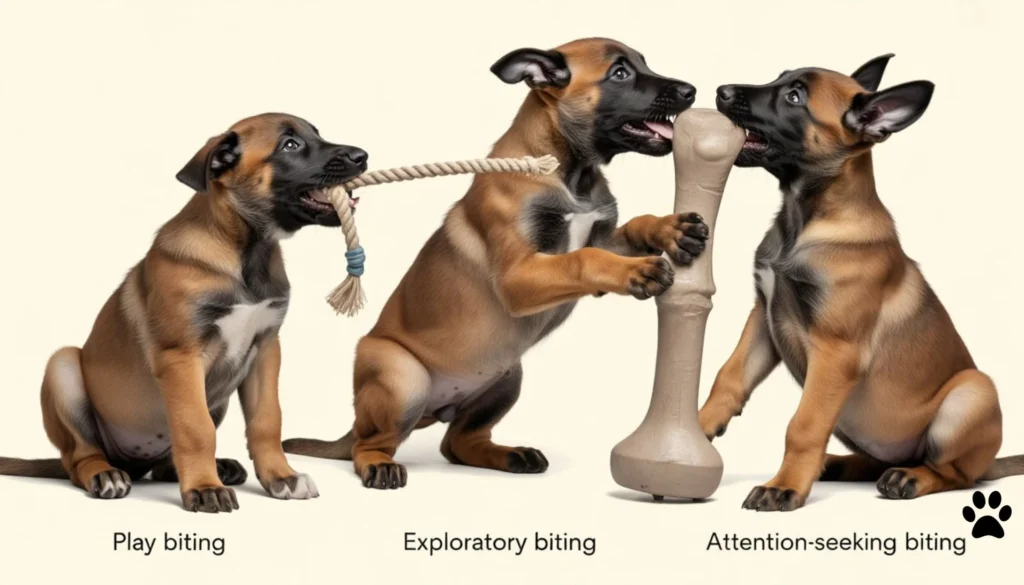
Not all biting is the same — and identifying which type you are dealing with determines the right response.
Play Biting
This is the most common type and the one most owners are dealing with. The puppy is excited, engaging, and using its mouth as its primary tool for interaction.
Signs it is play biting:
- Body is loose and wiggly
- Tail is wagging
- Puppy bounces back and re-engages after correction
- Biting is triggered by movement or excitement
Play biting responds well to redirection and bite inhibition training.
Teething Biting
Between 12 and 20 weeks, Malinois puppies go through intense teething. The discomfort drives them to bite anything firm that provides counter-pressure — which often means human hands and ankles.
Signs it is teething biting:
- More persistent and focused than play biting
- Puppy seeks out firm objects specifically
- Increased drooling alongside biting
- Slightly more intense than usual even for this breed
Teething biting responds best to appropriate chew toys and cold objects that relieve gum discomfort.
Overstimulation Biting
This is the most misunderstood type. A Malinois puppy that has been playing, handling visitors, or engaging intensely for too long crosses a threshold where self-regulation disappears entirely. The biting becomes frantic, the puppy cannot settle, and corrections make it worse.
Signs it is overstimulation:
- Biting is frantic and unfocused
- Puppy cannot settle even briefly
- Corrections escalate the behavior rather than reducing it
- Happens after long play sessions or busy environments
The only effective response to overstimulation biting is removing the puppy to a calm space and allowing them to decompress. Attempting to train through overstimulation produces zero results and frustrates both owner and puppy.
Why Standard Puppy Training Often Fails With Malinois
Most puppy biting advice — yelping like a hurt dog, time-outs, ignoring the behavior — produces inconsistent results with Malinois and sometimes makes things worse.
Yelping: Some Malinois puppies respond to yelping by escalating. The sound triggers prey drive rather than inhibiting it. Yelping works reliably with retrievers and spaniels. With Malinois, test it carefully — if the biting intensifies, stop immediately.
Ignoring: Malinois puppies do not interpret being ignored as feedback. They interpret it as a pause before the next engagement. Turning away and waiting rarely produces the extinction of behavior it produces in lower-drive breeds.
Punishment: Physical corrections on a Malinois puppy create two outcomes — a fearful dog or a more aggressive one. Neither is acceptable. Punishment-based approaches are particularly counterproductive with this breed’s temperament.
What works is working with the drive — giving it an appropriate outlet, teaching the puppy what to bite, and building impulse control through consistent positive reinforcement.
Step-by-Step Training — How to Stop Belgian Malinois Puppy Biting
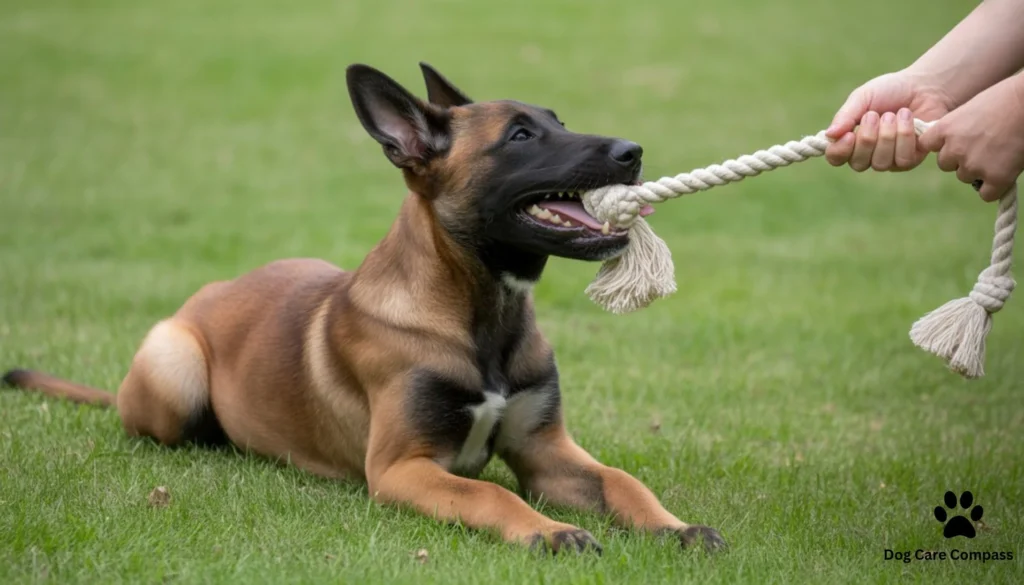
Step 1 — Teach Bite Inhibition First
Bite inhibition — teaching the puppy to control the pressure of its bite — is the foundation of everything else. A Malinois that has learned to modulate bite pressure is safer, more controllable, and easier to train in every other area.
How to do it:
- Allow the puppy to mouth your hand during play
- The moment pressure increases beyond comfortable — say “ouch” in a calm, flat tone and freeze completely
- Wait three to five seconds without moving
- Resume play
- Repeat every time pressure exceeds your threshold
- Gradually lower your threshold over weeks — what was acceptable last week becomes too hard this week
The goal is not to eliminate mouthing immediately — it is to teach the puppy that hard biting ends the game. This takes three to six weeks of consistent application.
Step 2 — Redirect to Appropriate Objects
Every time the puppy goes for skin, redirect immediately to an appropriate toy. The timing must be immediate — within one to two seconds of the bite.
Best redirection toys for Malinois puppies:
- Tug toys — long enough to keep hands away from teeth
- Rope toys — satisfying texture for gripping
- Kong toys stuffed with food — occupies the mouth with something productive
- Hard rubber chew toys — particularly useful during teething
The key is having a toy available at all times during interactions. A puppy that cannot find its toy will use your hand by default — not out of defiance but simply because it is the nearest available object.
Step 3 — Build Impulse Control Through Training
This is where Malinois training diverges most significantly from other breeds. Malinois have exceptional drives that need channeling — not suppressing.
Basic impulse control exercises:
Leave it: Hold a treat in a closed fist. Wait for the puppy to stop pawing and nosing. The moment it backs off — reward with a different treat. This teaches the puppy that backing off produces reward.
Wait: Ask the puppy to sit before any exciting thing happens — before meals, before walks, before play begins. Short waits of two to five seconds initially, gradually extending.
Settle: Place the puppy on a mat and reward any calm behavior. Build duration gradually. A Malinois that has a reliable settle command has the foundational self-regulation skill that makes everything else easier.
Ten to fifteen minutes of structured training twice daily produces noticeably calmer behavior — including reduced biting — within two to three weeks. Mental fatigue from training is as effective as physical exercise for reducing drive-based behaviors.
Step 4 — Manage Energy Levels
A Malinois puppy with unspent energy bites more. This is not complicated — it is simple drive management.
Age-appropriate daily exercise for Malinois puppies:
| Age | Daily Exercise |
|---|---|
| 8–12 weeks | 15–20 minutes gentle play |
| 3–4 months | 20–30 minutes structured activity |
| 5–6 months | 30–40 minutes — mix of play and training |
| 6+ months | 45–60 minutes — increasing intensity |
Do not over-exercise Malinois puppies before growth plates close — typically around 18 months. High-impact exercise like jumping and long runs causes joint damage that affects them for life. Mental stimulation through training produces the same calming effect with no physical risk.
Step 5 — Use Time-Outs Correctly
Time-outs work with Malinois — but the execution matters enormously.
Correct time-out protocol:
- Calm, neutral tone — no emotion, no drama
- Remove the puppy to a calm, boring space immediately after the bite
- Wait 60 to 90 seconds only — not longer
- Return the puppy and resume normal interaction
- Consistency across every household member — one person allowing biting while another corrects produces confusion
The time-out communicates that biting removes access to interaction. This is meaningful to Malinois because social engagement is highly rewarding to them.
Step 6 — Socialize Consistently
A Malinois puppy that is well-socialized — exposed to many different people, environments, sounds, and surfaces during the critical window — develops better bite inhibition naturally. Social confidence reduces anxiety-driven biting and improves overall impulse control.
Socialization also addresses the foundation of many long-term behavioral issues in this breed. A Malinois that was not adequately socialized as a puppy is significantly more likely to develop fear-based reactivity and aggression as an adult — something we covered in detail in the context of fear and anxiety in working breeds.
What Never to Do
These responses are common — and they make Malinois puppy biting significantly worse:
- Tapping or flicking the puppy’s nose — increases arousal and can trigger defensive biting
- Scruffing or alpha rolling — damages trust and creates fear-based aggression risk
- Yelling or reacting dramatically — high emotional response is exciting to high-drive puppies
- Allowing children to engage in rough play — Malinois puppies do not understand the difference between a child and an adult during high arousal
- Giving up on training after two weeks — this breed requires consistent months of work, not weeks
How Diet Affects Biting Behavior
This connection surprises most owners — but it is documented and relevant.
A Malinois puppy eating a high-quality, nutritionally balanced diet shows better impulse control and lower baseline arousal than one eating a diet high in fillers, artificial additives, and low-quality protein. The gut-brain connection in dogs is real — chronic gut irritation from poor diet quality presents as higher anxiety, reactivity, and reduced self-regulation.
For Malinois puppies specifically, a diet that supports healthy neurological development during the critical 8-to-20-week window contributes to calmer long-term behavior. The nutritional principles that support healthy development in Belgian Malinois puppies cover exactly what this breed needs at each growth stage.
Hydration also matters. A well-hydrated puppy regulates temperature and arousal more effectively than a dehydrated one. Fresh water available at all times is non-negotiable for high-drive breeds during training.
When to Get Professional Help
Most Malinois puppy biting resolves with consistent application of the steps above. These signs indicate professional behavioral guidance is needed:
- Biting that draws blood regularly despite consistent training
- Biting accompanied by growling and stiffening — not play signals
- Biting that has escalated rather than improved after 8 weeks of training
- Resource guarding alongside biting — food, toys, or space
- Biting directed specifically at children with no warning signals
A certified professional dog trainer with working breed experience — not generic puppy class experience — is the appropriate resource here. Malinois require trainers who understand drive-based training and have specific experience with protection and working breeds.
The Long-Term Picture — What Malinois Ownership Requires
Biting is the first challenge of Malinois ownership — not the last. This breed demands more consistent work, more mental engagement, and more structured activity than almost any other breed commonly kept as a pet.
Owners who approach this breed with a training mindset — committed to consistent daily work rather than occasional effort — discover one of the most rewarding dogs available. The same drive that makes puppyhood challenging makes adult Malinois exceptional companions for active, engaged owners.
The complete Belgian Malinois owner’s guide covers the full picture — temperament, training requirements, exercise needs, and what to expect at each life stage — for anyone committed to this breed for the long term.
Frequently Asked Questions
At what age do Belgian Malinois puppies stop biting?
With consistent training, most Malinois puppies reduce biting significantly by 4 to 6 months. Complete cessation of mouthing behavior typically occurs between 6 and 9 months as adult teeth are fully established and impulse control develops.
How many training sessions per day does a Malinois puppy need?
Two to three sessions of ten to fifteen minutes each is more effective than one long session. Malinois puppies learn fastest in short, high-intensity, positive sessions. Longer sessions cause fatigue and reduced responsiveness.
Can children live safely with a biting Malinois puppy?
Yes — but children must be supervised without exception during this phase. Children’s movements trigger prey drive, their reactions to biting often escalate arousal, and they are less equipped to apply consistent training responses. Management — not just training — is essential when children and Malinois puppies share a space.
Should I get a second dog to reduce biting?
Not recommended at puppy stage. A second dog often redirects the biting away from humans — but it does not teach bite inhibition or impulse control. These skills need to be trained directly regardless of whether another dog is present.
My Malinois puppy bites my ankles when I walk — what do I do?
Ankle biting is prey-drive behavior triggered by movement. Carry a tug toy at all times and redirect the moment you see the puppy focusing on your feet. Stopping movement entirely removes the trigger — then redirect to the toy before resuming walking.
Is my Malinois puppy aggressive or just playing?
Play biting in Malinois puppies involves a loose, wiggly body, wagging tail, and bouncy re-engagement after pauses. Aggressive biting involves a stiff body, hard stare, growling, and does not stop when the interaction pauses. If you are seeing the latter consistently — consult a professional.
Final Summary
- Malinois puppy biting is normal — the breed’s working drive makes it more intense than most breeds
- Identify the type of biting — play, teething, or overstimulation — before responding
- Bite inhibition training is the foundation — teach pressure control before stopping mouthing entirely
- Redirect every bite to appropriate toys immediately — timing is critical
- Build impulse control through daily structured training — ten to fifteen minutes twice daily
- Never use physical punishment — it creates fear or escalates aggression in this breed
- Manage energy appropriately — mental stimulation is as important as physical exercise
- Consistent application over weeks to months produces reliable results
Start today: Get a long tug toy. Every time your Malinois puppy goes for your hand — present the toy immediately. Do this consistently for one week and track whether the frequency of skin-biting reduces. That single change, applied consistently, produces measurable improvement faster than any other intervention.
For more Belgian Malinois guides covering training, nutrition, and behavior, explore the complete library at dogcarecompass.com.