My Dog’s Poop Went Soft After Changing Food — Here Is Exactly What Helped
I switched my Labrador Bruno to a new kibble on a Tuesday.
By Thursday morning I was standing in the garden staring at something that looked nothing like his usual firm, easy-to-pick-up stool.
Soft, shapeless, and clearly not right.
My first instinct was panic. My second instinct was to google everything at once. What I actually needed was a calm, clear explanation of why this happens and exactly what to do about it — step by step.
If your dog’s poop went soft after a food change — this guide is what I wish I had found that Thursday morning.
Also searching for: Dog diarrhea after food change what to do? How long does soft poop last after switching dog food? Dog loose stool new food? Dog upset stomach after food switch? — All covered below.
Dog Food Change Soft Poop — Quick Answer
Soft poop after changing dog food is very common and usually not dangerous.
It happens because the gut bacteria and digestive enzymes need time to adjust to a new protein source, fat level, and fiber profile.
What to do right now:
- Stop the new food temporarily
- Rest the gut for 12 to 24 hours — water only, no food
- Start a bland diet — plain boiled chicken and white rice
- Reintroduce food gradually using the 7-day transition schedule
- Add plain pumpkin or a probiotic to firm stools
If your dog is bright, drinking, and not vomiting — this is manageable at home.
🚨 Call your vet immediately if: Diarrhea is watery and constant · Blood in stool · Your dog is vomiting alongside loose poop · Lethargy or weakness · Puppy or senior dog with diarrhea lasting more than 24 hours
Why Does Food Change Cause Soft Poop in Dogs?
Bruno’s digestive system did not fail. It reacted — the way any gut reacts to sudden change.
A dog’s gut microbiome — the billions of bacteria living in the digestive tract — is calibrated to the specific food being eaten. Different proteins, different fat levels, different fiber sources — these all require different enzymes and different bacterial populations to digest efficiently.
When food changes suddenly, the gut microbiome needs time to adjust. Until it does, partially undigested food passes through faster than normal — producing soft, loose, or watery stool.
This is not illness. It is biology.
The speed and severity of the reaction depends on:
- How abrupt the switch was — overnight change vs gradual transition
- How different the new food is — same protein source vs entirely new ingredients
- Your dog’s individual gut sensitivity — some dogs handle changes easily, others are very reactive
- Fat content difference — higher fat in new food is one of the most common causes of digestive upset
Most healthy adult dogs recover within 3 to 5 days with proper management.
Step 1 — Stop and Assess First
Before doing anything — take 60 seconds to assess the situation clearly.
Check these things:
- Is your dog bright, alert, and acting normally?
- Is your dog drinking water?
- Is the stool soft but formed — or completely liquid?
- Any blood or mucus in the stool?
- Any vomiting alongside the soft poop?
- Is this a puppy, senior, or dog with a health condition?
If your dog is acting normally and the stool is soft but not watery — you are in manageable territory. Continue below.
If any of the warning signs above are present — call your vet before trying home management.
Step 2 — Rest the Gut (12 to 24 Hours)
The single most effective first step is giving the digestive system a complete rest.
Withhold food for 12 to 24 hours.
Do not withhold water — keep fresh water available at all times. Loose stool causes fluid loss, and dehydration is a real risk if water is also restricted.
For puppies: Do NOT fast for 24 hours. Puppies need calories to maintain blood sugar and cannot safely go without food for extended periods. For puppies — skip directly to the bland diet below and contact your vet for guidance.
Bruno spent one day on water only. By the next morning his gut had clearly settled — he was calmer, less gassy, and ready for a small bland meal.
Step 3 — Start the Bland Diet
After the gut rest period — introduce a simple, easily digestible bland diet.
This gives the digestive system something gentle to work with while the microbiome begins to restabilize.
The best bland diet for dogs:
| Protein | Carbohydrate | Ratio |
|---|---|---|
| Plain boiled chicken breast (no skin, no seasoning) | Boiled white rice | 1 part chicken : 2 parts rice |
| Plain boiled turkey breast | Boiled white rice | 1 : 2 |
| Boiled white fish (cod or tilapia) | Boiled white rice | 1 : 2 |
| Plain low-fat cottage cheese | Boiled white rice | 1 : 2 |
How to serve:
- Give 4 small meals spread across the day — not 1 or 2 large meals
- Each meal should be roughly half your dog’s normal meal size
- Serve at room temperature — not hot, not cold from the fridge
- No seasoning, no oil, no butter, no added ingredients of any kind
Continue the bland diet until your dog produces firm, well-formed stool — typically 2 to 3 days.
Step 4 — Add Plain Pumpkin to Firm Stools Faster
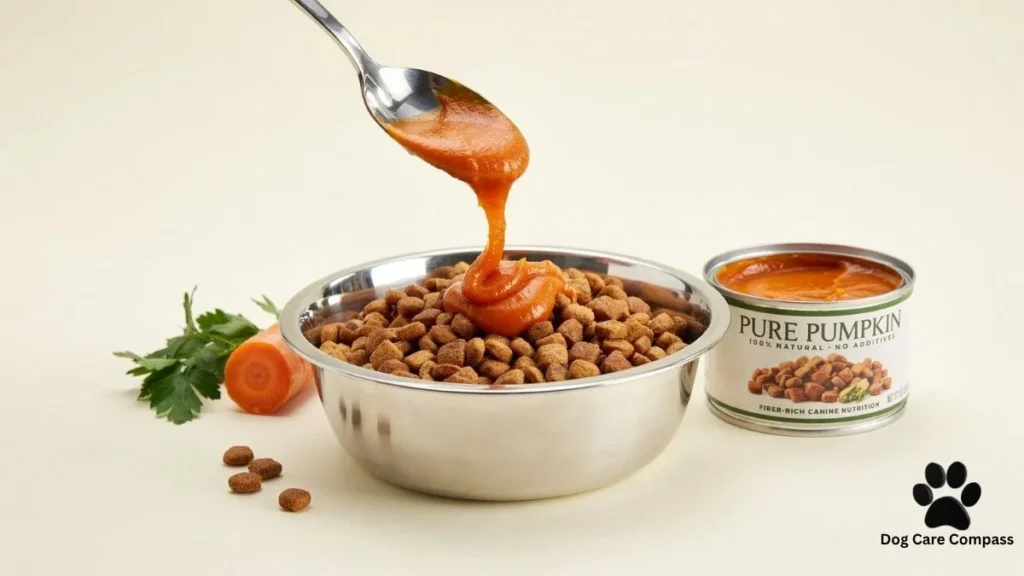
Plain canned pumpkin is one of the most effective and vet-recommended tools for firming soft stool in dogs.
It works because it is rich in soluble fiber — particularly pectin — which absorbs excess water in the gut and adds bulk to loose stool. It also feeds beneficial gut bacteria, helping the microbiome stabilize faster.
Dosage:
| Dog Size | Amount Per Meal |
|---|---|
| Small (under 10 lbs) | 1 teaspoon |
| Medium (10–35 lbs) | 1 tablespoon |
| Large (35–70 lbs) | 2 tablespoons |
| Extra large (70+ lbs) | 3 tablespoons |
Important: Use only plain canned pumpkin — not pumpkin pie filling, which contains sugar, spices, and additives that make digestive issues worse.
Add directly to the bland diet meals. Most dogs eat it happily mixed into chicken and rice.
I added pumpkin to Bruno’s second bland meal. Within one day his stool had firmed noticeably.
Step 5 — Add a Probiotic for Gut Recovery
A dog-specific probiotic accelerates the recovery of gut microbiome balance after a food change disruption.
Probiotics reintroduce beneficial bacterial strains that help digest the new food more efficiently — reducing the adjustment period from weeks to days in many dogs.
Options:
- Dog-specific probiotic supplement — Purina FortiFlora, Nutramax Proviable, or VetriScience Vetri Probiotic are commonly vet-recommended
- Plain yogurt — 1 teaspoon for small dogs, 1 tablespoon for medium, 2 tablespoons for large — plain, unsweetened, no xylitol
Add to bland diet meals for 5 to 7 days through the transition period.
Step 6 — The Correct 7-Day Food Transition Schedule
Once stool has firmed on the bland diet — begin the gradual transition to the new food.
This is the step most owners skip — and the reason the soft poop problem returns.
The gut microbiome needs at least 7 days to adjust to a new food. For sensitive dogs — 10 to 14 days is better.
7-Day Transition Schedule:
| Days | Old Food | New Food |
|---|---|---|
| Day 1–2 | 75% | 25% |
| Day 3–4 | 50% | 50% |
| Day 5–6 | 25% | 75% |
| Day 7 | 0% | 100% |
For sensitive dogs — extend to 10 to 14 days:
| Days | Old Food | New Food |
|---|---|---|
| Day 1–3 | 75% | 25% |
| Day 4–6 | 50% | 50% |
| Day 7–10 | 25% | 75% |
| Day 11–14 | 0% | 100% |
If soft stool returns during the transition:
- Drop back to the previous ratio — the one that produced firm stool
- Hold that ratio for 2 to 3 extra days before progressing again
- Slow the transition down — 14 days instead of 7
Do not push through if stool is loosening. The gut is telling you it needs more time.
What to Do If You Cannot Go Back to the Old Food
Sometimes the old food is unavailable — discontinued, recalled, or out of stock.
In that case, use the bland diet as the bridge instead of the old food.
Emergency transition schedule:
| Days | Bland Diet | New Food |
|---|---|---|
| Day 1–2 | 75% | 25% |
| Day 3–5 | 50% | 50% |
| Day 6–7 | 25% | 75% |
| Day 8+ | 0% | 100% |
This gives the gut a familiar, gentle base to transition from rather than jumping straight from nothing to a completely new food.
How Long Does Soft Poop Last After Changing Dog Food?
This is the question every owner asks — and the honest answer depends on what you do.
| Scenario | Expected Duration |
|---|---|
| Abrupt switch, no intervention | 5 to 14 days |
| Bland diet + gradual reintroduction | 3 to 5 days |
| Bland diet + pumpkin + probiotic | 2 to 4 days |
| Sensitive dog with slow transition | Up to 2 to 3 weeks |
| Wrong food for the dog — food intolerance | Does not fully resolve — vet assessment needed |
If soft stool persists beyond 5 to 7 days of proper bland diet management — the issue is likely not just transition. Something else needs to be investigated.
Signs the Soft Poop Is NOT Just a Food Transition Issue
Transition-related soft poop looks like a specific pattern.
It starts within 24 to 48 hours of the food change. It is soft but usually still formed. The dog is otherwise bright and eating. It gradually improves with bland diet management.
If the pattern looks different — something else may be going on.
See your vet if:
- Diarrhea is watery and completely liquid
- Blood — red or dark/tarry — in the stool
- Mucus in the stool without any blood
- Vomiting alongside loose stool
- Your dog is lethargic, weak, or not interested in food
- Soft poop started but your dog is also not drinking
- Symptoms in a puppy lasting more than 24 hours
- Symptoms in a senior or immunocompromised dog
- No improvement after 5 to 7 days of proper bland diet
These signs can indicate intestinal parasites, parvovirus, pancreatitis, bacterial infection, or an underlying health condition that needs diagnosis — not home management.
Common Mistakes That Make Things Worse
Switching back too quickly after firming. Dog firms up on bland diet → owner returns to 100% new food immediately → soft poop returns within a day. The bland diet firmed the stool. The gut microbiome has not actually adjusted yet. Always use the gradual transition schedule after the bland diet period.
Using human diarrhea medication. Products like Imodium (loperamide) can be dangerous for dogs — particularly certain breeds including Collies, Shelties, and Australian Shepherds, where a genetic mutation makes loperamide toxic. Never give human antidiarrheal medication without explicit veterinary instruction.
Adding too many new things at once. Pumpkin and probiotic together are fine. Adding pumpkin, probiotic, yogurt, a new topper, and a supplement all at once creates too many variables. Keep it simple — bland diet, pumpkin, and probiotic. That is all that is needed.
Ignoring the transition schedule entirely next time. Many owners learn from one bad experience and then repeat the same abrupt switch six months later. The transition schedule is not optional for sensitive dogs — it is the entire difference between 2 comfortable days and 2 miserable weeks.
Poop Consistency Guide — What You Are Looking At
| Stool Type | Appearance | What It Means |
|---|---|---|
| Ideal | Firm, log-shaped, easy to pick up | Healthy — no action needed |
| Slightly soft | Holds shape but softer than normal | Monitor — common during transition |
| Soft and mushy | No firm shape, difficult to pick up | Bland diet — start management |
| Liquid/watery | Completely liquid, no form | Call your vet — dehydration risk |
| With blood (red) | Fresh blood visible | Call your vet same day |
| Dark and tarry | Black, thick, foul-smelling | Emergency — possible internal bleeding |
| With mucus | Jelly-like coating on stool | Monitor — may indicate colitis |
| Yellow/orange | Unusual color alongside soft stool | Vet check if persisting |
Breed-Specific Sensitivity — Some Dogs Need Extra Care
Some dogs have genuinely more sensitive digestive systems than others — and breed plays a real role.
| Breed | Digestive Sensitivity | Recommended Transition |
|---|---|---|
| German Shepherd | Very high — prone to EPI and colitis | 14-day minimum transition |
| Labrador Retriever | Moderate — food-motivated, prone to overeating | 10-day transition |
| Border Collie | Moderate-high | 10-day transition |
| Poodle | Moderate — varies by individual | 10-day transition |
| Bulldog / French Bulldog | High — sensitive gut, prone to gas | 14-day transition |
| Golden Retriever | Moderate | 7 to 10 days |
| Husky | Moderate-high — raw protein often better tolerated | 10 to 14 days |
| Puppy (any breed) | High — gut still maturing | Always 14 days, vet guidance |
Preventing Soft Poop on Future Food Changes — The Checklist
- Always plan a minimum 7-day transition — 14 days for sensitive dogs
- Start with 25% new food, 75% old food on days 1 and 2
- Keep a small emergency supply of the old food for transitions
- Add plain pumpkin during any transition period — even when stool is firm
- Add a probiotic for 7 days during any food switch
- Weigh food portions rather than estimating by eye — overfeeding amplifies digestive upset
- If soft stool appears — slow down, do not push through
- Do not add toppers, treats, or new supplements during a food transition — one change at a time
Frequently Asked Questions
How long does soft poop last after changing dog food?
With proper bland diet management and gradual reintroduction — 2 to 5 days. Without any intervention — soft stool from an abrupt switch can last 5 to 14 days. If it lasts beyond 7 days of active management — see your vet.
Should I go back to the old food?
If soft stool is mild and the dog is otherwise well — you do not need to go back. Use the bland diet as a bridge and restart the transition more slowly. If symptoms are severe or the dog is unwell — yes, temporarily return to the old food while you consult your vet.
Can I add pumpkin to the new food directly instead of using a bland diet?
You can — but the bland diet gives the gut a more complete rest and typically produces faster recovery. Adding pumpkin to a dog still eating the food that upset them is helpful but less effective than the full bland diet approach.
My dog seems fine except for the soft poop — is that normal?
es — for a food transition reaction, the dog typically feels completely fine. They are eating, drinking, playing, and acting normally. Only the stool is affected. A dog that is also lethargic, not eating, or vomiting alongside the soft poop has a more serious situation that needs veterinary attention.
Final Summary
Dog food change causing soft poop is very common — the gut microbiome needs time to adjust to new ingredients
Immediate steps: rest the gut 12 to 24 hours (water only), then start bland diet — plain boiled chicken and white rice, 4 small meals per day
Plain canned pumpkin is one of the most effective tools for firming stool quickly — add to bland diet meals
Dog-specific probiotic accelerates gut microbiome recovery — use for 5 to 7 days during the transition
7-day transition schedule is essential — 25% new food days 1 to 2, 50% days 3 to 4, 75% days 5 to 6, 100% day 7 Sensitive dogs need 10 to 14 days — always slow down if stool loosens during the transition
Never use human antidiarrheal medication — it can be dangerous or toxic for dogs Soft stool should improve within 2 to 5 days with proper management — no improvement after 7 days means a vet visit is needed
Call your vet immediately if: watery diarrhea, blood in stool, vomiting alongside loose poop, lethargy, or a puppy/senior dog with symptoms lasting more than 24 hours If symptoms worsen at any point — stop home management and contact your veterinarian immediately

researching veterinary sources, scientific studies, and expert
guides to bring dog owners accurate, practical information. Every
article is written with care and reviewed against credible
veterinary references including ASPCA, AKC, and peer-reviewed
literature.
- Why Does My Dog Sleep So Much All of a Sudden? 8 Real Reasons - August 10, 2026
- How to Train a Dog to Stop Pulling Without Treats: This Method Works - August 5, 2026
- How to Train an Older Dog New Tricks (Even If They’ve Never Been Trained) - August 1, 2026