
German Shepherd Separation Anxiety: Signs, Causes, and How to Fix It
I had a colleague whose German Shepherd destroyed an entire couch while she was at work for three hours. Not chewed — destroyed. Cushions, frame, springs. When she came home, he was sitting in the middle of the wreckage wagging his tail like nothing had happened.
That dog did not have a behavior problem. He had separation anxiety — and nobody had recognized it until it reached that point.
If your German Shepherd howls when you leave, follows you from room to room, or causes damage when left alone, this guide covers exactly what is happening and what to do about it.
German Shepherd separation anxiety is one of the most common behavioral issues in the breed — driven by their intense loyalty, high intelligence, and deep attachment to their owners. It is manageable with the right approach, but it requires understanding before it can be addressed effectively.
Quick Answer
| Question | Answer |
|---|---|
| Is separation anxiety common in GSDs? | Yes — one of the most affected breeds |
| What causes it? | Deep bonding, under-stimulation, past trauma |
| Can it be fixed? | Yes — with consistent training |
| How long does it take? | Weeks to months depending on severity |
| Do I need a vet? | For severe cases — yes |
Why German Shepherds Are Prone to Separation Anxiety
German Shepherds bond intensely with their owners. This is one of the breed’s defining characteristics — the quality that makes them exceptional working partners, loyal family dogs, and deeply intuitive companions.
That same intensity makes them vulnerable to separation anxiety in a way that more independent breeds are not.
A GSD that has formed a deep attachment to its owner experiences genuine distress when that person leaves. This is not disobedience. It is not spite. It is a stress response driven by the same loyalty that makes the breed so valued.
Understanding this distinction changes everything about how owners respond — because punishment and correction are not just ineffective for separation anxiety, they actively make it worse.
Signs of Separation Anxiety in German Shepherds
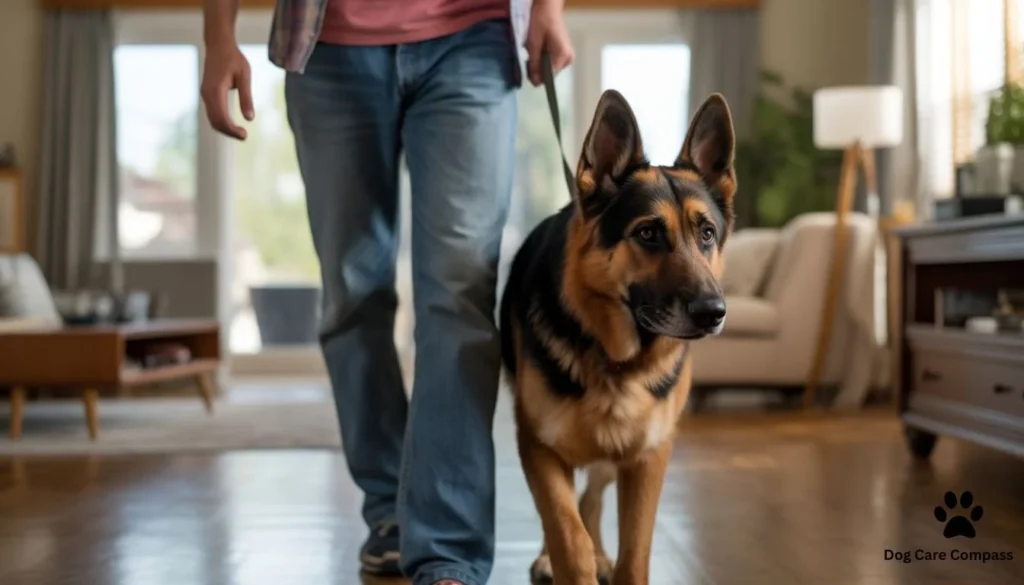
Separation anxiety presents differently in different dogs. These are the most common signs:
Before you leave:
- Follows you from room to room — called “shadowing”
- Becomes visibly anxious when you pick up keys or put on shoes
- Panting, pacing, or whining as departure cues appear
- Refuses to settle even when you are still home
While you are away:
- Howling, barking, or whining continuously
- Destructive behavior — chewing furniture, doors, window frames
- Attempting to escape — scratching at doors, breaking through barriers
- House soiling despite being house-trained
- Refusing to eat when alone
When you return:
- Extreme, prolonged greeting — beyond normal excitement
- Clingy behavior for extended period after return
- Visible relief that seems disproportionate to the time apart
The distinction between true separation anxiety and boredom-related destruction matters. A dog that destroys things selectively — targeting specific objects, causing damage in patterns — is more likely bored. A dog that causes damage specifically near exits, shows physical stress signs, and vocalizes continuously is showing genuine anxiety.
What Causes Separation Anxiety in GSDs
Insufficient Early Independence Training
Puppies that were never taught to be comfortable alone develop anxiety around solitude as adults. A GSD puppy that spent its first months constantly with its owner — working from home situations are particularly common here — never developed the emotional toolkit for managing time alone.
The puppy that follows you everywhere as a cute 10-week-old becomes the adult dog that cannot cope when you leave.
Major Life Changes
Separation anxiety often develops after significant disruptions — a change in the owner’s work schedule, a move to a new home, the loss of another pet in the household, or a change in family composition.
A GSD that coped well with being alone before a major change and suddenly cannot is responding to disrupted routine and perceived instability. Their attachment to their owner intensifies as the most reliable constant in a changed environment.
Rescue and Rehoming History
Dogs with histories of abandonment, multiple rehomings, or time in shelters develop hypervigilance around owner departures. Every departure triggers the same fear response — that this time the owner will not return.
Rescue GSDs require particularly patient and gradual independence training because the emotional history behind their anxiety is deeper than a puppy that simply was not trained for solitude.
Under-stimulation
A German Shepherd that does not receive adequate daily exercise and mental engagement has unspent energy and an active mind with nothing to focus on. When the owner leaves, that energy and mental activity have no outlet — anxiety fills the space.
This is the most addressable cause and the one that produces the fastest results when corrected. A genuinely tired, mentally satisfied GSD handles solitude significantly better than one whose needs have gone unmet.
How to Treat German Shepherd Separation Anxiety
Step 1 — Rule Out Medical Causes
Some behaviors that look like separation anxiety have medical components. A dog that soils the house when alone may have a bladder condition. A dog that vocalizes excessively may have pain-related anxiety.
A vet check before beginning behavioral treatment rules out physical contributions and opens the conversation about anti-anxiety medication for severe cases — which, for genuine separation anxiety, can make behavioral training dramatically more effective.
Step 2 — Desensitization to Departure Cues
Most anxious GSDs begin showing stress before the owner leaves — triggered by departure cues like picking up keys, putting on shoes, or reaching for a coat.
Desensitization works by disconnecting these cues from their meaning through repetition.
How to do it:
- Pick up your keys — then put them down and sit back down
- Put your shoes on — then take them off without leaving
- Pick up your bag — then unpack it
- Repeat these actions multiple times daily without actually leaving
Over days and weeks, the cues lose their predictive power. The dog’s anxiety response to these triggers gradually reduces.
Step 3 — Graduated Departures
This is the core of separation anxiety treatment — teaching the dog that departures are temporary and that being alone is safe.
Week 1:
- Step outside the door for 5 seconds — return calmly
- Repeat 10 times per day
- Gradually extend to 30 seconds, then 1 minute
Week 2:
- Build to 5 minutes, then 10 minutes
- Leave the property briefly — drive around the block
Week 3 onward:
- Gradually extend duration week by week
- Never jump ahead faster than the dog’s comfort allows
The critical rule — always return before the dog reaches full anxiety. You are teaching the dog that you always come back. Returning to a dog that is already in full panic mode reinforces the anxiety rather than reducing it.
Step 4 — Create a Safe Space
A designated comfortable space — a crate the dog has been trained to love, or a specific room with familiar bedding and scent — gives anxious dogs a physical anchor during alone time.
Crate training done correctly produces a dog that chooses its crate voluntarily because it associates it with safety and calm. A crate that was used as punishment produces the opposite — a dog that panics when confined.
Building positive crate associations takes time but produces a genuinely useful tool for managing separation anxiety long-term.
Step 5 — Exercise Before Departures
A German Shepherd exercised thoroughly before being left alone is physically tired and neurologically calmer than one that has been sitting in the house since morning.
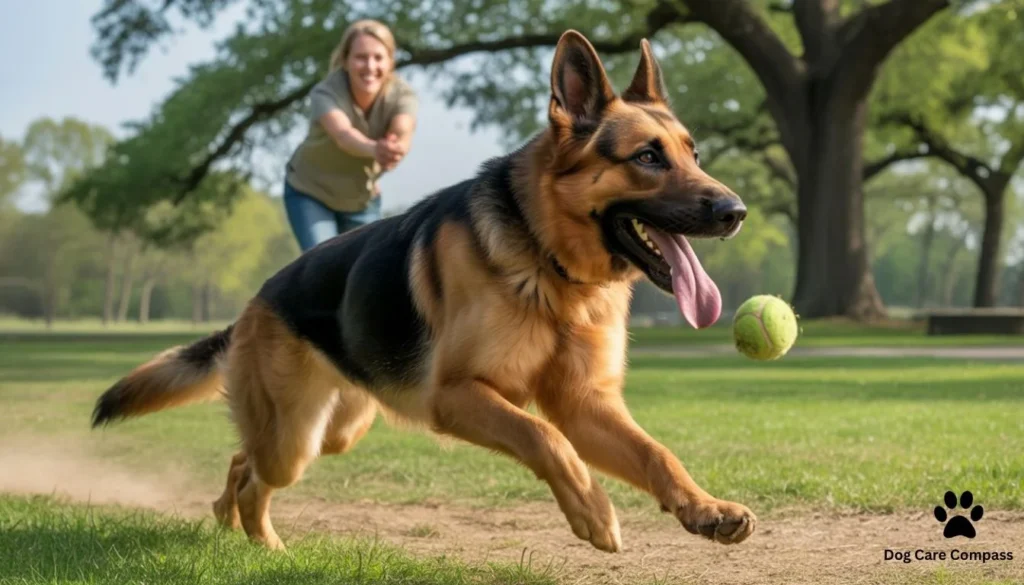
Thirty to forty-five minutes of vigorous activity — not a casual walk — before planned alone time reduces the intensity of anxiety responses significantly. The combination of physical tiredness and post-exercise neurological calm creates the best possible conditions for the dog to settle.
This single change — consistent vigorous exercise before departures — produces measurable behavioral improvement faster than almost any other single intervention.
The broader relationship between exercise, mental stimulation, and behavioral calm in German Shepherds is something we explored fully in our GSD calm down guide.
Step 6 — Mental Stimulation Before Leaving
A stuffed Kong, a puzzle feeder, or a long-lasting chew given immediately before departure gives the dog a task that occupies the first critical minutes of alone time — the period when anxiety peaks.
A dog focused on working out a food puzzle is not focused on the departure. By the time the puzzle is finished, the acute anxiety response has typically passed its peak.
Rotate enrichment options to maintain novelty — a Kong stuffed with the same thing every day loses its power to engage quickly.
Step 7 — Avoid Dramatic Departures and Returns
Owners with anxious dogs often develop elaborate goodbye rituals — long fussing, prolonged reassurance, emotional farewells. These rituals communicate to the dog that departure is a significant event worth being anxious about.
Calm, matter-of-fact departures — no fussing, no prolonged goodbye — produce less anxiety than emotional ones. The same applies to returns — greet the dog calmly, wait for them to settle before giving attention, rather than matching their frantic excitement.
This feels counterintuitive. It is also one of the most consistently effective changes owners can make.
Diet and Separation Anxiety — The Connection

A German Shepherd eating a high-quality, nutritionally balanced diet shows lower baseline anxiety than one eating a diet high in processed ingredients and artificial additives.
The gut-brain connection in dogs is documented and relevant to behavioral conditions including anxiety. Chronic low-grade gut inflammation — often driven by poor diet quality — increases baseline cortisol levels and reduces the dog’s capacity to manage stress effectively.
For GSD owners managing separation anxiety alongside digestive sensitivity, the dietary foundation matters. A dog whose gut is chronically irritated is harder to calm behaviorally than one whose physiology is well-supported. The nutritional approach for GSD puppies establishes the dietary foundation that supports healthy neurological development — and the behavioral stability that comes with it.
Certain nutrients support anxiety management specifically — omega-3 fatty acids reduce neurological inflammation, B vitamins support neurotransmitter production, and magnesium supports the nervous system’s capacity to regulate stress responses. These are all available through whole-food diets rather than supplementation alone.
When to Involve a Professional
Self-directed treatment works for mild to moderate separation anxiety. These signs indicate professional help is needed:
- Dog causes significant property damage or self-injury during alone time
- Anxiety has not improved after 8 weeks of consistent graduated departures
- Dog cannot be left alone for even 30 seconds without full panic response
- Separation anxiety is accompanied by aggression toward the owner on return
- Owner’s schedule does not allow the frequency of practice sessions required
A veterinary behaviorist — not a general trainer — is the appropriate resource for severe separation anxiety. Veterinary behaviorists can prescribe medication alongside behavioral modification, which for genuine separation anxiety produces significantly better outcomes than behavioral work alone.
Anti-anxiety medication does not sedate the dog or solve the problem — it reduces baseline anxiety enough that behavioral training can actually take hold. Think of it as creating the conditions for learning rather than replacing the learning.
Some respiratory issues in dogs can also be influenced by diet and environmental triggers. If you’re reviewing what your dog eats, it helps to know which fruits are safe for dogs. Our guide on what fruits dogs can eat safely explains healthy fruit options and which ones to avoid.
Breed-Specific Comparison
German Shepherds and Belgian Malinois both show high rates of separation anxiety — driven by the same intense owner bonding and working drive that defines both breeds.
The difference is in how the anxiety typically presents. GSDs tend toward destructive behavior and vocalization. Malinois tend toward frantic, high-energy pacing and escape attempts — reflecting their higher drive and more intense physical expression of stress.
The treatment approach is the same for both breeds — graduated departures, enrichment, exercise, and consistency. The Malinois typically requires more intensive exercise intervention and more rigorous mental stimulation as part of the protocol.
Frequently Asked Questions
Is separation anxiety the same as boredom in German Shepherds?
No — though they can look similar. Boredom produces selective, often goal-directed destruction. Separation anxiety produces damage concentrated near exits, continuous vocalization, and physical stress signs. A camera pointed at your dog while you are away tells you which you are dealing with.
Will getting a second dog help separation anxiety?
Sometimes — if the anxiety is primarily social and the dog bonds well with the new companion. It does not help if the anxiety is specifically about the owner rather than about being alone in general. Introducing a second dog is not a guaranteed solution and should not be the first intervention.
Can separation anxiety develop suddenly in an adult GSD?
Yes — triggered by major life changes, loss of a companion animal, change in owner’s schedule, or illness. Sudden onset in a previously stable adult dog warrants both a vet check and a review of recent changes in the household.
My GSD follows me everywhere at home — is that separation anxiety?
Shadowing is a precursor behavior rather than separation anxiety itself. A dog that follows everywhere is showing the hyperattachment that predisposes to separation anxiety. Working on independence at home — encouraging the dog to settle in a different room while you are present — addresses the foundation before it becomes a problem.
How long does it take to treat GSD separation anxiety?
Mild cases improve noticeably within 4 to 6 weeks of consistent graduated departure training. Moderate cases typically require 3 to 4 months. Severe cases may require 6 months or longer — particularly when medication is part of the protocol.
Should I punish my GSD for destruction caused by separation anxiety?
Never. The dog is not acting out of spite — it is expressing genuine distress. Punishment on return makes the anxiety worse by adding fear of the owner’s return to an already anxious dog. It also does not occur close enough to the behavior to function as meaningful feedback.
Final Summary
- German Shepherd separation anxiety is driven by the breed’s intense loyalty and bonding — not disobedience
- Signs include shadowing, departure cue anxiety, destructive behavior, and excessive greeting
- Graduated departure training is the core treatment — start with seconds and build slowly
- Exercise thoroughly before planned alone time — physical tiredness reduces anxiety intensity
- Mental enrichment immediately before departure occupies the critical first minutes of alone time
- Avoid dramatic departures and returns — calm and matter-of-fact reduces anxiety faster
- Diet quality influences baseline anxiety — a well-nourished GSD manages stress better
- Severe cases benefit from veterinary behaviorist involvement and possible medication
Start today: Set up a camera to watch your GSD while you step outside for two minutes. What you see tells you the severity of what you are dealing with — and gives you the baseline to measure improvement against as training progresses.
For more German Shepherd behavior and health guides, explore the complete library at dogcarecompass.com.
Pingback: German Shepherd Barking at Night? 8 Real Reasons and Fast Fixes - Dog Care Compass