

You just brought home a Belgian Malinois puppy — one of the most energetic, sharp-minded, and physically demanding dog breeds in existence. Congratulations. Now comes the real question every new Mal owner eventually asks: what should I actually feed this dog? It sounds simple. It isn’t. Most people walk into a pet store, grab the first bag labeled “puppy food,” and call it a day. With most breeds, that’s fine.
With a Belgian Malinois, it’s a recipe for joint problems, low energy, and a puppy that never hits its full potential. These dogs aren’t built like a Beagle or a Golden Retriever. They’re wired for work, built for endurance, and growing at a pace that demands precise nutrition — not guesswork. This guide covers everything you need to know about choosing the right dog food for Belgian Malinois puppy: what nutrients they need, which ingredients to avoid, how much to feed at every growth stage, and what actually works based on real-world experience.
What Makes Belgian Malinois Puppies Nutritionally Different?
Belgian Malinois aren’t your average puppy. They were bred for high-stakes tasks — police work, military operations, search and rescue, personal protection. Even at eight weeks old, your Mal pup is already wired for intensity. They explore more aggressively, play harder, and burn through calories faster than most breeds their size. This high metabolic rate means their nutritional needs are legitimately different. A standard puppy food formula, calibrated for average activity levels, often misses the mark for a working-breed pup.
You’re not feeding a companion dog — you’re fueling a high-performance machine that’s still under construction. There’s another factor that trips up a lot of owners: bone growth speed. Malinois puppies grow fast. Too much calcium or an imbalanced phosphorus-to-calcium ratio during this growth phase can cause developmental orthopedic disease — a painful and sometimes permanent joint condition. So feeding more isn’t the answer. Feeding right is.
Core Nutrients Your Belgian Malinois Puppy Actually Needs

Every decision you make about your puppy’s diet comes down to whether it’s delivering the right building blocks. Here’s what matters most:
Protein: The Foundation of Everything
Your Malinois pup needs a minimum of 28 to 32% crude protein in their diet. And it must come from real, named animal sources — chicken, beef, lamb, salmon. Not soy. Not corn gluten. Not “meat meal” with no origin specified. If the first ingredient on the bag isn’t a named animal protein, that food doesn’t belong in your Mal’s bowl.
Protein isn’t just for muscle. It fuels organ development, immune function, and the nervous system. For a breed known for its near-supernatural intelligence and drive, protein quality directly affects cognitive development too.
Healthy Fats and DHA
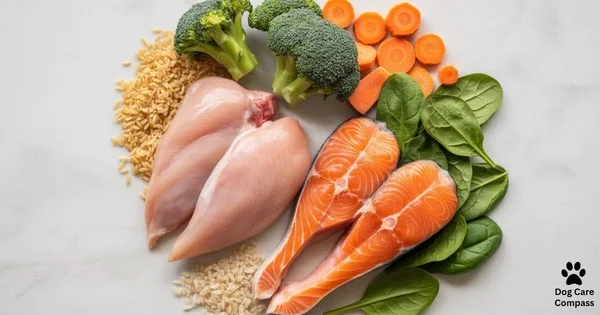
Fat often gets a bad reputation, but for a Belgian Malinois puppy, it’s essential. Aim for around 15 to 18% fat content in puppy food. More importantly, look for DHA — an omega-3 fatty acid found in fish oil — listed specifically on the label. DHA supports brain development and has been shown to improve trainability in puppies. For a breed you’ll likely be training intensively, this matters more than most owners realize.
Calcium-to-Phosphorus Ratio
This is where most general puppy foods fail Malinois owners. The ideal calcium-to-phosphorus ratio for a growing large-breed puppy is approximately 1.2 to 1. Too much calcium accelerates skeletal growth and can lead to joint deformities. Large-breed specific puppy formulas control this ratio precisely — general puppy food often doesn’t.
Joint Support: Start Early
Glucosamine and chondroitin aren’t just for old dogs. Belgian Malinois are incredibly athletic, and their joints take stress from day one. Foods that source these compounds naturally — from chicken meal, green-lipped mussels, or fish — give growing joints a meaningful head start.
How to Pick the Best Dog Food for Belgian Malinois Puppy
Walk into any pet store and you’ll face a wall of options. Most of them aren’t right for your Malinois puppy. Here’s how to filter quickly and confidently. First, always check the AAFCO nutritional adequacy statement on the packaging. It should clearly state “complete and balanced for growth” or “all life stages.” Without this statement, you don’t actually know if the food meets minimum nutritional standards. Second, choose a large-breed puppy formula — not a general puppy formula, and certainly not an adult formula. Large-breed puppy foods are formulated specifically for controlled bone growth, which is exactly what your fast-growing Malinois needs. Small-breed puppy food is often too calorie-dense and calcium-heavy for them.
Third, read the first three ingredients. These tell you almost everything. You want deboned chicken, salmon, or beef in the top slot. Avoid foods where corn, wheat, or unnamed by-products show up early in the list. Those ingredients pad the formula without contributing meaningful nutrition. Finally, look for foods with omega-3 sources listed (fish oil, flaxseed) and natural preservatives like vitamin E or vitamin C. Avoid BHA, BHT, and ethoxyquin — synthetic preservatives with a questionable safety record.
Ingredients to Seek and Ingredients to Skip

Reading a dog food label shouldn’t feel like decoding a chemistry textbook. Here’s a practical breakdown of what’s genuinely useful versus what’s just filler — or worse, harmful.
Seek these ingredients:
- Deboned chicken, beef, salmon, or lamb as the first ingredient
- Chicken meal or fish meal — concentrated, high-protein sources
- Brown rice, sweet potato, or oats as digestible carbohydrate sources
- Fish oil or flaxseed for omega-3 fatty acids
- Dried chicory root or inulin
- prebiotic support for gut health
- Mixed tocopherols or ascorbic acid as natural preservatives
Ingredients to Actively Avoid
Some ingredients have no place in a Malinois puppy’s food — full stop.
- BHA, BHT, ethoxyquin — synthetic preservatives with potential health risks
- Artificial colors: Red 40, Yellow 5, Blue 2 — completely unnecessary
- Generic “animal fat” without a named source
- Soy protein as the primary protein source
- Corn syrup or any added sugars
- Excessive sodium — more than 0.3% is unnecessary for puppies
A useful rule: if the ingredient list reads like a chemistry exam and you can’t identify half the items, walk away. Good dog food is made from things you recognize.
Feeding Schedule and Daily Portion Guide
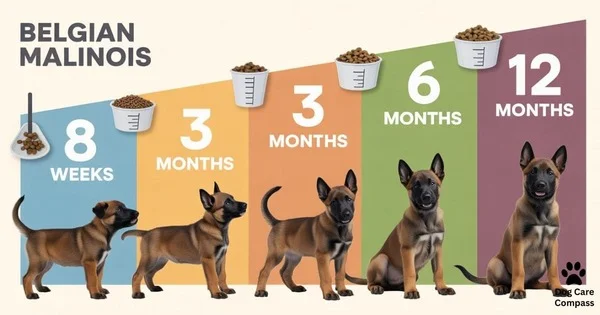
One of the most common mistakes Belgian Malinois owners make is either free-feeding or guessing portion sizes. Both lead to problems. Overweight puppies develop joint stress. Underweight ones lack energy for development.
Structure is everything with this breed. Use this schedule as your baseline, then adjust based on your puppy’s body condition. You should be able to feel their ribs without pressing hard, but not see them clearly.
| Age | Meals Per Day | Daily Amount | Key Focus |
| 8 – 12 weeks | 4 | 1 – 1.5 cups | Frequent small meals, gut development |
| 3 – 6 months | 3 | 1.5 – 2.5 cups | Bone and muscle building phase |
| 6 – 9 months | 2 – 3 | 2 – 3 cups | Energy demands increase with training |
| 9 – 12 months | 2 | 2.5 – 3.5 cups | Transitioning toward adult metabolism |
| 12+ months | 2 | 3 – 4 cups | Begin switching to adult large-breed food |
These amounts assume a food with approximately 380 to 400 kcal per cup. Always check your specific brand’s feeding guidelines — caloric density varies significantly between formulas.
Dry vs Wet vs Raw Food — An Honest Comparison
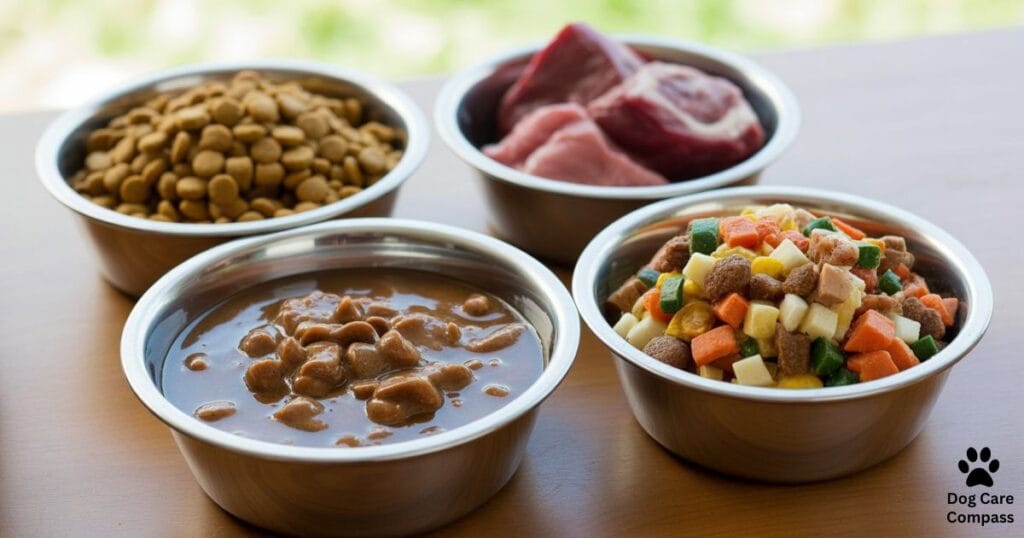
The debate between kibble, wet food, and raw diets is one of the most heated topics in the dog owner community. For Belgian Malinois puppies specifically, here’s a straightforward breakdown of each option.
| Food Type | Pros | Cons | Best For |
|---|---|---|---|
| Dry Kibble | Convenient, cost-effective, supports dental health | Lower moisture, some brands use fillers | Most owners — reliable and practical |
| Wet / Canned Food | High moisture, highly palatable, easy to eat | Expensive, doesn’t clean teeth, lower protein density | Picky puppies or supplementing kibble |
| Raw (BARF) Diet | Mimics ancestral diet, high bioavailability, shiny coat | Requires careful balancing, bacterial risk, expensive | Experienced owners with vet guidance |
| Fresh / Cooked Food | Human-grade ingredients, highly digestible | Time-consuming to prepare, costly at scale | Owners with flexibility and time |
For the majority of Belgian Malinois owners, a high-quality dry kibble large-breed puppy formula supplemented with a daily dose of fish oil covers all the bases. It’s nutritionally complete, easy to portion, and practical for busy households. If you want to explore raw feeding, consult a canine nutritionist first — an unbalanced raw diet does more harm than quality kibble.
Common Feeding Mistakes Belgian Malinois Owners Make
Even experienced dog owners slip up with this breed. Here are the most frequent feeding mistakes — and straightforward ways to avoid them.
Switching food too fast
Belgian Malinois have sensitive digestive systems. Any transition to a new food should happen over 7 to 10 days, gradually increasing the ratio of new food to old. Skip this step and you’re looking at vomiting, loose stools, and a genuinely uncomfortable puppy.
Overfeeding because they seem hungry
Malinois will eat whatever you put in front of them. They’re not good self-regulators as puppies. If you rely on their appetite as a guide, you’ll almost certainly overfeed them. Stick to the portion schedule and resist those big expressive eyes.
Skipping the large-breed puppy formula
Many owners pick up whatever puppy food is on sale, assuming all puppy food is roughly equivalent. For Malinois, this shortcut often surfaces months later as joint problems or uneven bone development. The extra cost of a breed-appropriate formula is worth every penny.
Ignoring treat calories during training
Malinois are working dogs and most owners train them frequently using treats as rewards. That’s great — but treats add up fast. Keep treat calories under 10% of daily intake and factor them into daily portions.
Feeding too close to exercise
Belgian Malinois are prone to bloat if fed right before or after intense activity. Always leave at least 60 to 90 minutes between meals and vigorous exercise sessions.
Real Experience: What Actually Worked With My Belgian Malinois
When I brought home my first Belgian Malinois — a male I named Ajax — I made nearly every feeding mistake possible. I bought a popular brand of general puppy food based on marketing, not ingredients. For the first two months, Ajax had intermittent loose stools, low energy after training, and a coat that lacked any real shine. My vet called it “adequate nutrition.”
I wanted better than adequate. After switching him to a large-breed puppy formula with salmon as the first ingredient and controlled calcium levels, the difference was visible within three weeks. His stools firmed up almost immediately. His coat developed a genuine luster. And during our evening training sessions, he had a second gear I hadn’t seen before — the kind of sustained focus that makes Malinois genuinely extraordinary to work with. I also added half a teaspoon of pure fish oil to his kibble daily.
His obedience trainer commented on his focus and actually asked what I had changed in his diet. Whether that’s the DHA doing its job or coincidence, the results spoke for themselves. Ajax is now three years old, competing in protection sports, and his vet consistently praises his joint health and muscle condition. I credit a lot of that to getting the foundation right in that first year. The right dog food for Belgian Malinois puppy isn’t glamorous — but it matters more than most owners ever realize.
Transitioning From Puppy to Adult Food
Belgian Malinois reach physical maturity later than smaller breeds — typically between 12 and 16 months. Don’t rush the transition to adult food. Switching too early cuts off the nutritional support your pup still needs for bone density and muscle development. When the time does come, follow a gradual 7 to 10 day transition. Start with 25% new food mixed with 75% puppy food for the first three days, then 50/50 for three more days, then 75% adult food, and finally 100% by day ten.
Monitor stool quality and energy levels throughout — these are your best real-time indicators. Choose an adult food formulated for active or working breeds. Belgian Malinois in regular training or working roles have higher protein and caloric needs than the average sedentary pet. A standard adult maintenance formula often undersupports them over time.
Frequently Asked Questions
How much protein does a Belgian Malinois puppy need?
Aim for 28 to 32% crude protein minimum, sourced from named animal proteins. This supports healthy muscle growth without stressing the kidneys — as long as the overall diet is balanced and your puppy is healthy.
Can I feed my Belgian Malinois puppy adult dog food?
No. Adult food lacks the specific calcium-to-phosphorus ratios and caloric density that a growing Malinois needs. Always use a puppy or all-life-stages formula until at least 12 to 14 months.
Is grain-free food good for Malinois puppies?
Grain-free diets have been linked to dilated cardiomyopathy in some dogs. Unless your vet has diagnosed a confirmed grain allergy, opt for food with quality grains like brown rice or oats. Most Malinois digest grains perfectly well.
How do I know if my Belgian Malinois puppy is at a healthy weight?
Use the rib test: you should feel each rib easily without pressing, but they shouldn’t be visually prominent. From above, look for a slight waist behind the ribcage. When in doubt, ask your vet to assess body condition score at the next checkup.
Can I add raw eggs, yogurt, or vegetables to my puppy’s food?
Yes — in moderation. Plain cooked eggs, plain Greek yogurt, and vegetables like carrots or blueberries make excellent additions. Avoid onions, garlic, grapes, and macadamia nuts — these are toxic to dogs.
When should I switch to adult food?
Between 12 and 16 months for most Belgian Malinois. Use a 7 to 10 day gradual transition. If your dog is in active training, lean toward the later end — 14 to 16 months — to ensure full nutritional support through late development.
Final Thoughts
Getting your Belgian Malinois puppy’s nutrition right isn’t complicated — but it does require intention. You’re raising a dog with exceptional physical and mental capabilities, and those capabilities are built, brick by brick, on the quality of food they receive in their first year of life. The right dog food for Belgian Malinois puppy is a large-breed specific puppy formula with real animal protein at the top of the ingredient list, controlled calcium levels, and a solid source of omega-3 fatty acids. Feed on a schedule. Transition carefully. Avoid the common mistakes. And pay attention to how your puppy looks and performs — they’ll tell you what’s working. Malinois are extraordinary dogs. They’ll give you everything they have. The least you can do is fuel them right.